
Learn how to mill flour using a hand wheat grinder for fresh-ground, whole-grain flour with a unique blend of grains.
“The daily grind” has become a cliché we use to describe the unsatisfactory feeling that accompanies spending our days toiling for someone else’s bottom line. But that phrase has a much different historical root, one that I’ve come to understand on a personal level.
Grinding flour to yield the day’s bread is a repetitive task, but also a life-giving one that can feed a family. Having brought the literal daily grind back into my kitchen with a hand-operated grain mill, I’d like to share with you what it’s like to live with — and love — grinding all the flour for a household’s needs.
Sourcing a Hand-Operated Grain Mill
For manual mills, get the best-quality implement you can afford. The better the construction, the better it’ll serve you (and maybe your kids). I didn’t follow that advice with my first mill. Instead, I purchased a cheap yet highly rated model with plastic components; a spindly, removable handle; and a clamp-on base. The flimsy design caused it to wobble as I attempted to grind flour and made the mill impossible to keep in place. Plus, the awkward handle frustrated my efforts.
After that experience, I’ll only recommend a mill that can be securely bolted to an immobile surface. If the implement is made out of cast iron, even better. And it’ll make a world of difference if the mill has a flywheel with a good grip, rather than anything removable.
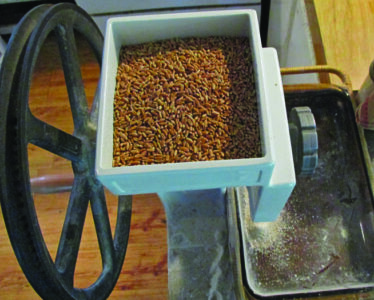
High-quality hand-powered grain mills are made and sold by Country Living and GrainMaker. These mills will cost a pretty penny if you buy them directly from the manufacturers, but every cent is worth the investment. You can also find manual mills at antique malls, Amish country stores, and Lehman’s.
If you’re looking for a better deal, you can usually find like-new pre-owned grain mills on eBay or other online auction or marketplace websites for a fraction of the original cost.
The Thrill of Milling
The first order of business after acquiring a mill is to find grains to grind. Though I’ve experimented with growing small plots of wheat, millet, sorghum, and rye, our land can’t yet produce the bulk of the grains our household consumes. Meanwhile, we purchase bulk grains through the natural foods website Azure Standard, because it’s downright impossible to find organic whole grains in most rural supermarkets.
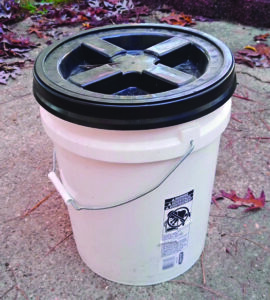
We’ve found 50-pound bags of whole grains to be the best value for our family. Because the mice would have a festival, we transfer all grain into food-grade 5-gallon buckets secured with Gamma Seal lids. These buckets are bug-proof, rodent-proof, and moisture-proof, and they look orderly when stacked neatly and labeled with their contents and the date.
When you’re ready to grind your own whole wheat flour, your first order of business will be to give the whole grains a once-over. On occasion, I find small bits of gravel in my wheat berries. Running a pebble through a manual mill makes a horrible sound, isn’t good for the mill, and results in sandy and rather unpalatable flour. (My family shudders when recalling the episode of the “Gritty Crêpes of 2019.”)
How to Mill Flour
The actual act of grinding couldn’t be simpler. After the mill has been installed on a solid, stable surface, plant your feet in a good position and crank that handle! Manually grinding flour may tire you during the first few weeks. Take heart: You’ll eventually get stronger, and the grinding will get easier. If you don’t have the physical strength to power the implement with your arms, many mills with flywheels can be adapted to be run on foot power using a stationary bicycle.
Most mills don’t come with a container to catch the freshly ground flour, and you’ll soon find that a round bowl does a pretty shoddy job with a flat-fronted mill. We have success using a thrifted rectangular casserole dish. Even so, expect to clean dust-fine flour from around your grinding area.
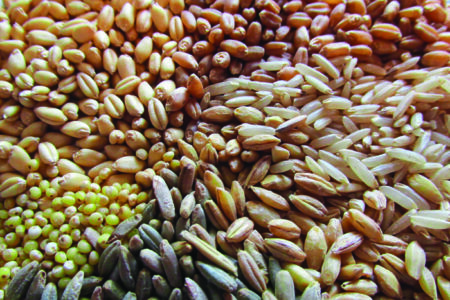
As you gain more experience, you’ll discover that each grain has a different feel while being ground. Some, such as hard red wheat and brown rice, are brittle and fracture apart, making a robust grinding sound. Others, such as soft white wheat and rye, feel slippery as you grind, nearly whisper out of the mill, and require more turns of the wheel to pass through the milling plates. The more fine the grind, the more effort it’ll take on your part to get the kernels through the mill. Conversely, a coarse grind can feel almost effortless.
Grinding a cup of fine flour takes me 2 to 3 minutes these days, although it took longer when I was getting used to the mill. Hand-grinding enough flour for a loaf of bread or morning pancakes will require more time and effort than you’re used to from when you merely opened a bag of commercial flour. When I bake multiple loaves of bread, I sometimes work throughout the previous day to grind the required 8 to 10 cups of flour.
Baking with Home-Ground Flour
Fresh-ground, whole-grain flour acts differently than the stale white flour you buy at the store. Take whole wheat, for example: Rather than smelling like bleach and paper packaging, it smells vital and sweet, because it’s rich with oils and nutrition. Fresh flour acts completely different in recipes and requires you to relearn baking techniques.
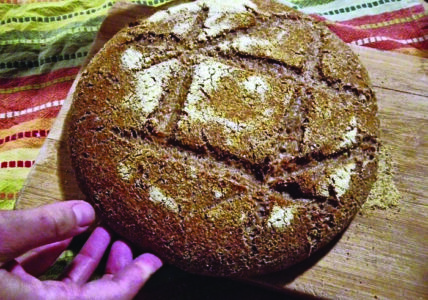
The nuances of working with freshly ground flours are an adventure you’ll need to go on yourself, but I can offer you a tip that’s made all the difference in my cooking. Whatever I’m making with whole-grain flour, be it brownies, biscuits, sourdough bread, or pancakes, I allow the dough or batter to rest for at least 10 minutes after mixing the ingredients.
After that rest, I typically find the dough has become far too dry and requires more liquid than the recipe called for. This is particularly true when I’m trying to convert a white-flour recipe for freshly ground whole-grain flour. The latter takes a long time to soak up liquid and ends up absorbing much more than white flour. If you skip this extra step of resting and then adding more liquid as required, your otherwise delicious whole-grain baked goods will likely turn out dry and crumbly.
Why Trouble with Manual Grinding?
I’ve been asked why I do things “the hard way” by folks who can’t understand why I manually grind all my flour — and manually pump water and manually wash laundry. I try to convince my critics with a fresh, hot slice of crusty whole-grain sourdough. Though it proves my point, it usually doesn’t convince them to try it themselves.
Beyond the resulting delicious baked goods, the reasons for taking flour production into your own hands have to be rooted in personal philosophies that can withstand the allure of store-bought convenience and the realities of daily grinding. If you’re curious about getting a manual grain mill, you’re likely willing to consider some of the following benefits offered by the implement.
- Alan Scott, co-author of The Bread Builders, explains the benefits of sourdough bread made from fresh-ground, whole-grain flour: “With its full complement of vitamins, minerals, soluble and insoluble fiber, antioxidants, and other beneficial phytochemicals, the whole-grain bread naturally provides nutrients that, day-to-day, protect against diseases that have become chronic in modern society: diabetes, several cancers, diverticular disease, and cardiovascular problems. Bread made from whole wheat provides significant amounts of essential minerals — iron, zinc, magnesium, manganese, selenium, and some calcium. … Recent research shows that dough fermentation unlocks minerals from acid bonds.”
- Whole-grain flour can go rancid within just a week, so grinding flour on demand will ensure your family gets the freshest, healthiest, most nutritionally sound baked goods.
- Whole, unground grains can last pretty much unchanged when stored properly. Having a manual mill and a few hundred pounds of whole grain in storage will allow you to have a shelf-stable store of food you could depend on for years.
- Rather than buying bags of different commercial products, you can produce infinitely customizable flours with a manual grain mill. Grind soft white wheat at the finest setting for delicate pastries and toothsome biscuits, or mix and coarsely grind millet, rice, wheat, and flaxseed for breakfast porridge. Crush hard red wheat for bread on the fine setting for the first half of the grind, then on coarse for the final half to produce a hearty loaf full of chewy texture. Using store-bought flour can sometimes lead to mindlessness — if some gets wasted, you can always buy more. But when using hand-ground flour, you’ll find it more difficult to accept waste when you’ve processed the flour yourself.
- A manual mill will work off-grid or in the event of a power outage. All you need are two willing arms.
With a manual grain mill among your kitchen tools, a world of good health, customization, fresh-ground flavor, and nutrition will open up. Hand-cranked mills offer a higher level of self-sufficiency. And if you’re ever able to grow your own grain, you’ll have taken your food into your own hands. This is a remarkable achievement by modern standards, and one that was once cherished by self-sufficient people the world over.
Wren Everett and her husband live on an Ozark homestead, where they seek to live as self-sufficiently as possible.