Tight-lipped, I turned the dial to preheat the oven to 475 degrees F. One of these days, I know it’s going to blow. This isn’t my first oven. Or second. It’s the fourth we installed in this kitchen, in my apparent serial-killer spree on electric kitchen appliances.
The first came with the house, and went out with an unseasonable fireworks display that spitefully cast ash over the bread that killed it. The second was a Craigslisted pinch hitter that didn’t last long. With a pop, a flash, and a waft of burned chemical aroma, it, too, was taken out by a loaf of bread. The third was in better shape – taken out of a house that no longer needed it, but totally functional. For a year, anyway. Then came the familiar pop and flash, and I was left with the usual half-cooked loaf that died with the oven.
As I gazed at the red “on” light of my latest victim, I wondered about a society that creates ovens that can’t stand up to the simple act of baking daily bread.
My childhood home was one of typical suburban convenience – food was bought, not cooked, and certainly not grown. My knowledge of bread was that it came in bags. When I went to college for an art degree, I became wholly responsible for my own food. I finally began to care about it – where it came from, how it was grown, who grew it. I was vaguely aware that people of the past – those peasant-farmer types whom my college-educated family disregarded – knew a lot more about bread than how to buy it in plastic bags.
In the post-college wasteland of failing to find a use for that degree, I realized my suburban background and education had left me with practically no useful skills. I could smear pigments on a canvas with some proficiency, but I didn’t know how to care for the most basic of my needs without going to a store.
My art history professor taught me that one impetus for art’s emergence in our prehistoric past was that humankind had finally achieved such a level of nutritional security that we could spare time and energy on creativity. Fine art emerged from a stable food supply. I found myself in a reverse realization of food insecurity: My food came from mysterious sources that I didn’t understand, know, or trust.
I realized I wanted to work in the soil, not just in the studio.
When I met a man who shared that hope, we launched into a quest for self-sufficiency. We got married, quit everything, sold everything, disappointed my parents, moved to the Ozarks, started an off-grid homestead, and began to relearn how to make, grow, eat, build, and live as modern peasant-farmers. I hung my framed art degree on the goose-house door. We were done with “modernity” and wanted to learn how to stop being dependent on fragile, corporate systems outside our control.
That journey included trying to declare bread independence, to get my staple food back into my own hands.
Yeast
The first thing I reclaimed was yeast. Yeast used to be nearly synonymous with humankind. In nearly all indigenous and traditional cuisines in all countries and cultures, fermentation was a backbone, creating irreplaceable textures, flavors, and food memories. It preserved the raw harvest and alchemically transformed it into finished dishes. Some fermentation starters were created spontaneously from yeast and bacteria already present; others were refined into heirlooms and passed from one generation to the next.
It’s only recently that many of us forgot our ancestral ties to yeast and bacteria, and, as I found out with my first sourdough starter, it’s not too late to reclaim it.
Starter
If you have no inherited food knowledge, starter is an enigma, an “ingredient” in a lineup of ingredients. When I first made one, it was a mysterious process that didn’t fit in any schema of my limited (at the time) cooking knowledge. As I read through books and articles dedicated to the subject, I believed it was a difficult endeavor. But when I put the books down and started to ferment, it all became clear.
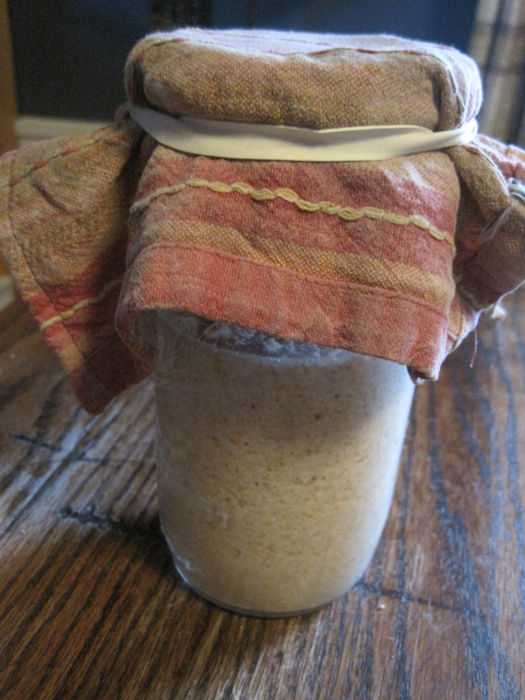
Capturing wild yeast is so simple that anyone with a bit of flour and water on hand already has done the bulk of the work. In a jar, mix whole-wheat flour with filtered water in equal amounts. Cover with a cloth. Starter is started. Halve the fermenting batter every day and mix in fresh batter – whole-wheat flour and water mixed in the same 1-to-1 ratio – to feed the growing population of wild yeast and acidifying bacteria. Soon, the population of bacteria and yeast within the jar will reach a happy equilibrium and, as long as you feed it regularly, will continue on in its bubbly utopia. Best of all, once a starter lives on your counter, you’ll never need to buy a packet of mysterious yeast pellets from the grocery store again.
I had yeast at my fingertips. It was time to reclaim flour.
How is Flour Made?
Before supermarket shelves were lined with paper cuboids of white flour shipped from the hulking bulk of industrial mills, flour was a local production. In Europea during the Middle Ages, the town miller was someone who operated as a central part of village life. By the power of mules, wind, or water, frighteningly huge gears and grindstones spun to feed the people of the village.
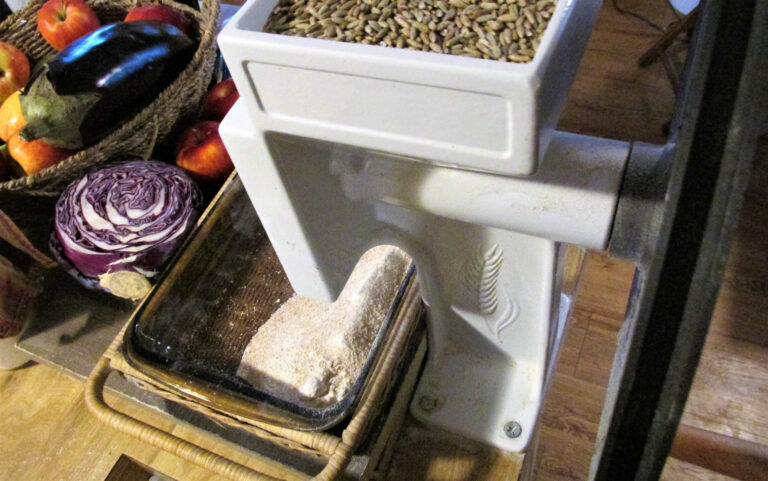
Now, millers are history. Those who want fresh-ground flour today need to take a step even further back in history and bring small hand mills back into their homes. Like the querns, manos, and matates, and hand mills of centuries near-forgotten, these small wheat-pulverizing devices return us to the true meaning of the “daily grind.” So, we purchased a like-new, manual, cast-iron mill from eBay and bolted it to the counter. It stands like a silent declaration of dependence-resistance, always drawing an inquisitive eyebrow-raise from those who enter.
Fresh-milled, whole-wheat flour is worlds apart from a bag of white flour. It smells sweet and vital, full of the nourishing oils that aren’t shelf-stable and don’t make it to the commercialized bags. Grinding it yourself transforms that bran-speckled flour into a precious material to be used with mindfulness – rather than as a mindless commodity.
Now that I knew yeast and flour, I began to chase wheat itself.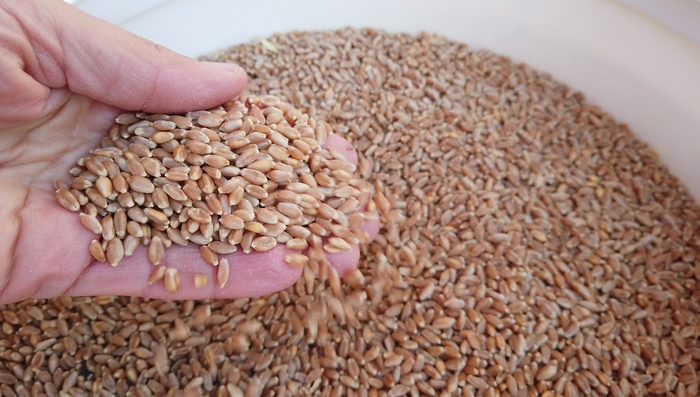
Heirloom Wheat
The calendars of agrarian cultures were based on the plowing, sowing, reaping, and threshing of their staple seed, with accompanying festivals and feasts. But now, few of us have ever put those seeds to soil. For those who do, it’s a strangely isolated event, quietly done, seldom spoken of. I fumble through ancient sowing motions like a child, still unsteady. In the bluebird-trilled, grasshopper quiet, the echoes of lost community ring loud, ghosts of past harvest knowledge screaming to be remembered in languages I don’t understand. But maybe the wheat remembers. It still knows how to grow, and I grow along with it.
The first year, I grew a small patch of ‘Red Fife,’ a Mennonite heirloom. The seed packet was laughably small – the contents just filling my hand. Sparsely planted, that covered about a 10-by-2-inch patch of land. I carefully cut the tall stalks once they turned gold, rubbed the grains free with my hands, and threshed them in a midsummer breeze.
It yielded 2-1/2 cups of seeds – enough for a small loaf. My husband and I have gotten better at tilling, planting, and scything the harvests of our land since that meager harvest, but, as with many endeavors, the more you learn, the more you realize you don’t know. By peasant standards, I still have a long way to go.
Bread
The ingredients listed on a typical bag of store-bought bread are an eyeful. Huge amounts of dough conditioners, oxidizers, bleaches, additives, and preservatives are often employed to produce predictable and passably palatable bakery. None of those ingredients is needed to make a good loaf of bread. If anything, they stand in the way.
You don’t have to grow and grind your own flour; all you need is 4 cups of flour, somewhere around a cup of active starter, a teaspoon of salt, and enough water to bind it all together. Then, it needs to sit. After that, knead it, adding more water as necessary, since fresh whole-wheat flour soaks it up like a sponge. Then, another wait.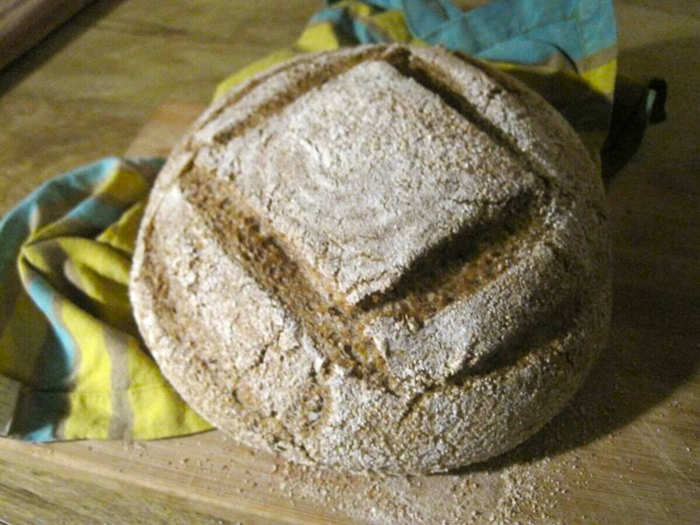
You can start a loaf of bread as the sun rises and eat it when the sun sets. The process sets a pleasant cadence to the day: grind, feed starter, knead flour, let rise, shape loaf, let rise, bake, eat. Interspersed between those dependable punctuations, life weaves in the background.
The final result of all of this emerges from the red-hot bowels of the oven with little fanfare. It steams on the cutting board a moment, I ring the dinner bell, and it’s gone. I find it fitting that the entire nature of bread is to be broken, sliced, torn, and consumed. After spending my college years trying to paint something meaningful and enduring, perhaps my best work of art is that which disappears into the mouths of the people I have the honor and duty to feed.
It’s been eight years since I killed my first electric oven. I now live in an off-grid, half-buried home that my husband built with his own hands. The starter hangs out on the counter like an old friend, the stalwart flour mill has its own little table, and the back room holds next year’s seed wheat. And I finally have an oven that can’t be killed by popping electrical wires or burned-out connections. It simply runs on wood harvested from my land, warming the home while it does the magnificently monumental and wonderfully mundane act of baking our daily bread.