Chicken of the woods poisonous look-alikes are easy to identify and avoid, meaning even beginning foragers can quickly pick up the skill of chicken of the woods mushroom identification. These distinctive, easy-to-find fungi are an excellent complement to any meal.
Have you been checking on the chicken lately?” asked my wife, Elaine. “Isn’t it about ready to come back?”
No, we don’t have a wayward hen that periodically returns for visits. But we do have a chicken of the woods mushroom that reappears every six weeks or so on an ash stump, or on one of the long-dead tree’s roots, from late May through early November. The stump is just 15 yards from our front door, so we don’t have to go far to gather what we (and many other foragers) consider the best-tasting wild mushroom.
Chicken of the Woods Mushroom Identification
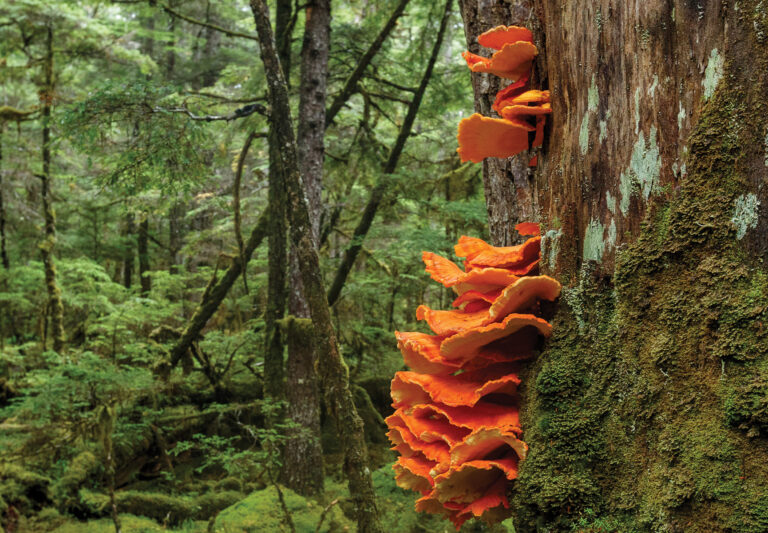
Widely found across North America, Laetiporus sulphureus is saprobic, meaning it grows on dead or dying wood, especially hardwoods, such as white and red oaks. This fungus is as beautiful as it is flavorful, boasting dazzling yellow and orange colors on a fan-shaped body that can be a foot wide. The mushroom’s wavy margins add to its fetching appearance, as do the yellowish-white flesh and yellow pores.
Another plus is that sometimes when you find one chicken of the woods growing on a tree, more may be lurking on the tree’s backside. The most chickens we’ve found on one tree is six. If you come across a hardwood harboring a number of these mushrooms, you have the potential for numerous meals from a fungus that, true to its name, has a pleasant chicken-like taste and meaty consistency.
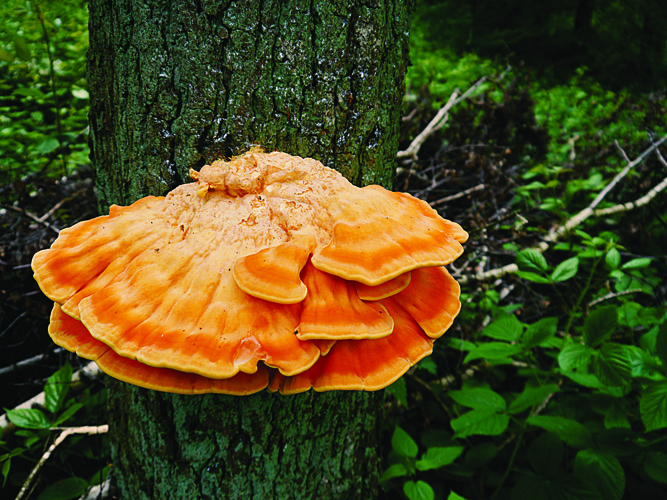
One of the questions Elaine and I face when we come across a chicken of the woods is whether to harvest it then or to come back later, especially if the fungus is only 6 or 7 inches wide. Jeff Huffman, a fungi fan from Roanoke, Virginia, is our go-to person for identification and advice on mushrooms. “Letting it grow all depends on the consistency that you desire,” he says. “Young ones will be soft, similar to a button mushroom. However, as this mushroom ages, the outer edges will stay soft, but the rest will start to become denser the closer it is to the host. The part that’s closest to the host will be denser, tougher, and woody. The longer the chicken grows, the denser the body will become too. So, for older ones, I cut farther away from the host, because that remaining part has grown too tough and dense.”
Huffman adds that some cooks use the tougher parts to make a broth. Those same parts can also be chopped and puréed to create a creamed soup. “That’s what’s so great about mushrooms,” he says. “They’re like animals in that people have found uses for most of a mushroom, just like they’ve found uses for most of a pig or beef cattle.”
Edible Relatives
Huffman says a close relative of chicken of the woods, L. cincinnatus (known as “white-pored chicken of the woods”), is just as delicious. Some foragers think it’s even superior in taste. It thrives from the East to the Great Plains. Found typically at the base of oak trees (although it can be found over roots), L. cincinnatus features less yellow in its surface color and has white pores.
Foragers living on the West Coast and in some areas of the Southwest can also hunt for a native species of chicken of the woods: L. gilbertsonii. Like its close relatives, this mushroom favors oaks — but also thrives on eucalyptus trees. Its traits include yellow pores, a fan-shaped appearance, and a saprobic nature.
Huffman recommends severing any wild mushroom from the host, leaving behind its base. Many people believe doing so will make it easier for the mycelium to regenerate at some future date. Huffman suggests placing foraged edible mushrooms in a paper bag or basket, as doing so will preserve the flavor much better than a plastic bag would. Chicken of the woods has a tendency to attract bugs, so he likes to dunk them in salt water to eliminate the beasties before cooking.
Beware of Chicken of the Woods Poisonous Look-Alikes
Caveats almost always exist with mushroom species, and chicken of the woods is no exception. Some people experience intestinal issues after consuming this species, especially if they ate it while they were drinking alcohol, or if the fungus was harvested from a conifer. In short, even choice edible mushrooms can cause gastrointestinal problems. Wild mushrooms should never be eaten uncooked.
With all edible mushrooms, consume only a small portion of the fungus the first time you eat it. Also, never eat an unfamiliar mushroom until it’s been identified by an expert. Join a local mushroom club to learn from experienced foragers. The North American Mycological Association is an excellent national club to join, says Huffman. It’s also a good idea to purchase field guides. Two of my favorites are the National Audubon Society Field Guide to North American Mushrooms and Appalachian Mushrooms: A Field Guide.
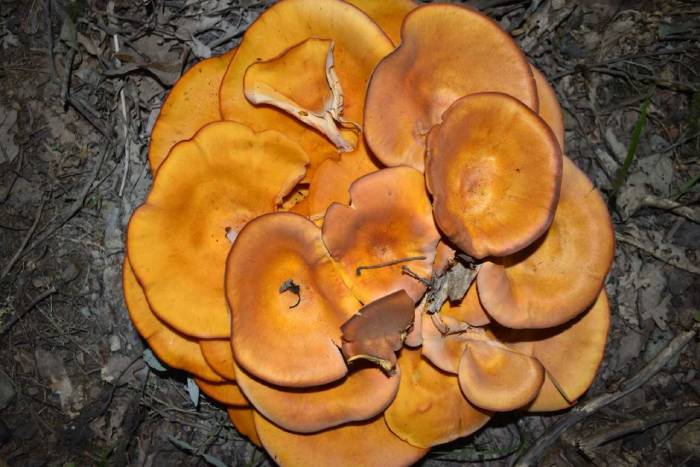
Unfortunately, many edible mushrooms have inedible look-alikes that are toxic to humans. Especially in the East, Huffman says any look-alike appearing on a conifer shouldn’t be eaten. One species that’s a chicken of the woods’ poisonous look-alikes is the jack-o’-lantern (Omphalotus illudens). Like the former, this bright-orange to yellowish-orange mushroom can grow on stumps or buried wood and can fruit in clusters. I’ve misidentified jack-o’-lanterns as chicken of the woods or chanterelles from a distance, but when I come close, the vase-shaped appearance, gills, and orange flesh help identify it as a mushroom to avoid.
Once you’ve mastered chicken of the woods mushroom identification, and gathered these delectable fungi, you can cook them up and enjoy their distinct flavor. Here are a few of our favorite recipes featuring them.
Chicken of the Woods Recipes
- Chicken of the Woods Chicken Salad
- Grilled Venison Tenderloin Cutlets
- Chicken of the Woods Rice Pilaf
Flickr image by AngyDS (CC BY-NC-ND 2.0).
Bruce Ingram is a freelance writer and photographer and the author of 10 books, including Living the Locavore Lifestyle, a book on living off the land. Get in touch with him at BruceIngramOutdoors@Gmail.com.
Originally published as part of “Chasing Chicken of the Woods” in the July/August 2023 issue of Grit magazine and regularly vetted for accuracy.