Learn how mushrooms can save the world through mycoremediation projects, a fungus-forward approach to cleaning up the Great Lakes.
My early foray into working with mushrooms started with the pursuit of food and flavor, but the rabbit hole has taken me down into a world of wonders I’d never dreamed of. The first species I tried growing – pink oyster mushrooms – delivered a savor I hadn’t expected: They taste like bacon, have a major comfort-food factor that’s great in just about any meal, and are loaded with antioxidants. They’re a stunning shade of pink and grow very quickly.
That was enough to make me dive into mushroom cultivation, hook, line, and sinker, but there was so much more going on beneath the surface than I possibly could’ve realized. Unlike the plant and animal kingdoms, Kingdom Fungi has only been recognized as its own kingdom since 1969. Prior to that, it was lumped in with the botanical kingdom, and comparatively little research had focused on fungi. Since then, researchers and citizen scientists have been diving deep to learn as much as possible about one of earth’s least-known kingdoms, and the discoveries have been profound. Scientists have classified over 100,000 species of fungi, but they think upward of 4 million may exist, meaning that with all the amazing things we know about mushrooms, we’ve only studied less than 10 percent of those species. What’s been found so far has shown us that mushrooms may hold the missing keys to solving many of our planet’s problems, from wellness and food scarcity to soil management and environmental remediation.
What is Mycoremediation?
Mycoremediation is the process of using fungi to decontaminate land, water, and air. Those same bacon-flavored pink oysters have the capacity to take up heavy metals, including cadmium, lead, mercury, chromium, and arsenic, from anything they grow on – along with digesting and decomposing organic pollutants, such as polycyclic aromatic hydrocarbons (PAHs) and polychlorinated biphenyls (PCBs). In chemistry terms, heavy metals are elements and can’t be destroyed. If you were to remove all the contaminated soil containing heavy metals, you’d need a lot of space; but mushrooms can extract the pollutants and then be decomposed or incinerated in a contained unit and securely stored in a cask that occupies a tiny fraction of the space that storing contaminated soil and sediment requires.
How Mushrooms Can Save the World
I live in Michigan, the heart of the Great Lakes, which hold 90 percent of the country’s surface freshwater. Industrial contamination severely impacted our rivers and lakes, to the extent that there are 43 Areas of Concern (AOCs) for severe pollution designated within the Great Lakes basin.
The Rouge River has historically been one of the most severely contaminated waterways from industry, so much so that it caught fire in 1969. It spans roughly 127 miles and drains into the Detroit River, carrying with it PFAS, heavy metals, PCBs, PAHs, mercury, oil, and harmful bacteria, such as E. coli. The health issues and the impact on soil and water in the neighborhoods and land surrounding the river are profound, and work to remediate the contamination has been underway for decades.
The trouble is, current conventional methods for remediating contaminated waterways typically involve dredging the sediment from the river or lake bed and hauling it to a landfill where it will be encapsulated in cement, plastics, or ceramics and remain there until the encapsulation degrades. This method is a ticking time bomb that can one day fail, allowing all of those contaminants to be released back into the environment.
Agencies and programs are currently in the process of removing 70,000 cubic yards of contaminated sediment from the Rouge, but there will be millions left to go when this initial removal is done. It’s incredibly expensive, takes up a huge amount of landfill space, and involves hauling huge truckloads of contaminated waste nearly an hour from its source while putting everything along that route at risk. All this for a solution that doesn’t guarantee the same contaminants won’t make their way out to become an issue again for the next generation.
This problem has been eating away at me for years. My childhood summers were spent swimming in the Great Lakes, and my college years and many important career moments were spent in Detroit. I’ve seen firsthand the ripple effect of the contamination in the region’s waterways and brownfields on the citizens and neighborhoods.
When I first heard about myco-remediation, my brain lit up – many plants can uptake contaminants, but none can independently digest and eliminate them without the aid of bacteria or additional steps. Fungi can release enzymes into their surroundings to break down contaminants, simultaneously absorbing contamination and digesting it internally. The fungi can be destroyed, and what remains can be stored in an iron cask a fraction of the size of the loads of sediment currently being hauled across the state daily.
Mycoremediation Projects
So why wasn’t anyone doing this? The concepts have been proven. People around the world are experimenting with mycoremediation in small-scale projects, and there have been a handful of interesting research projects on the subject. But nobody has had the opportunity to tackle a major environmental contamination in a scalable, efficient way. Third-party lab-validation on a visible scale would demonstrate what an effective and affordable alternative mycoremediation is compared with conventional remediation, so the people who make the decisions on how to address major contamination sites can make an informed decision.
I spent years bothering about this, keeping notes, sketching concepts, and trying to find a way to bring something like this to life in a way that could, at a minimum, improve Detroit’s waterways, but they could ideally restore and preserve the Great Lakes ecosystem. Through my work as the president of the Detroit Institute of Gastronomy and various events I participate in, I’ve spent a lot of time on campus at The Henry Ford Museum and Greenfield Village, and during that time, I had the honor of meeting Debra Reid, curator of agriculture and environment. On a rainy day hike around the grounds, I told her about my vision for mycoremediation on the Rouge River and beyond. She understood and helped make the introductions I needed to the Edison Institute’s grants team, the Friends of the Rouge, and John Hartig, a brilliant Great Lakes scientist and author. Collectively, they helped set things in motion. In partnership with The Henry Ford, we received a $25,000 grant from The Americana Foundation to begin our mycoremediation efforts on the Oxbow and Suwanee Lagoon on the grounds of The Henry Ford, which sits directly on the Rouge River.
Since April of 2025, my team and I have been gathering as many native species of fungi as we can find on the grounds, the island on the lagoon, and along the shores of the Rouge. Each species of mushroom tends to have specific contaminants it tackles best, and using native species enables us to avoid introducing potentially invasive species of fungi. Native fungi are also ideal because they “learn” over time. Because we’re working with species directly from the area we’re looking to remediate, the native fungi already have built-in experience with those particular contaminants.
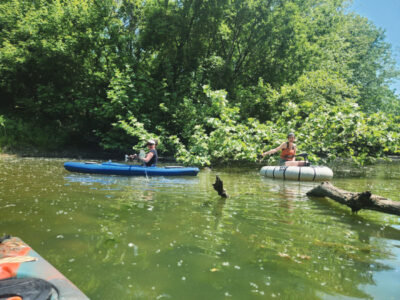
Now that we’ve collected a catalog of over 80 native species to work with, we’re using a few of the best-suited species we’ve found to develop living water filters made of fungi, wood chips, and straw. We’re installing them directly in the water, where we’re assessing the most efficient methods for removing contamination as the water flows through. The grant funding from The Americana Foundation is enabling us to test our water samples before and after filtration for PFAS, PAHs, heavy metals, and organic contaminants. This testing provides data on mycoremediation’s extraordinary potential to provide a scalable, economical, sustainable method for restoring and preserving the Great Lakes ecosystem for generations to come. We hope to give people around the world the tools and knowledge to apply those same concepts to their own regions.
Micro-Myco at Home
The simplest water mycofilters can be made by inoculating straw with your chosen species of fungi, filling a burlap sack with it, and either staking it down to the bank (partially in the water, partially out, so it has sufficient oxygen) or creating a sort of raft frame so it can float partially submerged on the surface of the water.
In soil remediation, a similar approach can be taken in colonizing wood chips with your chosen fungi. Then, if you’re targeting organic contaminants where you won’t need to take it back out of the ground later, layer the prepared straw or wood chips with soil. If you’re targeting heavy metals and need to remove it later, to be destroyed, put the medium in burlap bags and layer them in soil. Be extremely cautious in handling materials used to uptake heavy metal contamination, and make sure you have an appropriate plan for destroying the material and containing the remnants at the end of the process.
For fascinating mycoremediation projects that you can do around your farm, read Tradd Cotter‘s book, Organic Mushroom Farming and Mycoremediation. To dive into the wild history of the contamination of the Rouge River, I heartily recommend Rouge River Revived by John Hartig – it’s a fascinating read and will inspire you to seek creative solutions for restoration and preservation no matter what region you live in.
Kingdom Fungi holds a multitude of possibilities for sustainable ecosystem preservation, and we’ve barely scratched the surface. I believe it holds the answers to many of the world’s challenges today. It’s something that anyone can begin to explore and experiment with practical and exciting solutions. If you decide to take on your own mycoremediation project, please show the world what you’re working on so these methods can continue inspiring others to tackle environmental pollution, one mushroom at a time.
Erin Hamilton is a Michigan-based mushroom cultivator, writer, and culinary educator. She’s the founder of The Mushroom Conservatory, and currently serves as president of the Detroit Institute of Gastronomy. She’s taught thousands of people to grow gourmet and functional mushrooms through workshops and her hands-on mushroom growing kits, and writes regularly on fungi, food, and sustainability.
Originally published in the March/April 2026 issue of Grit magazine and regularly vetted for accuracy.