Try this rain gutter growing system on your homestead and reap the benefits of saving space and rainfall.
The weather here has been warming with nighttime temperatures in the 50s and day-time temperatures in the 70s. Finally, I think the winter grip has loosened and allowed spring to settle in. The daffodils and tulips are in full bloom and life is good on the Urban Ranch.
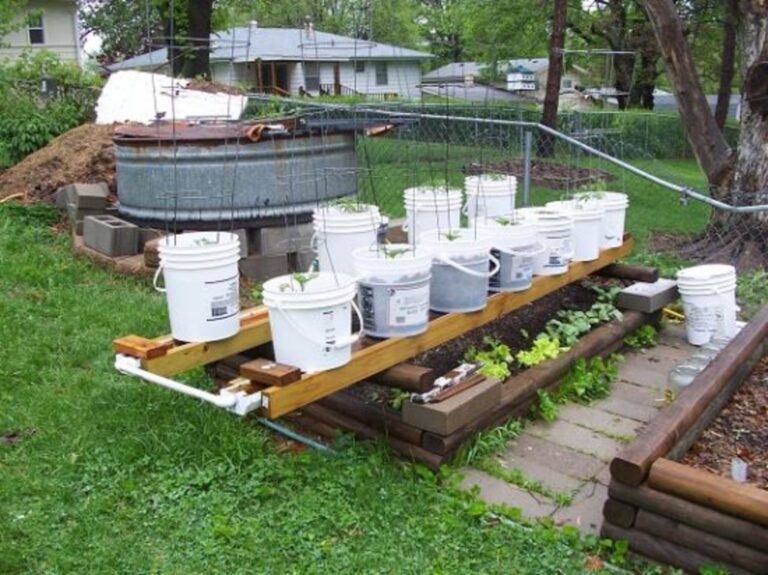
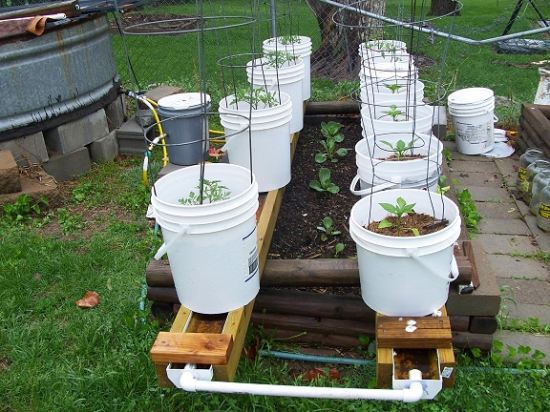
Some time ago, I mentioned a new growing system that I wanted to try that was invented by a fella up in Minnesota that used rain gutters to automatically water the plants. I now have one working system and hope to have another working by warm weather planting time of May 15.
The first thing that needed to be done to build the system was to use roofing screws to attach the gutter to two 10-foot 2x4s. A 3/4-inch hole was cut into the end caps for water transfer. Since these two gutters have the same water source, they must be perfectly level with each other. In order to do that, great pains were taken, and a leveling system was devised to get both perfectly level from end to end and side to side. The first layer of leveling was accomplished with landscaping timbers. Lag screws were used for the next leveling.
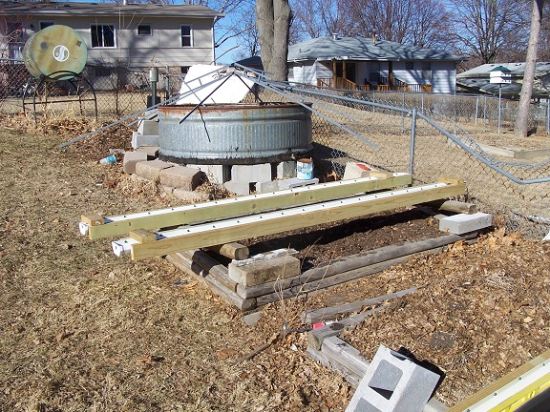
Each 2X4 got a lag screw on each end, which was a total of four on each trough. Now the screws can be tweaked with a wrench up or down to obtain perfect leveling even after water is in the trough. Water in the trough will seek its own level and be the final leveling test.
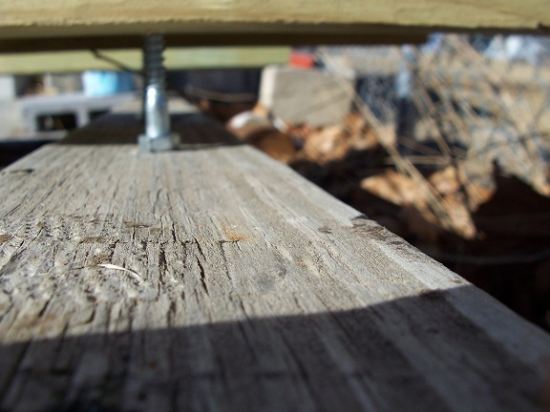
Now the two troughs must be connected, and the leveling process gets a little more complicated. We’ll come back to the buckets later, but for now we have to move on as to how the water gets into the gutters. Rainwater is collected in the big tank that is seen in the background so that water has to be automatically transferred from that tank to the gutters. So let’s see how that’s done.
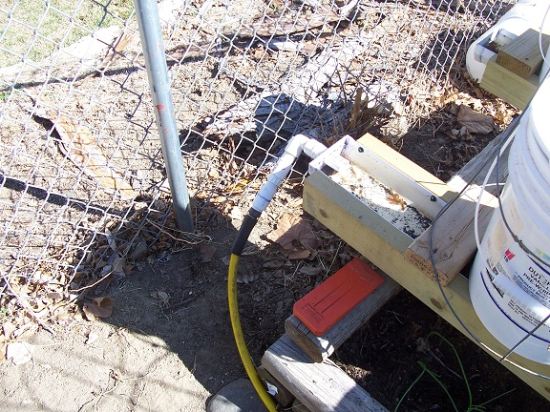
The parts for this system are all glued together with PVC adhesive and so far hasn’t leaked. The hoses for this system are cut to length and fitted with two female ends. Cheap hoses can be used, as there’s little pressure on this system, which is entirely gravity-fed.

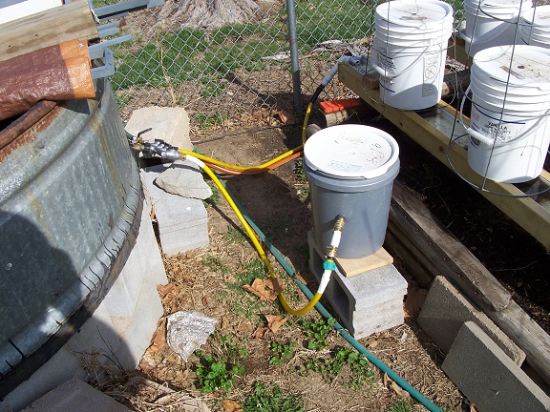
I wanted originally to attach a float valve to the gutter, which would monitor the level of the water and allow water to be added when needed. The ones I ordered came with no float adjustment hence a bucket system was used. This float valve will keep the water level in the bucket at a constant level. By raising or lowering the bucket, the water level in the gutters can be adjusted. With a little tweaking with different width boards, the water level was matched perfectly.
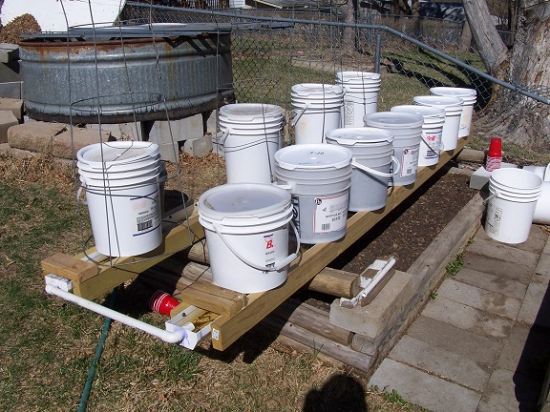
Since the float valve has pipe threads and the hose has, of course, hose threads, an adapter had to be fabricated to match the two together. Now the water valve from the big tank is turned on and the water flows into the bucket. This water level is maintained by the float valve, which in turn maintains the water level in the gutters. It’s all done mechanically without the use of timers as in the last system I built.
The first thing that must be found is food-grade buckets. I found a practically unlimited supply of buckets for a buck each at the local bakery department.

The next step is to cut a 2 7/8-inch hole in the bottom of the bucket. This will be where the net cup sets and protrudes out the bottom of the bucket.
The net cup is filled with a mixture of growing medium that’s not just dirt, but a mixture of two 5-gallon buckets of compost, one bucket of peat, a coffee can full of Perlite, a cup of garden lime, a couple of handfuls of Epsom salts, and two buckets of soil. I mix it up in a compost tumbler and pack it tight in the net cup and a little looser but firm in the rest of the bucket.
The bottom of the bucket bowed upward to the inside of the bucket so with a little heat from a plumber’s torch the bow can be reversed to get maximum use from the wicking action of the net cup. The cup will then set down into the rain gutter at a full depth. The net cup sets down into the water and wicks water up into the bucket growing medium to keep it moist.

I set the buckets with their net pots on the water-filled rain gutters. The buckets are planted with tomatoes and bell peppers. The multilevel growing of cabbages in the actual raised bed under the rain gutters is working so far. I figure once the tomatoes grow up, they will shade the cabbages during the hot part of the summer. Along one side of the raised bed, under the gutters, radishes and lettuce are growing. The radishes are almost ready as well as the lettuce. Once they are eaten, other warm weather root crops such as carrots will be planted.

Onions are planted in the raised beds on the opposite side. These all started from seed. Some are doing quite well and others not so much. I may just replant those that are not doing well with plants from a local nursery. This set-up, with the automatic watering, is working extremely well so far. We will see if this set-up works as well or better than the traditional method. I’m not sure if I’ll have enough time to set up another bed for cucumbers, but I’m hoping so.
We just went through a night of severe weather. We didn’t get any tornadoes, but the winds of 80 mph and rainstorms were toying with the idea. Altogether we got about 1 3/4 inches of rain. It filled my water storage tanks. Altogether, I have an estimated 500 gallons of water stored from the spring rains. I’m hoping to be able to water the garden most of the summer with collected water.
I hope all your garden plans are starting to come together for the year. Until the next time, keep your hands in the dirt and mind thinking toward harvest.