Source low-cost food-grade bulk containers to give new life to buckets, barrels, and IBC tote uses around the farm.
Beyond the convenient boxes, jars, and jugs at the grocery store is an unseen world of food transport on a massive scale. Enormous amounts of food are freighted from growers to packers to factories and distributors, and they don’t come in cutesy little packages. No, we’re talking containment on a giant scale, with 275-gallon totes of cooking oil, 55-gallon drums of syrup, or 5-gallon buckets of sliced jalapeños traveling their seldom-noticed routes alongside you on the freeway.
This article isn’t about the complexities and nuances of the food-shipping industry, however. This article is, instead, all about the containers that make food-moving possible. You see, once those massive totes, barrels, and buckets have been relieved of their contents, they can be repurposed for endless uses on the homestead. These giant containers aren’t just a thrifty way to help you along your path to self-reliance, but they’re also a plastic item that can find new life far from a landfill. That’s what I call a win-win.
Finding Food-Grade Containers
Of course, this journey can only begin once you have the containers. There are probably lots of places you could search online to find used totes and buckets, but I’ve been able to source all of my own containers through Craigslist. Some sellers make a business being the intermediaries between the food industry receiving ingredients and industrious folks looking to repurpose the vessels that carried said ingredients. For the purposes of this article, I’ll focus on the three most useful containers – at least, according to me!
One of the most useful items you can have for the farm and garden is the 5-gallon bucket. They’re portable, stackable, and rugged, and you can often find them with lids to match.
Another particularly useful container is a 55-gallon barrel. We’ve found them in both steel and plastic, but they often lack lids.
IBC (intermediate bulk container) totes are some of the biggest vessels we’ve dealt with, but they’re still small enough to fit in a truck bed for hauling. They’re basically huge plastic boxes with spigots that are contained within a protective metal cage. Whether they come in 275- or 330-gallon amounts, their footprint is the size of a pallet, making them easy to transport.
Whatever containers you get, ensure they’re food-grade plastic and contained food-grade materials. This is important for two reasons. The first being that the plastic in food-grade containers is designed to prevent chemicals from leaching into their contents. Some plastic may be labeled “food-grade for single use” but will deteriorate when left in the sun. According to IBC Tanks, IBC totes should be made from food-grade polyethylene plastic resin, which doesn’t break down and is suitable for potable water applications.
The second reason is that you’ll have to deal with whatever they contained. Shipping containers always retain some remnant of their former contents, and it’s a whole lot safer for you and your land to deal with food materials than with industrial ones. Don’t just settle for any reused container – many have been used to transport flammable, corrosive, or otherwise dangerous materials that can hurt you or your land, particularly if they’re reused to contain water. Check the labels left behind on the totes themselves – they’ll tell you what they contained.
Cleaning Containers
So, let’s say you’ve gotten your new containers home, starry-eyed with the promise they hold for nesting boxes, rain catchment, or general-purpose totes. Once you unload them from the truck, however, you’ll first have to contend with the weird residues left behind from their earlier life.
In our own repurposed containers, we’ve had to deal with the vestiges of a well-known fruit punch drink (red dye everywhere!), canola oil, pickled jalapeño peppers, and, probably worst of all, soy lecithin, which clings to surfaces with a tar-like grip.
Most containers that held water-soluble materials can be reasonably cleaned with judicious use of a hose and a nice, long bask in bright sunshine. If you find yourself dealing with weird ingredients (such as the aforementioned soy lecithin), you may need to get a little more hands-on. Though it took a significant amount of waiting and elbow grease, we were able to dissolve all stubborn residues with several long soaks in hot, detergent-laced water and scraping with a homemade wooden paddle.
When it comes to dreaming up a new life for a used food-grade container, there’s really no limit to the thrifty homesteader, gardener, or farmer’s creativity. These ideas are, by no means, an exhaustive list.
Food-Grade 5-Gallon Buckets
- Nesting Box Chickens will happily nest in a 5-gallon bucket tipped on its side and partially blocked to prevent nesting materials from escaping. You can build a wooden frame around the bucket to keep it stable or screw a whole row of them to a board to accommodate your feathery flock.
Pigeons also enjoy using buckets for brooding their babies. I’ve had great success merely dangling buckets from their handles on nails along the edge of my cote. - Off-Grid Toilet and Dry-Matter Storage If you use an off-grid toilet, you understand how important it is to be able to maintain your system quickly and easily. Try using 5-gallon buckets, as you can easily carry them by hand when it’s time to change them out. Separate buckets can also be used to hold the dry matter necessary as “fill” to control odors. Though there are some quick-to-use snap-on lids that can convert a bucket into a toilet within five seconds (these are often available in the camping section of an outdoors store), you can build a much more aesthetically pleasing setup for your off-grid throne with a little online searching and DIY ingenuity.
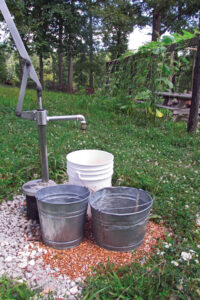
- Water Transport Though many of you probably don’t use a manual pump for your daily water (I do!), the 5-gallon food-grade bucket has been my best tool for bringing water into our home from the well. They’re easy to scrub and keep clean, and they’re not too heavy to lug.
- Off-Grid Laundry With the aid of an old-fashioned washing plunger, you can turn two clean 5-gallon buckets into an instant washing system. Use one bucket for soaping, scrubbing, and swishing, and the second bucket for rinsing.
- Easy-Harvest Root Planter For some gardeners, bending over and digging up parsnips, carrots, and other root vegetables might be too taxing on aching backs or with limited mobility. Drill some holes in the bottom of a bucket (or use a leaky one), and harvest time will be as easy as dumping the bucket over and picking up your veggies.
- Aggressive-Spreader Stopper We all love mint, but we probably don’t all love mint in every corner of the garden. Place aggressively spreading plants, such as mint, in a leaky bucket, and then bury that bucket in your herb garden to get all the benefits of the plants without having to deal with their greedy reach.
- Root Cellar Storage Filled with damp sand, 5-gallon buckets can make a dandy container for holding root vegetables in the basement until it’s their time to shine in the kitchen.
Food-Grade 55-Gallon Drum
- Rain Barrel Rain barrels can be connected to any roof on your property to capture rainwater and direct it to your plants and animals. We have a rain barrel attached to every roof available on our dry Ozark hill, providing easy, off-grid access to nonchlorinated water for all the living things on our land.
Be sure to cover the top of the barrel with a window screen; otherwise, you’ll also be an unwitting host to a mosquito-breeding extravaganza. - Large Root Planter Huge roots that provide a massive amount of food, such as gobo (great burdock) or mangel beets, can be easily grown and harvested in 55-gallon barrels, providing you with a convenient way to harvest the otherwise difficult-to-dig root in its entirety.
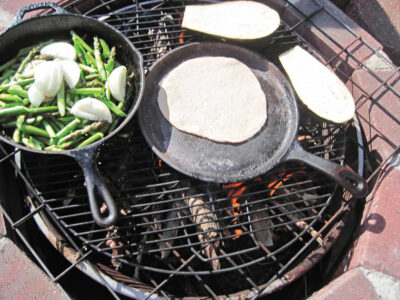
- Fire Barrel If you’re able to find a steel barrel, these can be cut in half with an angle grinder to make excellent fire barrels. In the photo here, I’m cooking lunch over an open flame. That fire is burning in half of a 55-gallon barrel that’s snugly housed in a brickwork surround.
275-Gallon IBC Tote Uses
- Rain Catchment My land is beset by drought through most of the summer, so my off-grid garden completely depends on the spring rains. We’ve connected several 275-gallon IBC totes to gutters on our house, barn, and shed roofs that allow me to harvest as much rain as possible and direct it to my thirsty crops.
- Aquaponics I mention aquaponics only in passing, as it’s something I personally don’t have any experience with. I have seen, however, other homesteaders who’ve rigged up a chain of IBC totes in their greenhouses to farm tilapia and grow food crops. It’s certainly worth an investigation if the topic interests you!
As I hope you now see, there’s often no need to build something new when there’s a world of shipping containers already out there, just waiting to be rescued from disuse and, instead, turned into something vital for your land.
Wren Everett and her husband quit their teaching jobs and moved their family to the Ozarks. There, they live off-grid, try to grow as much of their own food as possible, and work to rediscover the old skills of self-sufficiency.