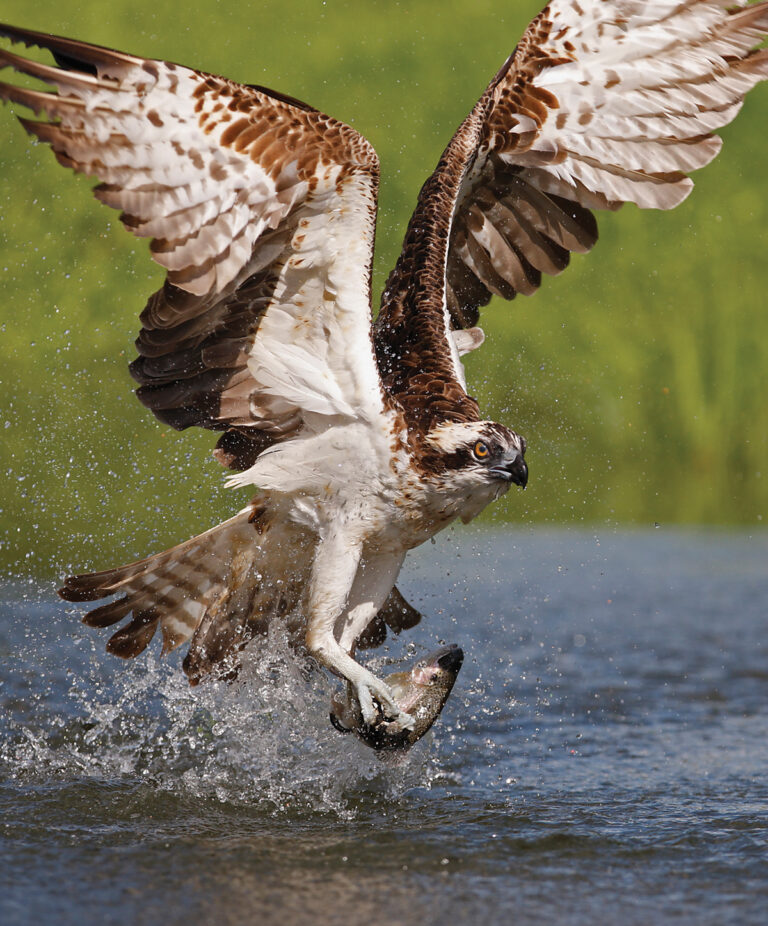
Few species (except humans and their introductions) can claim a worldwide distribution, but the osprey (Pandion haliaetus) is one feathered exception. Ospreys are found on every continent except Antarctica, near coastal areas, rivers and lakes: anywhere there is a steady supply of finned fare. Since ospreys feed almost exclusively on fish, they are often referred to as fish hawks or fish eagles.
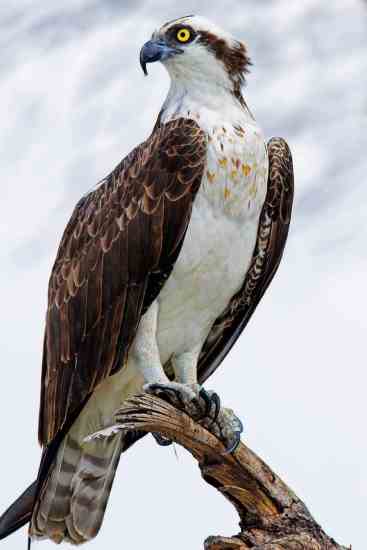
North American ospreys are often found in the same areas as bald eagles (also a fish eater) and often may be confused with them. Like bald eagles, ospreys are large birds. Adult ospreys grow to nearly 2 feet in height and may have a wingspan of almost 6 feet. Their crown, forehead, neck, breast and belly are all white, while their back and wings are black. Ospreys also have a distinctive black eye stripe separating the white feathers on the crown from those on the neck and chest. By contrast, the entire body of a bald eagle is black, with the head and tail feathers a bright white.
Subtle sexual dimorphism exists between male and female ospreys (like many other birds of prey): the female osprey is slightly larger than the male, weighs about 20 percent more and has a larger wingspan. Female ospreys also have darker plumage.
Home life
Ospreys mate for life. Once they construct a nest, the pair will return to that same nest year after year, continuously building onto it. An older nest can easily reach 4 to 5 feet in diameter and weigh several hundred pounds.
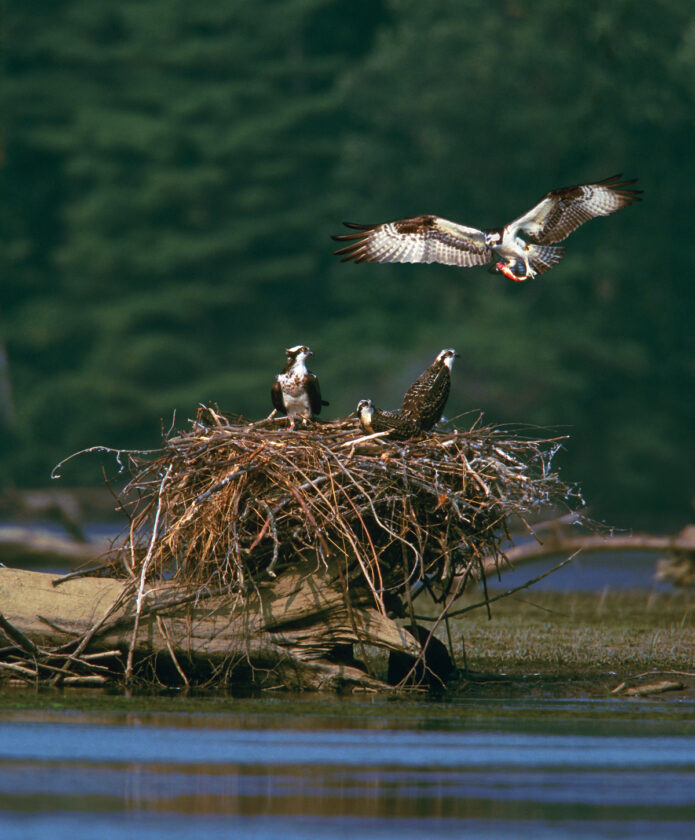
Ospreys are sexually mature at roughly 3 years of age. Males court the females with an aerial display and delivery of food (fish). The more food he brings her, the more receptive she will be to him and less likely to mate with another male. Once the pair bonds, nest construction begins. Both sexes collect nesting materials, although the female generally arranges the materials to her liking, since she is the one that spends most time incubating the eggs. From the time the eggs are laid until the young fledge, the male osprey will spend much of his time hunting for himself, his mate and, eventually, his offspring.
Female ospreys generally lay two or three eggs that are light brown with brown, red and grey speckles. Osprey eggs hatch in about a month in the order they were laid. This gives the oldest hatchling an advantage as it gets to start feeding and growing before its siblings. When there is a shortage of food, the younger birds often do not survive. This is a common occurrence among many raptors and is referred to as “brood reduction.” Osprey chicks are covered with white and brown down, which is soon replaced by a dark gray down.
Both osprey parents help care for the young, and the chicks grow rapidly. Osprey chicks reach more than 70 percent of their adult size in just a month’s time. The juveniles are ready to leave the nest after about two months, but they may return to the nest for several weeks to beg food from their parents until they learn to fish on their own.
In some parts of their range, young ospreys remain in the wintering region through their first year rather than return to the breeding grounds. It is believed that this behavior enhances the chance of successful mating, which improves breeding success when the birds finally return to the nesting area.
Osprey nests historically were constructed in the tops of large dead trees with flattened tops. In more recent times, ospreys have adapted to building their nests on the tops of power poles, cell phone towers and channel markers. Their strong attraction to power poles (in many areas, the tallest tree-like structures available) sometimes leads to accidental electrocution. The immediate nest site is defended by both adult birds, but unlike many eagles and hawks, ospreys do not defend a particular hunting territory.
Because they do not have a large territory to defend, ospreys are more tolerant of other ospreys as long as they stay away from the immediate nest. As a result, ospreys often nest in colonies, with only a few hundred feet or less between nests. I have observed several active nests on parking lot light poles (less than 100 feet between poles) near Lake Eufaula State Park in Alabama.
Some ospreys migrate seasonally, while others (especially those in the warmer parts of their range) breed and winter in the same areas. Nonmigratory ospreys typically breed between December and March, while migratory animals usually breed in April or May. Of the four subspecies of ospreys found in the world, the Caribbean subspecies (found in the Bahamas, Cuba and southern Mexico) is the only one that is totally nonmigratory. The many individuals of the North American subspecies that breed in the northern United States and Canada winter in South America.
What’s for supper?
When it comes to food, the osprey’s diet is pretty monotonous: fish, fish and more fish. Ospreys are one of the only raptors that feed almost entirely on fish (about 99 percent of their diet). While bald eagles feed heavily on fish, they also prey on ducks, wading birds, rabbits and other animals when available.
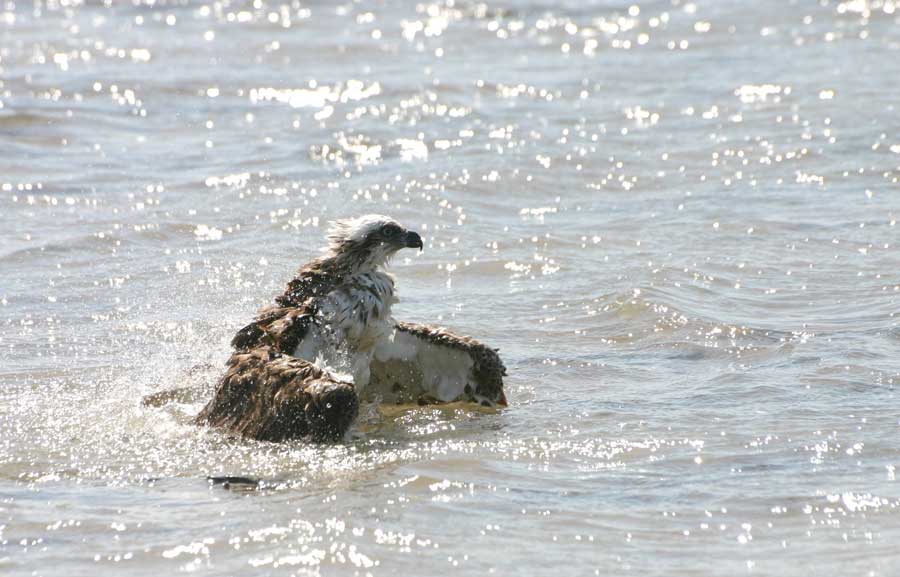
Unlike bald eagles, which swoop down over the top of the water and catch fish near the surface, ospreys plunge completely into the water, sometimes going under, to catch their prey. When a likely candidate for dinner is spotted, the osprey will begin hovering over the water. When the time is right, it dives toward the surface from as high as 200 feet, talons out in front.
In addition to sharp talons, ospreys have specialized spines on the pads of their feet, called “spicules,” that help them hold onto a fish. They also possess an opposable toe that can be rotated forward or backward, depending on the circumstances. After taking flight again, an osprey will rotate its foot so that there are two claws on each side of the fish, repositioning the fish to face the head forward, making it more aerodynamic in flight.
Ospreys are not particular and will usually feed on the most abundant species in their area. While bald eagles often feed on carrion, such as salmon that have died after migration or fish that have been killed by hydroelectric generators, osprey usually prefer to capture their prey alive. In areas where bald eagles and ospreys coexist, it is not uncommon for the larger eagles to “mug” ospreys that are carrying fish and steal their supper.
Osprey conservation
In the 1960s and 1970s, osprey populations began to decline dramatically. Like bald eagles and peregrine falcons, ospreys had fallen victim to certain types of pesticides, the most widespread of which was DDT. These pesticides did not break down easily in the environment and had the dangerous property of building up in the food chain. Since ospreys were at the top of the food chain, they got extremely high doses of these chemicals. The main effect DDT and its relatives had on birds like ospreys and eagles was to cause a thinning of the eggshells to an extent that when the adults tried to incubate them, the eggs broke.
The likelihood of a world without ospreys was a real one for many years. After DDT and related pesticides were banned from use in the United States in 1972 (and many other parts of the world afterwards), osprey numbers began to recover. That ospreys are willing to nest on virtually any tall structure also helped them make a comeback. State and federal wildlife agencies have aided the effort by providing safe nesting platforms in many areas. In an effort to reduce the number of osprey electrocutions, many utility companies have also constructed nesting platforms to attract the birds away from power poles. As a result of all of these efforts, the awesome osprey can still be seen diving feet first after its prey in our rivers, lakes, bays and lagoons.
John Marshall teaches in North Little Rock, Arkansas, commuting from the small town of Benton where he lives with his wife, children, granddaughter and several pets.