Learn about stinging nettle leaf benefits, how to eat stinging nettle, and how to make salves and soup from nettle to reap its health benefits.
What is Stinging Nettle?
Nettle is a fascinating plant. It’s a source of both pain and healing. It can be food, herbal medicine, and one of the easiest wild plants to find once you know what you’re looking for. Whether you cultivate it in the garden or forage it in the wild, nettle is abundant, easy to identify, and surprisingly useful.
Stinging nettle (Urtica dioica) is a perennial. It can grow as tall as 8 feet, though around the Missouri Ozarks, it usually tops out around 2 feet. Despite sharing a name, bullnettles (Cnidoscolus texanus and C. stimulosus) aren’t part of the nettle family.
Where to Find Stinging Nettle?
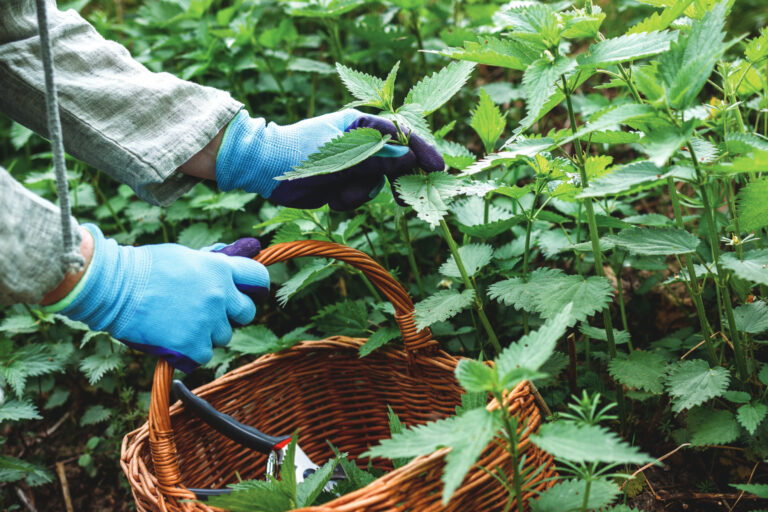
Nettle prefers moist ground along rivers, creeks, and lakes, but we also find it thriving in sunny openings in the woods. Tiny green-to-pink flowers bloom from June through September before producing small, one-seeded fruits called “achenes.” The egg-shaped leaves (1 to 4 inches long and 1/2 to 1-1/2 inches wide) grow opposite one another along the square stem and have sharply toothed edges.
Young leaves and seeds are commonly harvested for food and herbal use, while the roots are used in some preparations.

Why do Nettles Sting?
You can forage nettle in most states or grow it in your garden. But beware: The plant’s tiny hairs embed in exposed flesh and cause stinging and burning. It’s difficult to get them out, and you won’t take nettles lightly ever again. I learned that lesson the hard way. One day, I was hunting morels when I spotted a mushroom and reached down without paying attention to the plants around it. My hand brushed a patch of nettles, and within seconds, it felt like it was on fire. That happened more than 20 years ago, and I still remember it. Ever since then, I always look before I reach for a mushroom.
How to Treat Stinging Nettle
So, the first lesson is to wear gloves the entire time you handle unprocessed nettle! When picking nettles, don’t rub your face. Carry them in something that won’t brush against you or your clothing. If you touch nettle, apply aloe or a paste of baking soda and water. Or, use juice from inside jewelweed stems or crushed dock leaves.
Nettle Leaf Benefits
Nettle really is a nutritional powerhouse. Modern research helps explain why nettles have been valued in herbal medicine for centuries. A nutritional and pharmacological review by Bhusal et al. (2022) reports that it contains a good quantity of vitamin C and provitamin A, as well as zinc, cobalt, potassium, nickel, and molybdenum.
Studies suggest compounds in nettle can help reduce the release of histamine and other inflammatory chemicals, which may explain why many people consume it during allergy season.
In The Lancet in 2000, Marilynn Larkin described a study where 27 individuals applied fresh stinging nettle directly to joints and reported less osteoarthritic pain when compared with the use of non-stinging white deadnettle.
Researchers have also been studying nettle’s effects on blood sugar regulation, inflammation, and cardiovascular health. While results are promising, larger human studies are still needed, so anyone taking medications for those conditions should speak with their healthcare provider before using it regularly.
How to Eat Stinging Nettle
Nettles taste somewhat like spinach, but you don’t want to eat them raw. Those tiny hairs will attack your mouth and throat. Fortunately, heat destroys the sting. Blanch the leaves in boiling water for about two minutes, plunge them into ice water, and then they’ll be ready to use or freeze. Drying works too, making nettles perfect for teas and tinctures.
Nettle Tincture
To make a tincture, fill a wide-mouthed quart canning jar 1/4 full of dried herb or 2/3 full of fresh leaves. Then, fill the jar with vodka, rum, or brandy. Place a lid on it and store in a cool, dry, dark place. Shake the jar daily. After 4 to 6 weeks, strain out the solids and place the liquid in bottles for use by dropper as needed.

When using salves, don’t get them near your eyes, on your face, or on other sensitive body parts.
Stinging Nettle Tea
To make tea, place about 1 teaspoon of dried nettle in a tea ball and cover with 8 to 12 ounces of hot water. Allow it to steep for 5 minutes. Remove the tea ball and enjoy. You can also make this in larger quantities and drink as a sweet tea.
Serve nettles as a spinach or Swiss chard replacement, add to soup, and more.
Stinging Nettle Look-alike
Nettles may grow near members of the mint (Lamiaceae) family, such as catnip (Nepeta cataria). Note catnip’s smooth, square stem and shorter leaves versus stinging nettle’s longer leaves and hairy stems. Rubbing the leaves with a gloved hand will reveal a minty aroma from the catnip but not much smell from the nettle. Later in the season, most mint species present tiny white-to-purple blossoms at the tops of each stalk, while stinging nettle flowers appear as strings of beads where leaves join the prickly stems. Both mint and nettles spread via rhizomes and seeds.

Nettle Soup Recipe
Yield: 4 servings.
- 1 pound bacon
- 4 cups fresh nettles or 1 cup dried nettles
- 1/2 cup chopped onions
- 2 cloves garlic, chopped
- 2 quarts beef or chicken broth
- 1/2 cup sour cream
- 1 cup shredded cheddar cheese
- Salt and pepper, to taste
- Crusty bread or crackers
- In a large skillet, cook the bacon until crispy. Break it into small pieces.
- Use the bacon grease to sauté nettles, onions, and garlic for 5 minutes on medium heat.
- Add broth and simmer for 20 minutes.
- Turn burner to low and add sour cream and shredded cheddar cheese. Add salt and pepper to taste.
- Serve chunky or purée with an immersion blender. Enjoy hot with crusty bread or crackers.
Nettle Dip Recipe
Yield: 6 servings.
- 6 cups fresh nettles or
- 1-1/2 cups dried nettles
- 1 pound bacon or shredded cooked chicken (or a combination)
- 8 ounces cream cheese
- 2 cups shredded cheddar cheese
- 1/4 cup green onion, chopped
- Tortilla chips or carrots for dipping or pita bread for spreading
- If using fresh nettles, blanch them in boiling water for 2 minutes.
- Remove from water and plunge into an ice bath for 1 minute. Drain and dry between two layers of tea towels to remove all excess moisture.
- If using dried nettles, place them in 2 cups of boiling water and hydrate for 10 minutes. Drain and pat dry between towels.
- Cook bacon until crispy, then drain and crumble.
- Combine nettles, cream cheese, shredded cheese, onions, and meat. Mix well.
- Chill and serve as a delicious, hearty appetizer with tortilla chips, carrots, or pita bread.
Nettle Salve for Burns
Make this salve for burns and irritated skin.
- 4 ounces coconut oil or tallow
- 1 ounce dried nettle
- 1 tablespoon beeswax
- 20 drops frankincense essential oil (optional)

- Melt coconut oil or tallow over a very low heat or melt setting.
- Add in dried nettle and stir.
- Continue heating on lowest setting for 1 hour, stirring as needed. The oil will turn green.
- Strain off herbs and discard. Return oil to the pan and add beeswax.
- Melt the wax, turn off heat, and add essential oil if desired.
- Pour into heat-safe containers, and let cool.
- Use for skin irritations such as eczema and mild burns.
Nettle Salve for Sore Muscles
This salve recipe includes capsaicin to warm sore muscles and aching joints, but it can irritate burns and inflamed skin.
- 4 ounces coconut oil or tallow
- 2 ounces dried nettle
- 2 teaspoons dried cayenne pepper
- 1 tablespoon beeswax
- 20 drops peppermint or rosemary essential oil
- Combine melted coconut oil or tallow with nettle and cayenne pepper. Heat on low for 1 hour until the oil is well-infused.
- Strain the oil through fine cloth and discard herbs.
- Return oil to the pot and add beeswax. Heat on low or “melt” setting until well-combined.
- Remove the mixture from heat; add essential oils.
- Pour into jars, allow to cool, and use for joint or muscle pain.

A Sustainable Bounty
Nettle is just one of many humble plants full of nutrition and healing. We often overlook or disdain these plants until we know what they can do. Harvest only the young leaves and take just a portion from each patch, leaving plenty to regrow and produce seed. If you’re lucky enough to find a healthy stand, scatter a few seeds where you’d like another patch to grow. With a little care, nettle may become one of your favorite wild foods and herbs. Just don’t walk into it with bare legs or handle it with bare hands!
Jenny Underwood is a homeschooling mom living with her husband and four kids on their fifth-generation Missouri Ozark homestead. She began writing for magazines several years ago when she realized that their debt-free, self-sufficient lifestyle could encourage others to do the same. Her articles focus on gardening, food preservation, DIY projects, chickens, and healthy, homemade recipes.
Originally published in the September/October 2026 issue of Grit magazine and regularly vetted for accuracy.
Frequently Asked Questions
Why do nettles sting?
The plant’s tiny hairs embed in exposed flesh and cause stinging and burning.
Where to find stinging nettles?
Nettle prefers moist ground along rivers, creeks, and lakes, but we also find it thriving in sunny openings in the woods.
What is stinging nettle?
Stinging nettle (Urtica dioica) is a fascinating perennial plant with tiny hair-like needles that, when embedded in exposed flesh, cause stinging and burning. It can grow as tall as 8 feet, though around the Missouri Ozarks, it usually tops out around 2 feet.