Learn about early food forest permaculture planning and development by John Hershey during the Franklin D. Roosevelt administration.
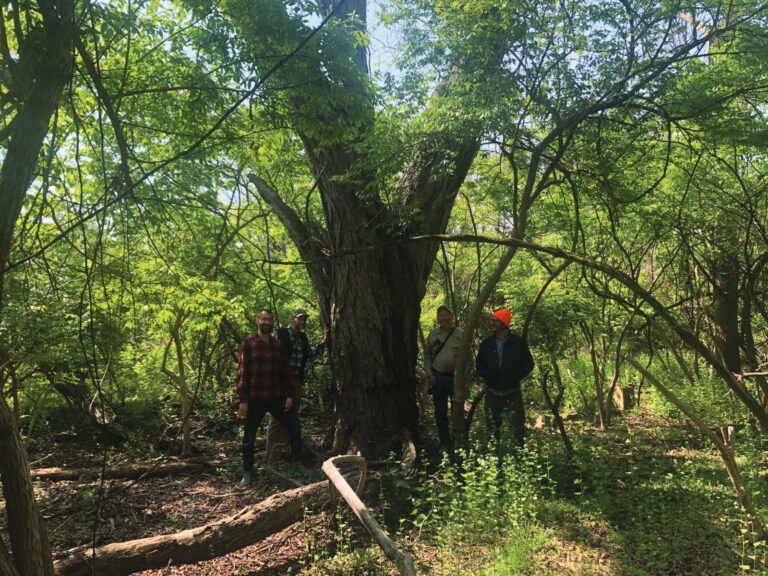
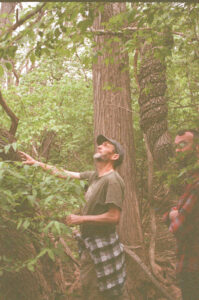
“Picture this as an old farm field with walnuts that’s been abandoned for 60 years,” a nursery operator named Dale Hendricks said as he stepped off the sidewalk of a busy suburban intersection and into a tangled thicket. I peered up into an overstory strangled with thick vines and down at the understory Hendricks was pushing his way through. It was lush with invasive garlic mustard, brambles, and fallen branches. “A walnut grove?” I asked skeptically. I’d have to muster more imagination.
“These are the trees [we saw] in the Permaculture Design magazine article,” Hendricks said as we walked. He was referring to an article that had inspired him and one of the younger men with us, an urban forester and fourth-generation horticulturalist named Max Paschall, to first go looking in 2016 for trees planted by a nurseryman named John Hershey in central Downingtown, Pennsylvania. I’d gotten to know Paschall during the early months of my interest in tree nuts in fall of 2019, when I’d found a blog post he wrote about his visits to the Hershey trees. Through Paschall’s writing and a series of phone conversations, I’d learned the basics of Hershey’s story.
Rooted in Necessity
Hershey, I reminded myself as we walked farther into the tangle, was a Quaker and a nursery operator passionate about the potential of not only fruit but also nut trees. Like so many of the modern-day nut-tree enthusiasts I’d spoken to, he believed that the way we farm – endless monocultures, planting row crops on slopes, and constant tilling – is the root of a long list of environmental and economic maladies. He saw perennial fruit and nut trees as an elegant solution. A self-proclaimed “do-er!,” Hershey had started a fruit and nut tree nursery in Downingtown in 1921 and, as part of his breeding work during that decade, planted the walnut grove we were now walking into and a number of other nearby trees. Hershey’s burgeoning expertise got him featured in J. Russell Smith’s 1929 book Tree Crops – the same text that had inspired many of the modern-day agroforesters I’d spoken with. By the early 1930s, Smith had gotten the book into the hands of a high-up in the Franklin D. Roosevelt administration named Arthur Morgan. Morgan was a fellow Quaker and was inspired by Smith and Hershey’s visions of a sustainable fruit- and nut-tree-centered agriculture. In 1933, when Roosevelt appointed Morgan chairman of a Depression-era relief program known as the Tennessee Valley Authority (TVA), he asked Hershey to help lead.

As an economic and environmental repair engine, the TVA was charged with revitalizing the entire Tennessee River basin, a large area that stretched beyond its namesake state into Virginia, North Carolina, Kentucky, Georgia, Alabama, and Mississippi. During World War I, the U.S. government had encouraged wheat and corn growers all over the country to ramp up production with slogans. With most laborers drafted and overseas, farmers had responded by going into debt to replace the men with new plows and machinery. For a few years, these farmers did well financially. Acreage planted in grain soared, and the government bought everything they grew. But when the war ended, things changed: Commodity grain prices plummeted, and farmers plowed up even more land just trying to break even. In the Midwest, where native grasslands had been plowed and cut over to make way for grains, farms experienced the period of severe drought and erosion that came to be known as the Dust Bowl. According to one source, “by 1934, an estimated 35 million acres of formerly cultivated land had been rendered useless for farming, while another 125 million acres – an area roughly three-quarters the size of Texas – was rapidly losing its topsoil.” And in Appalachia, years of annual grain agriculture on sloped land combined with expanding acreage and the dire effects of the chestnut blight – and the widespread timber extraction that followed it – had produced an exhausted, eroded landscape. Flooding alternated with droughts and forest fires in the river valley, erosion ran rampant, and for a brief moment at the highest levels of U.S. government, tree crops were considered a key solution.
The government employed 3 million men in the Civilian Conservation Corps nationwide and planted 2.3 billion trees in deforested areas all over the country. Hershey and Morgan shared a belief that simply planting trees to control flooding and erosion and the droughts that led to wildfires wasn’t enough; true economic and environmental repair, they believed, depended on planting trees that also fed farm animals – and people.
At the experimental nursery in Norris, Tennessee, Hershey worked to source the best genetics from all over eastern North America for a wide array of fruit and nut species: everything from blight-resistant Asiatic chestnuts to black and English walnuts, pecans, hicans (a cross between a hickory and a pecan), hickories, oaks, heartnuts, hazelnuts, pawpaws, persimmons, mulberries, crab apples, and honey locust trees. Hershey decided that the best way to find especially good trees was to put ads in rural newspapers and sponsor contests with cash prizes, and this turned out to be a winning strategy. Responses poured in from up and down eastern North America, and Hershey took the best of the best – many of which, Paschall noted when we first spoke, were likely the result of millennia of Indigenous selections and stewarding – and began propagating. When I’d stopped in Johnson City, Tennessee, a few days earlier, my guide there, a young permaculturist named Taylor Malone, had shown me a towering, überproductive pecan and a row of mature Chinese chestnuts in a suburban backyard. After looking through old TVA paperwork, he believed all of these were Hershey trees. “They sent out thousands of fruit and nut trees over the course of a decade,” Malone told me of Hershey’s time with the TVA.
But the momentum on a national scale, Malone explained, was short-lived. Five years into Hershey’s work at the Norris experimental nursery, President Roosevelt dismissed Arthur Morgan over a political fight. At the same time, Hershey discovered he had cancer and returned home to Downingtown, to his wife and family. The TVA tree crops nursery limped along until just after the start of World War II, but without Hershey or Morgan there to lead it, plantings focused less and less on food, and more and more on trees that provided only erosion control and timber. Still, Hershey’s experiments continued. He recovered from his cancer and continued to both champion and plant tree crops until he died in 1967, at which point he’d covered more than 100 acres in Downingtown with thousands of carefully sourced, top-producing fruit and nut trees – which apparently included the gnarled grove we now stood beneath.
A Lasting Legacy
Just ahead of me, Hendricks stopped walking and paused beneath a particularly large, shaggy-barked tree. “This is one of the walnuts,” he said, and pointed to a pile of half-eaten shells and dried leaves as proof. “There was an article in the Permaculture Design magazine, maybe 16 or so [years ago] about these [trees] called ‘Standing Tall Amidst the Sprawl,'” Hendricks said as we all gathered around the trunk to better hear him. The article referenced a map of Hershey’s plantings that had been published in an updated edition of Smith’s Tree Crops in 1953 claiming that many of the trees were still standing.
“[Max] and I were like, ‘The trees are still there!'” Hendricks said, shaking his head and chuckling. “So, he and his dad looked it up on maps and stuff, and then I bumped into Max at a backyard fruit growers meeting, and Max said, ‘Hey, let’s go out. I know where those trees are.'” That, Hendricks told me, is how he and Paschall had met our other companions: Adrian Martinez, a member of the local planning board; Rick Webb, a horticulturalist and member of the Downingtown Tree Commission; and Matt Bennett, who, like me, was here visiting today to pay witness to Hershey’s legacy.
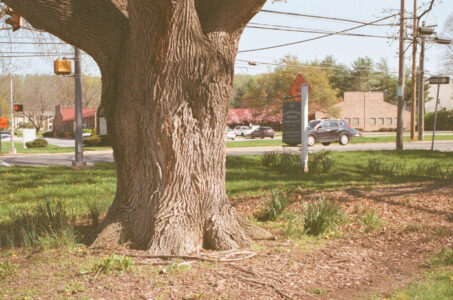
These walnut trees, Hendricks explained, were one of the few intact Hershey groves left in central Downingtown. The rest had been slowly thinned by developers and homeowners over the decades. There were still a few tall, slender American persimmons towering over a parking lot across the street right next to a nail salon, three hicans standing on a neighboring lot that a developer had agreed to save thanks to months of Martinez’s lobbying, and two large bur oaks standing watch over the main drag in front of the nearby Downingtown Friends Meeting House. Most of the trees that remained stood out as though they’d been planted as ornamentals or for shade – alone in grassy medians, manicured and scattered behind houses and on roadsides. But the walnut grove, still dense and intact and untouched for decades, felt like a long-forgotten secret just off Downingtown’s central vein.
“It’s just a shocking amount of beautiful productivity,” Hendricks said, looking at the trees. And it was – far more food than I’d ever seen intentionally grown in a suburban neighborhood, or, for that matter, in the woods around my house on Cape Cod, where some of the same species were growing without the advantage of human selection and tending.
“I wonder if there’s more wildlife around here because of these plantings,” I mused aloud.
“I don’t know,” Paschall said, “but that would make a great project for a Ph.D. student.” We walked back toward our cars, pausing to greet a middle-aged man out with his dog. “She came all the way from New England to see your neighborhood,” Hendricks said by way of introduction, gesturing to me. The rest of us gathered, explaining why we were here and giving the man a brief introduction to the Hershey plantings.
“You know, sitting on the deck with my bird book, I’m close to 50 different varieties of flying creatures,” the man told us, clearly intrigued. But when Hendricks asked him if he’d ever eaten any of the fruits or nuts from the trees himself, he gave a puzzled head shake. “No,” he said. “Are they good for eating?”
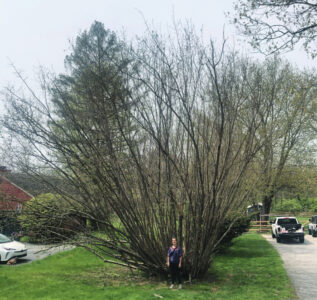
This is how most of the people they’ve spoken to react to learning about Hershey’s plantings, Hendricks and Paschall said as we walked away. Hendricks had offered to prune back a pair of giant hazels we’d seen earlier, explaining to the couple who owned the house that if he cut the trees back, they’d produce far more nuts – nuts the couple could eat. But “they said they’d rather leave them alone,” he said, shaking his head disappointedly. Another homeowner had cut down a giant mulberry, because it made a mess every year when it dropped its fruit on the street, and almost all the chestnuts and persimmons that fell each fall were left on the ground by neighborhood residents for animals to eat. Besides Hershey enthusiasts like us who came to visit, Paschall said, no one really saw all this food as much of a human opportunity.
“Yeah, that’s something that I’ve come across in Philadelphia,” Bennett jumped in. He was working with an AmeriCorps nonprofit project, he explained, removing invasive species and replacing them with native plantings on natural lands in the city. “I’ve brought up the conversation with a number of my colleagues, suggesting we plant native edibles, and they say we do. But they’re planting wild ones that really don’t have any foraging value; they’re not planting cultivars selected for humans.” People have been using modern breeding methods to increase yields for native edibles, such as pawpaws, hickories, elderberries, honey locusts, persimmons, hazelnuts, and even oaks, for decades now, Bennett went on, but organizations like his – environmental groups focused on revitalizing “natural” spaces – often refuse to use these improved trees, saying they need to plant wild trees. “And I can agree, if you’re reforesting a thousand acres in the middle of central Pennsylvania,” he went on. “But for that acreage surrounded by people where something like a third of everyone is in poverty, it’s like, maybe we should be planting for humans.” I looked to my left and saw Hendricks and Paschall nodding. Clearly, they’d been hoping to get to this.
Building a Habitat
“There’s a really strong divide,” Paschall chimed in, “between people interested in planting trees to rebuild wildlife habitat and people interested in planting many of the same species as crops for people to eat.” Later, I spoke with a forester named Christopher Riely, who was experimenting with creating climate-resilient forest plots in southern New England, and he said the same thing. Riely and a team of researchers have been thinning oak-hickory stands to help forests adapt to water stresses and, in some experimental plots, adding hybrid chestnuts to try to increase the diversity of mast species. “Assisted migration,” he called this part of the work – bringing southern species north and foreign species into the mix in ways similar to Hershey, responding to the fact that while native trees have been the most resilient historically to New England forest conditions, “conditions are changing.” But when I asked him if the landowners he and his team were working with were excited about the food potential of these experimental plots, he said no.
Most people in the U.S., Paschall went on, still see humans and nature as fundamentally separate – two distinct spheres of being. I nodded. It was the same divide I’d felt since childhood. “Habitat means critters; it doesn’t mean humans to most people,” Hendricks said. I nodded, grasping for a way to describe a feeling that had been building for months now.
“Sometimes I think we don’t believe we can have a habitat,” I ventured. I’ve noticed some people, I tried to explain, see the way we separate ourselves from nature as sort of a form of elitism – a belief that we’re better than nature or animals, or above them in some sort of hierarchy. But more recently, I’d been viewing it differently. “I almost see it as a form of – I don’t know what the right word is,” I stumbled. “Self-loathing? Like, we’re so awful that we couldn’t possibly be part of this beautiful thing.”
“Right,” Paschall said, nodding. “And thinking that way requires fundamentally ignoring tens of thousands of years of human evolution and Indigenous history.”
“But humans need habitat too,” Hendricks jumped in, looking at us seriously. “Diverse, productive, and abundant ecosystems make free people possible and healthy people possible. They go together. It’s not a little thing.”
Excerpted from Feed Us With Trees: Nuts and the Future of Food (New Society Publishers, 2025). Elspeth Hay is a public radio host and author. As she’s deeply immersed in her own local-food system, her work focuses on the people, places, and ideas that feed us.
Originally published in the March/April 2026 issue of Grit magazine and regularly vetted for accuracy.