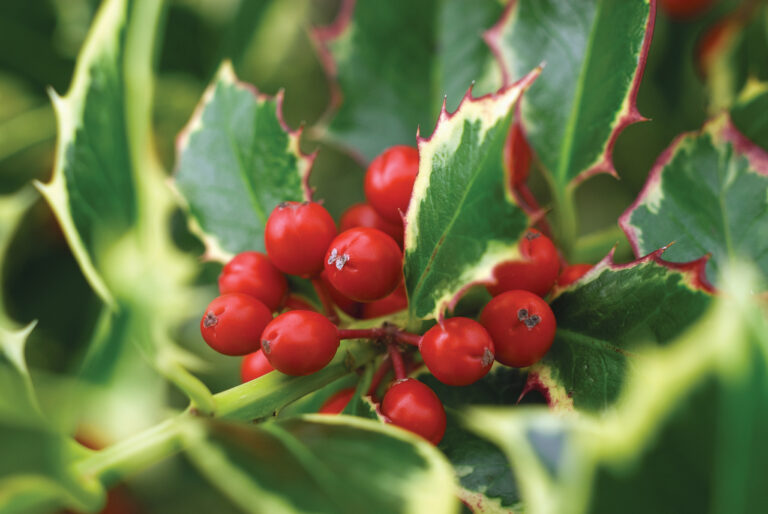
Most of us simply think of holly as a beautiful shrub with glossy green leaves, pristine white flowers and brilliant red berries, and we often associate it with the Christmas season. Holly is much more than just a pretty bush, though.
Christmas Holly History and Lore
The history of holly dates back to Roman times. The Romans associated the evergreen holly with bringing colorful cheer to the darkest time of the year. They often presented branches to one another at festivals. Later, the druids, Celts and Britons also associated holly with life and continuity during winter solstice celebrations, and they frequently brought berried branches into their homes. Holly has long had a strong association with Christmas, as indicated in writings from the 15th and 16th centuries. Today, evergreen holly remains a symbol of the joy of life, continuity and Christmas.
Selecting and Caring for Different Types of Holly Bushes
Many varieties of holly exist around the world, but the plant used most often for creating Christmas decorations and displays is the evergreen English holly (Ilex aquifolium). Native to western and southern Europe, northwest Africa and southwest Asia, this holly is mainly associated with Christmas – past and present – in Europe, but it is now also grown and used at Christmastime in many other parts of the world. Fresh cuttings of English holly are widely sold in North America during the holiday season. Instead of purchasing it, though, why not grow your own?
The majority of our holly varieties enjoy a well-drained soil, supplemented with organic matter, and slightly on the acidic side. A few like or tolerate more neutral to even slightly alkaline soils. Most plants prefer partial sun in hot summer areas, though in cooler coastal areas, the plants can handle sun or shade. Some even tolerate full shade quite well.
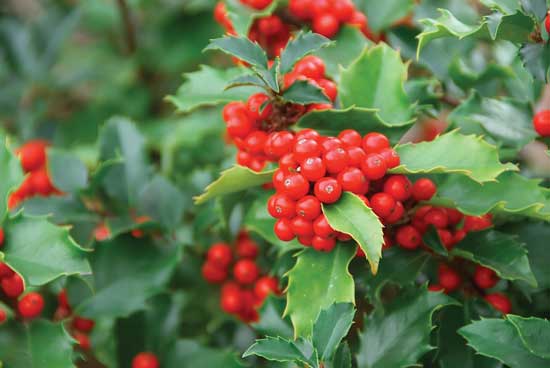
One common characteristic of most holly plants is that there are both male and female plants, which enables the females to bear fruit. However, there are some cultivars that have been developed to be self-fertilizing. It is said that the best berry production occurs with five females for every male. Males and females also have to be within 30 to 40 feet of each other.
Most hollies are highly attractive to many birds, such as the cedar waxwing. At times this can be a concern for humans, as the birds sometimes will eat most of the berries on your tree before you have a chance to cut the branches for decorating purposes. Most hollies are deer resistant and salt tolerant. Prune most hollies to the shape desired in late summer.
Types of Holly Bushes
English Holly
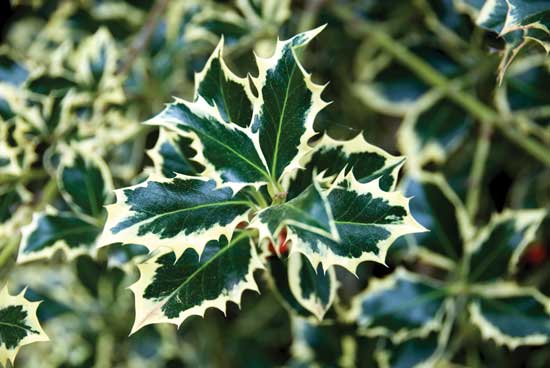
English holly is a dense tree that grows to 30 to 50 feet tall, with distinctive glossy, dark green spine-margined leaves, fragrant white flowers and brilliant red berries. Hardy to about Zone 6, you can choose from many cultivars, only a few of which are listed here. This holly can tolerate severe pruning and, because of this, it can be considered for hedging or for topiary, if you are adept with pruning for this effect.
Gold Coast (I.a. ‘Monvila’) is a good male selection (no berry production) for a low-growing shrub or evergreen hedge. It grows to 4 or 5 feet high and wide, and its small dark green leaves are edged with bright golden yellow.
Aurea Marginata is a female with bright golden-yellow margined leaves. It is not considered to be a great producer of berries, though.
Argentea Marginata is a female that has dark green leaves with creamy white edges. Pyramidal in form, it grows to about 15 feet high and 8 feet wide. It is a great plant to consider for privacy screening or as a tall hedge.
Santa’s Delight is a female with blue-green leaves, each with a broad edging of creamy white. This is another pyramidal form that grows to similar dimensions as the Argentea Marginata cultivar.
American Holly
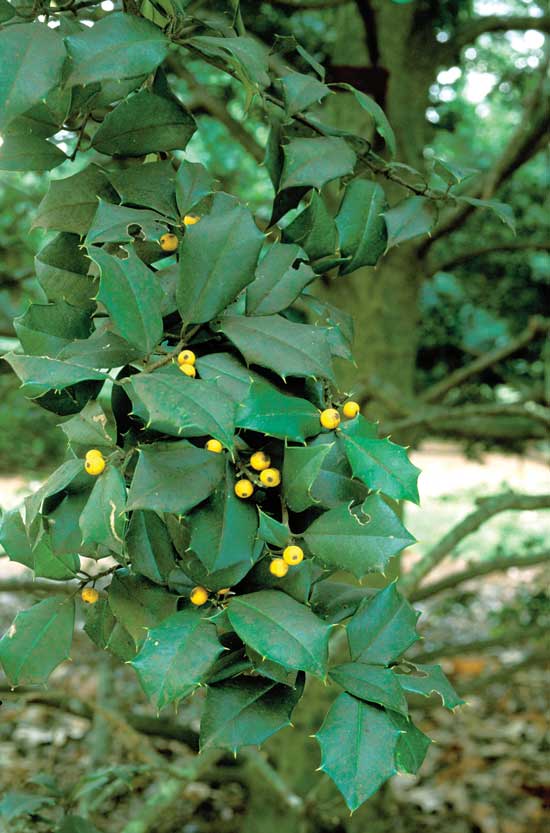
American holly (Ilex opaca) is a tree holly that grows 40 to 50 feet high and 20 to 40 feet wide. Because of its size, you should carefully consider where to plant it. More than 1,000 cultivars can be found; choose those that are densely pyramidal with dark green foliage and abundant fruits.
Canary and Goldie are heavy producers of yellow fruits, with light green leaves. Jersey Delight has reddish-orange fruits, and Manig has dark orange-red fruits.
Chinese Holly
This holly (Ilex cornuta) is one of few that can tolerate heat, drought and poor soil quite well. Typically a multi-stemmed shrub that grows to a height of about 10 feet, it is hardy to Zone 6. Dense growing, with spiny-edged dark green (yellow-green underneath), firm leaves and fragrant white flowers, Chinese holly can be pruned hard, often into a small tree shape. There are numerous cultivars.
Burfordii holly is a female that prolifically produces large, bright red berries. This cultivar grows fairly fast to about 15 feet high by 10 feet wide. Dwarf Burford grows slower, is compact and round, at about 5 feet high and wide. D’Or is a yellow-fruited form of Burfordii.
O’Spring is an upright, 10-foot-tall male with creamy yellow leaf margins. Sunrise has yellow foliage, though older leaves and interior leaves become green. Cajun Gold has red fruits and gold, margined green leaves.
Meserve Hybrid Holly
Hardy to about Zone 5, the Meserve hybrids (Ilex x meserveae) are beautiful holly plants for colder areas.
Red Beauty is a narrow, pyramidal and conical form – 6 feet tall by 3 feet wide – that produces sparkling red fruit with spiny, glossy, dark green leaves. The tree maintains its dense upright form with little to no pruning.
Berry Magic – also known as Blue Boy and Blue Girl, China Girl and China Boy, or Blue Princess and Blue Prince – is sold as one plant with both a male and female in the same container. These hybrids grow to about 10 feet high and wide.
Castle Sprite is a dense, compact, pyramidal, red-fruited female that grows to about 8 feet in height and about 4 feet wide.
Castle Wall is the male version, and it grows to about 6 feet tall by 3 feet wide.
Both of the Castle hollies are adaptable and handle damp soil quite well. They should be pruned as soon as possible after flowering.
Golden Girl has shiny blue-green foliage and brilliant, rich yellow-orange fruits. It grows to a height of around 12 feet, and is often 10 feet wide.
Other hybrids and their cultivars worth checking into further are Ilex x aquipernyi ‘Meschick’ Dragon Lady and I. x attenuate ‘Fosteri.’
Craft, Cut and Care
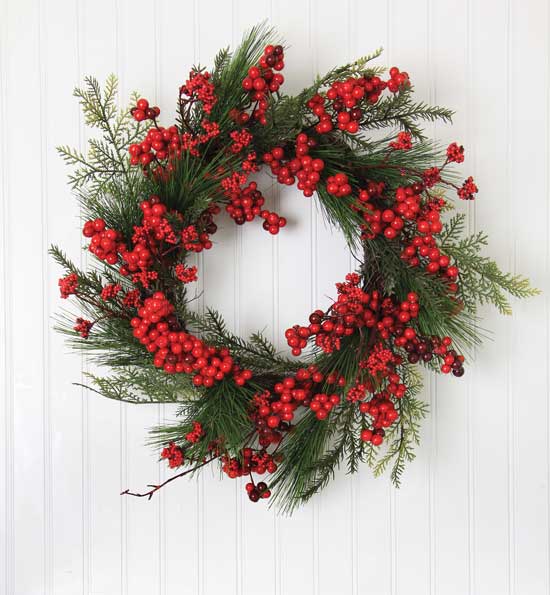
With all of the holly varieties available, decorating possibilities abound using different hollies in addition to the usual bright red berries and glossy green foliage. For example, golden or orange berries, yellow and green variegated foliage, and more lend themselves to various projects, such as wreaths and garlands for both indoor and outdoor decorations, centerpieces for table arrangements, and placing branches of various sizes on the mantle, plus many more design ideas.
Cut holly from growers has been treated with a fungicide-hormone combination to help it retain its leaves and berries longer. That being the case, holly will look fresh for about two weeks.
A more enjoyable — and less expensive — option is to cut berry-laden branches from your own garden.
Christmas Holly and Ivy Wreaths
Whether you buy or grow your own holly, here are some basic guidelines to ensure your projects and decorations last as long as possible.
Cut holly and ivy branches are basically no different than cut flowers, cut greens, or even fresh cut Christmas trees. All will last longer if water is provided during their entire indoor stay, which can be up to two weeks. By adding a small amount of bleach to the water, you will kill any bacteria that might block the flow of water up the stem. If at all possible, mist your branches as well, especially in warm, dry conditions.
Select the branches you wish to cut, and cut them at a 45-degree angle, just above a leaf node. This helps the branches absorb water. Room-temperature water is ideal for increasing the life span of most cut greens, including holly and ivy. If possible, soak your branches overnight with the cut end in the water. Start your designing and decorating as soon as possible after cutting and soaking.

The use of floral foam is highly recommended, because it retains considerable water for plant uptake, and it also provides a base in which to stick your branches. There are even wreath-shaped foam blocks available at craft stores to make your decorating projects easier. Check your arrangements daily for signs of dehydration, and replace any dried-out branches with fresh branches as needed.
Fresh cut holly and ivy will dry out quickly in just a few days if water is not provided. Again, think of cut flowers and Christmas trees.
Keep your wreaths and branches away from direct heat and sunlight.
For outdoor wreaths and branches, protect them from freezing, if it is at all possible.
A walk through the woods where holly bushes can be found has always enhanced the holiday season for Jesse and his family. Jesse’s first book Quiver Trees, Phantom Orchids and Rock Splitters: The Remarkable Strategies of Plants is now available.