What does the USDA Certified Organic definition mean for farmers? Learn the requirements for organic certification through one Ohio farm’s journey.
 This article is also in audio form for your listening enjoyment. Scroll down just a bit to find the recording.
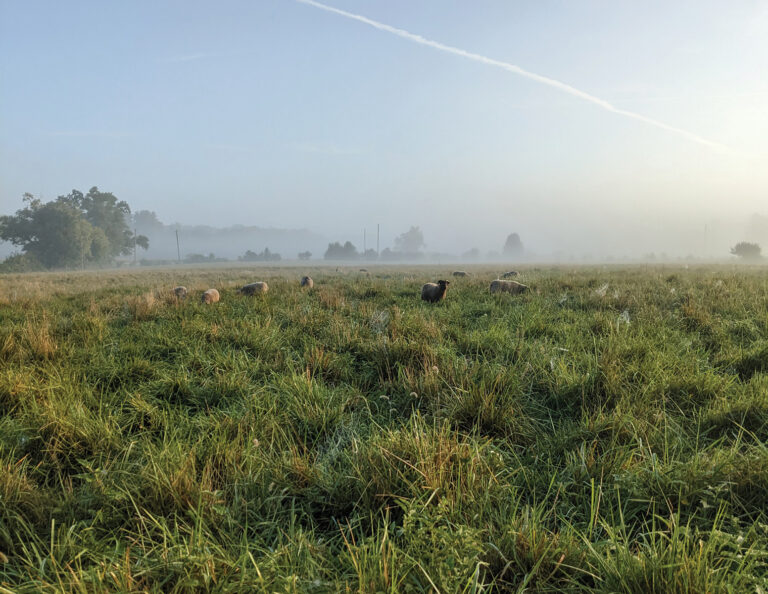
Our farm’s journey to organic certification truly began in 1968. When my parents purchased the land that would become our farm — named Innisfree on the Stillwater — and began farming, there were only a few trees along the riverbank, and the fields came right up to the driveway. Over the years, they deliberately chose to take acres of crop ground out of production, starting with the field borders along the river, driveway, and creek. Their decision was met with protest from other farmers who saw it as a loss of prime farmland and, therefore, money; however, my parents saw it as an increase in wildlife habitat, areas for walking and bird-watching, and a natural buffer to reduce the effects of seasonal flooding. They didn’t farm organically, although they did try to limit the use of pesticides and herbicides. They told me that if there’d been markets to sell organic crops in this area, they would’ve done so. Now, more than 50 years later, we’re reaping the rewards of their unpopular decision.
Certified Organic: Definition for Farmers
Let’s start by defining “organic” and “Certified Organic.” Merriam-Webster tells us that organic means “of, relating to, yielding, or involving the use of food produced with the use of feed or fertilizer of plant or animal origin without employment of chemically formulated fertilizers, growth stimulants, antibiotics, or pesticides.” The Certified Organic definition, according to the U.S. Department of Agriculture (USDA) website, are “grown and processed according to federal guidelines addressing, among many factors, soil quality, animal-raising practices, pest and weed control, and use of additives. Organic producers rely on natural substances and physical, mechanical, or biologically based farming methods to the fullest extent possible.”
While many people use organic methods on their farmsteads, USDA organic certification involves paperwork, fees, and yearly inspections. These added requirements may lead some to ask, “Why become certified, and what are the requirements for organic certification?” The answers to those questions are based on what type of farmstead you have, your goals, and whether you’re raising livestock, growing produce, or, as in our case, growing row crops and hay.
Meeting the Requirements for Organic Certification
Becoming Certified Organic meant accountability to our goals as land stewards. We believe in improving our corner of the planet from the ground up and the adage of leaving things better than we found them. We’d already implemented rotational grazing for our beef cattle, which noticeably improved pasture health and meat quality, and the next step was to look at what we could do with the tillable acreage.
After my parents retired from farming, they leased the land to a production farmer who grew corn and beans. When my husband and I took over the farm’s daily operations, we discovered how different his methods were from how we wanted to treat the land. He applied various herbicides and pesticides in all stages of crop production. The soil was depleted of naturally occurring organisms, and he seemed to need more inputs to grow those crops every year. This bothered us, and we weren’t getting good answers as to why the increase was necessary. The tipping point came when we saw the trees bordering the fields sick and dying from herbicide over-spray. After much discussion, we parted ways with that farmer and considered what to do next.
My parents had already sold most of the farming equipment, and new (or new-to-us) equipment was out of our budget, so we chose to fallow the cropland while exploring options. I posted “no spray” signs along the road, which led several farmers to visit and inquire if we were looking for someone to farm the land. We told them our plans, and one farmer seemed to fit well with our goals.
Choosing a Path to Organic Certification
I scoured the internet for ideas and options during this time. By searching the websites of Ohio State University Extension, the USDA, and various organic agriculture organizations, as well as searching “how to become Certified Organic in Ohio,” I found several paths we could take. One approach was to use conventional seeds and farm with fewer chemicals, but we ruled this out, because there didn’t seem to be a way to use fewer chemicals with the available seeds.
Another option was to become Certified Naturally Grown (CNG), which was described to me as “beyond organic.” CNG was appealing because of the beef cattle we had at the time, but we have more cropland than pasture, and CNG focuses on produce and livestock, not row crops.
We even thought about planting trees to harvest for lumber until we realized how much physical labor and upfront cost it would entail. Becoming Certified Organic looked like the best fit for our farm. Of the several organizations covering Ohio, we chose the Ohio Ecological Food and Farm Association (OEFFA) as our certifying partner.
Audio Article
The Process
This wasn’t a quick decision or process — it was more than a year from the end of our production farmer’s tenure to contracting with our organic farmer, and it wasn’t until 2021 that all our fields were Certified Organic. A three-year transition period (and, in some cases, five years) is required before a field can become certified, so while we’ve followed the organic standards since 2017, we couldn’t market the harvest as Certified Organic until the transition period was complete. At the time, no transitional certification was available, meaning we were paying for organic inputs but receiving conventional pay for the harvest. Now, a Certified Transitional Organic certificate is available for producers, allowing them to receive a higher price for their crops than for a conventional harvest, but not the full organic value.
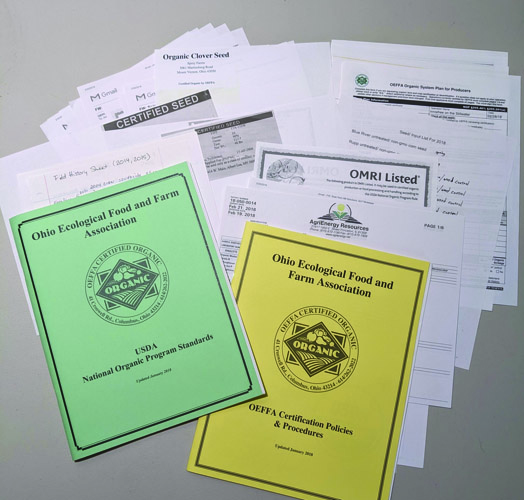
Having worked for government entities before, we knew there’d be plenty of paperwork for the certification process. Still, I was surprised at the amount of detail necessary in our initial application. The OEFFA Organic System Plan (OSP) for producers was more than 20 pages long. Although some sections didn’t apply to our certification, it took several weeks for us to be satisfied that we had all the required information. There were several email exchanges with OEFFA, along with texts and emails to our farmer to double-check that we had the information correct.
Everything relating to the crops involved documentation, including a field history for the previous three years, inputs for the upcoming year (seeds, soil amendments, etc.), equipment, post-harvest handling, soil test results, water sources, and buffer zones. Purchasing organic seeds would be ideal, but if we couldn’t obtain organic, we needed a paper trail documenting our search history, along with verification that the seeds we purchased were non-GMO and untreated. To make things even more of a challenge, some of the information needed to be duplicated in two or three different sections.
Looking back, I don’t think there’s been a year that I’ve filled out the OSP 100% correctly the first time — I always seem to forget to remove an implement from the equipment list, add a new soil amendment, or update the name of a seed variety. These oversights are easily corrected during our annual inspection or through an email with OEFFA to update the OSP.
Each year, OEFFA sends out a list of approved inputs allowed in organic production. There are categories for crops and livestock, and the inputs include fertilizers, pest control, soil amendments, feeds, medical treatments, food contact substances, and cleaners. Whatever goes in or on the ground must be on that list, and we do a lot of verifying names and manufacturers when completing the yearly OSP. These inputs are approved by the Organic Materials Review Institute (OMRI), a third-party organization that tests and approves products suitable for organic use. OMRI works under the USDA National Organic Program (NOP) guidelines and is just one of the several third-party groups in the United States that test and approve inputs. Canada and Mexico also have equivalents to the NOP.
After submitting the OSP and the certification fee, we were assigned an inspector to meet us at the farm. I had the OSP and farm information, our farmer had the paperwork for the crop and storage side, and the inspector had a copy of the OSP and their questionnaire. The kitchen table was covered with papers and laptops! For several hours, we discussed our organic goals, verified the information in the OSP, corrected any errors or gaps, and answered questions. We had paper copies of all documentation available for the first few years of inspections. In 2020 and 2021, we were virtually inspected and began using a shared cloud-based folder. We uploaded scans of seed searches and tags, photos of storage areas, and even videos of the fields. The OSP discussions took place via email and Zoom or Google Meet. We’ve since returned to in-person inspections but still use the cloud-based folders to reduce the amount of paper.
Once the inspector was satisfied with the OSP and our documentation, it was time for the field inspection. We walked to each field and discussed the crops planted, the buffer zones between our land and adjoining farms, cultivation methods, and whatever else caught the inspector’s eye. At that point, the inspection was technically over, although several inspectors also wanted to see where our farmer stored the harvest, so they drove to that location. Photos of the storage facilities were acceptable to other inspectors.
We have a different inspector every year, and although they all follow the inspection report provided by OEFFA, each brings their unique experience and expertise. One was interested in our various soil types, another focused on our buffer zones, and a third quizzed us on our seed selections. While the report questions were the same, I could expect every inspection to be self-contained. This was jarring the first time, as I expected the same person and was caught off guard when I needed to explain everything about our farm again to the new inspector. But I’ve enjoyed meeting a new inspector each year and having wide-ranging conversations with them about the different aspects of organic farming.
Is Transitioning to a Certified Organic Farm Worth It?
As daunting as the yearly paperwork and physical inspection sound, we were pleased to learn that we didn’t need to complete the entire OSP every year, although the inspector will go through the whole plan during the farm inspection. The paperwork has become even more streamlined — we only needed to fill out six pages covering the field data, seeds, and inputs for 2022. If changes need to be made to other items, additional pages must be submitted, but we’ve found it much better than combing through the entire 20-page document every year.
Becoming Certified Organic may sound like an incredible amount of work, and, yes, the first few years of transitioning can be challenging as you learn the requirements and how your certifying organization works. Communication with that organization is critical, whether you have questions on how to document information, need to amend or update your OSP after submitting it, or any of a thousand things that can come up when running a farmstead. Carefully read every email and letter from your organic organization for any changes. I missed that we needed to include our gross income for the previous year’s harvest and had to scramble for that number during our last inspection. There’s a great deal of information to absorb, but those folks are there to help you navigate the process, and they want you to succeed.
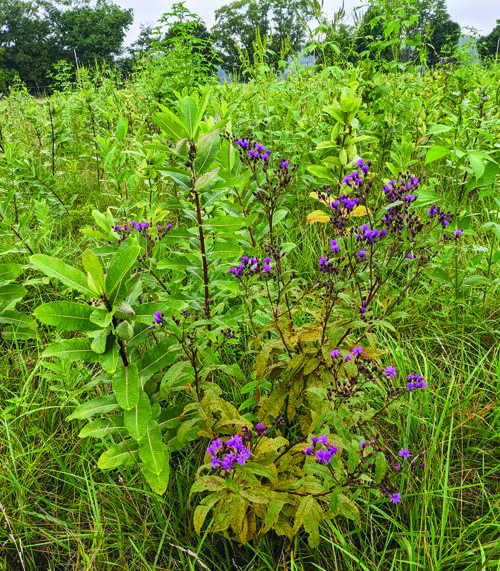
We’ve found the challenges worth the effort — the soil is filled with life, the perimeter areas are healthy and home to a variety of wildlife and pollinators, and we continue to show other farmers in the area that it’s possible to grow crops without using herbicides and pesticides. Organic certification was the right answer for our goals — research your options to see if it’s right for you!
Requirements for Organic Certification in Your State
If you’re interested in transitioning your farm to Certified Organic, check out these resources to help you along the way.
- University of Arkansas Division of Agriculture’s Extension Offices Database
- National Organic Program (202-720-3252)
- Organic Farming Research Foundation (831-426-6606)
- Organic Materials Review Institute (541-343-7600)
- Rodale Institute (610-683-1400)
- Sustainable Agriculture Research and Education
- U.S. Department of Agriculture’s “Organic 101: Five Steps to Organic Certification“
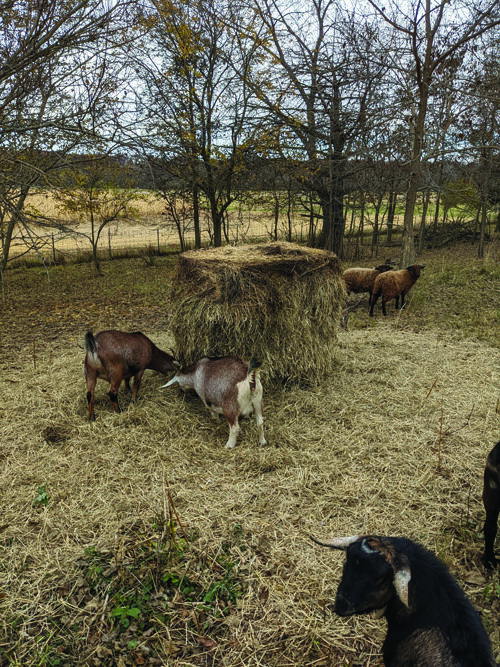
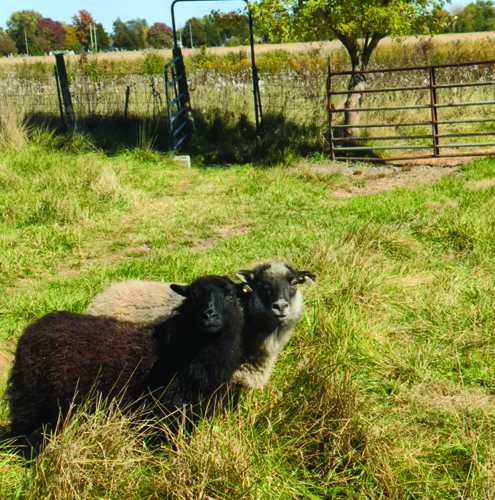
Keba M. Hitzeman (she/her) grew up as a free-range child on the farm she now owns with her husband. They transitioned from modern farming and grass-fed and -finished beef cattle to Certified Organic crops and hay, and grassfed and -finished sheep and goats. They’ve continued her parents’ work of adding areas for pollinators and wildlife. You can find her on Facebook and Instagram (@InnisfreeOnTheStillwater).
Originally published as “Transitioning to a Certified Organic Farm” in the May/June 2023 issue of Grit magazine and regularly vetted for accuracy.