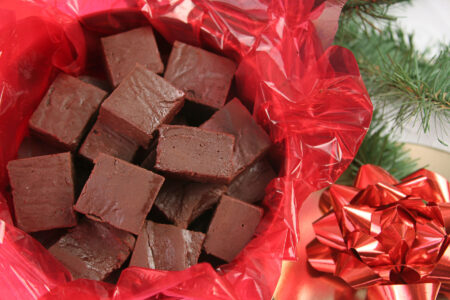
Forming the perfect fudge is a sugar crystal project that takes a bit of knowledge about candy chemistry, and a little luck, of course.
You’re determined. You can do it. You can make perfect fudge. Not the grainy, sugary kind you made last year, but the smooth, melt-in-your-mouth sweetness that your grandmother used to make. You’ve researched; you now know a firm ball from a hard ball from hard crack, and you’re armed with a candy thermometer, just in case. You’ve read up on the proper procedure and have your pastry brush ready to catch any errant sugar crystals that might threaten the creamy smoothness. (Read more about controlling crystallization in Comfort Foods, Page xx.) But, this seems like a lot of extra work. What’s the point of all of this? Must I waste all that yummy fudge by not scraping the pan? Why does all this happen? To understand fudge, you need to understand a couple of things – crystals and supersaturated solutions.
First, crystals. Sugar is a crystal. If you look at table sugar, this seems obvious – tiny, hard grains of sweetness. It’s made up of many identical molecules (sucrose) that find it easy to stack together tightly and become crystals. This is sugar’s tendency that we must fight to keep our fudge creamy instead of gritty.
Honey and maple syrup are solutions of various types of sugar molecules (such as glucose and fructose) and other ingredients dissolved in water. Their natural state is liquid (unless the honey or syrup sit around long enough that the sugar concentration becomes high enough to crystallize).
On the way to a supersaturated solution, let’s talk about saturation. Saturation is what happens when you’ve dissolved all of something that you can in a fluid. If you sneak two extra packets of sugar into your already super-sweet iced tea, and no amount of stirring gets rid of the crystals that fall to the bottom, it’s because your tea has reached saturation. One way that you can increase the saturation amount is to heat your tea. Heat energizes the molecules in the liquid and makes room for more sugar to dissolve. (Maybe you notice less sugar in the bottom of your glass as your tea warms up?) So, as you heat water and sugar, more of the sugar will be dissolved in the water.
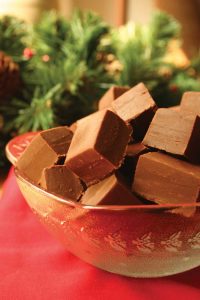
If you just let a heat-saturated solution cool slowly and don’t disturb it, it may become supersaturated with sugar. This means that more sugar is dissolved than the predicted theoretical maximum. The excess sugar will eventually be “squeezed” out (with the resulting sugar glob at the bottom of the glass or pan) but in the meantime the solution is supersaturated with sugar.
In the case of our fudge, it’s been heated to a point where the solution will accept more sugar than usual and then allowed to cool. What you’ve created is a very unstable situation. More sugar is in the solution than can stay there comfortably. The smallest change can start the crystallization of the sugar – a speck of dust, an errant sugar crystal, scrapings from the side of the bowl that are already starting to crystallize. Because this causes it to crystallize from one point (like in rock candy), the crystals that form are relatively large and can feel gritty.
The last stage for our fudge is controlled crystallization. By waiting to stir the fudge until it cools enough to be supersaturated, you can create crystallization all at once throughout the candy. As you stir the fudge, without scraping the walls of the bowl, many crystals form at once, and the stirring keeps them from growing large. This is where that lovely, velvety texture comes in. Yum.
GRIT Web Editor Jenn Nemec remembers her grandmother as a great cook who made amazing fudge.