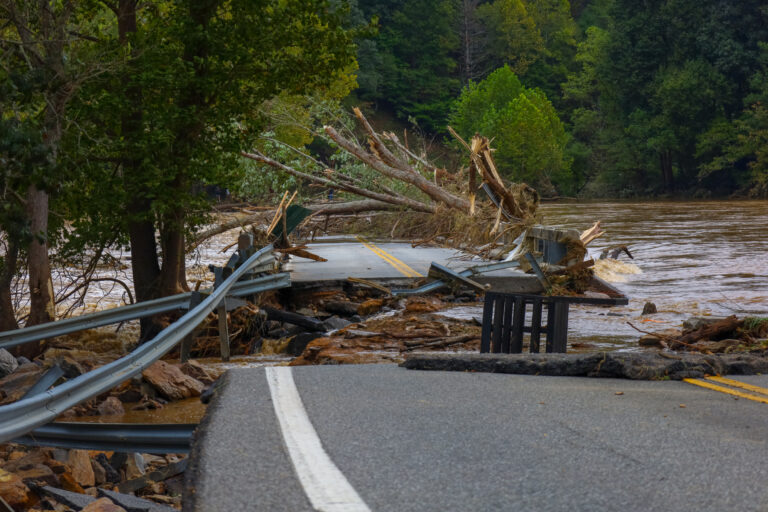
Learn about climate classifications and what extreme weather the U.S. faces, and how costly the damage is.
It seems a weekly weather disaster occurs somewhere in the United States. What’s going on, and are things getting worse?
The National Climatic Data Center (now part of the National Centers for Environmental Information) has tracked billion-dollar weather disasters in the United States since 1980. Although an arbitrary dollar threshold is not a true picture of all weather-related destruction, it typically covers major events that people hear about. This continued until 2025, when the government stopped accounting for weather-related disasters because of “alignment with evolving priorities, statutory mandates, and staffing changes.” However, the data is still available.
Climate Central, describing itself as a “policy-neutral, nonprofit independent group of scientists and communicators who research and report the facts about our changing climate and how it affects people’s lives,” took over this data set, utilizing the same sources.
Climate Classifications
These weather disasters fall into nine categories that cause fatalities and significant destruction to agriculture and infrastructure: drought/heat wave, flooding, severe weather, hail, tornado outbreak, hurricane/tropical cyclone, wildfire, winter storm/cold wave, and freeze. Heat and cold aren’t particularly destructive but can result in significant loss of life. Drought conditions usually coincide with hot weather and can produce major financial losses, especially to agriculture. Similarly, for cold waves, winter storms can cause major damage from the winds and precipitation accompanying the cold air. “Freeze” damage primarily refers to agricultural losses due to an unusually cold wave in spring or to winter in warmer, less-prepared southern areas. “Severe weather” refers to damage typically produced by strong thunderstorms, and the classification includes wind damage and flash flooding. Though also associated with strong thunderstorms, “hail” is its own category because of potentially significant damage to property and agriculture. “Tornado outbreaks,” also produced by severe thunderstorms, carry their own classification because of the extensive damage they produce. “Hurricane” damage includes a wide variety of extreme weather possibilities, including strong winds, coastal flooding, fresh water flooding from copious rainfall, and even storm-generated tornadoes. The “flooding” category includes river flooding from heavy rains or excessive snowmelt. “Wildfire,” though not a specific weather event, is tied to weather conditions, such as drought and strong winds, and causes significant destruction to property and agriculture.
Adjusting for Damage
Allowing for inflation (consumer price index adjustment), there were 403 weather-related billion-dollar events from 1980 to 2024, producing total damage just under $3 trillion, with half of that occurring in the past 10 years. These events also took the lives of nearly 17,000 people. This count doesn’t include many similar events that caused less than $1 billion in damage each. The 45-year average for these events is nine per year. Since 2020, the average increased to 23 events per year because of a higher population and more structures, especially in vulnerable areas, as well as an increase in severe weather events.
In 2025, according to Climate Central, 23 events produced over $100 billion in damage and resulted in 276 deaths. This boosted the total damage since 1980 to over $3 trillion. In terms of monetary losses, the Los Angeles wildfires in January of 2025 were the worst. With over 12,000 structures destroyed, losses were estimated at over $60 billion. An unusually quiet hurricane season contributed to the overall decrease in events and damage in 2025. Climate Central says more events are still being analyzed and may be included.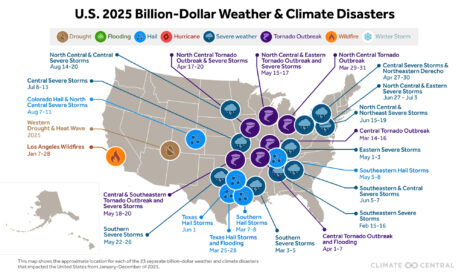
Hurricanes have produced over 50 percent of all billion-dollar disasters since 1980 ($1.5 trillion) and account for the top nine costliest weather disasters. The costliest weather disaster was Hurricane Katrina, which caused over $200 billion in damage, mostly to New Orleans. Severe storms (thunderstorms) are the most common cause of billion-dollar disasters, accounting for half of these occurrences. Annually, the warmer seasons see the most weather disasters. Severe storms and river flooding occur most often in late spring. Summer and early fall see a rise in wildfire and tropical cyclone occurrences. Each of the 50 states has had at least one weather disaster costing over a billion dollars. The greatest risk is in the central, southern, and southeastern U.S. Since 1980, Texas has had the most events – 190 – and Florida has endured the greatest losses with 94 percent of tropical cyclone events. In Hawai’i, Hurricane Iniki, which devastated the island of Kauai in 1992, and the horrific 2023 wildfire that destroyed the town of Lahaina on Maui, resulting in 100 deaths, each cost over a billion dollars. As of 2025, Alaska’s eight events were all wildfires.
The Deadliest Damage
Hurricanes account for the greatest loss of life, with over 7,000 fatalities recorded since 1980. The deadliest weather disaster in U.S. history was a hurricane that hit Galveston, Texas, in 1900. Though the exact number of people killed by that storm can only be estimated, it may have exceeded 10,000. In more recent years, Hurricane Maria in 2017 killed nearly 3,000 people in Puerto Rico and the U.S. Virgin Islands. Floods cause around 100 deaths per year; the central Texas flood in July 2025 was responsible for over 100 fatalities alone. Interestingly, many believe that extreme cold and extreme heat cause the greatest weather-related loss of life in the U.S., though actual numbers are nearly impossible to ascertain since it can be difficult to determine how temperature stress affects a person. Estimates range in the thousands for cold and even more for heat. Individual heat waves are the worst.
Canada hasn’t been spared from weather-related disasters, and insured losses surpassed $8 billion for the first time in 2024. The Calgary hailstorm in August 2024 caused $3 billion in damage in less than an hour, impacting an estimated 1 in 5 houses. The costliest event ever in Canada was the 2016 Fort McMurray wildfire, destroying nearly 2,600 homes and resulting in $4.5 billion of damage.
Dr. Ed Brotak has a doctorate in biometeorology from the Yale School of the Environment. As a college professor for 30-plus years, he taught students about the weather, animals, and plants. He lives in Asheville, North Carolina, with his wife, who is also a meteorologist.
Originally published in the September/October 2026 issue of Grit magazine and regularly vetted for accuracy.