What is CEC in soil? Learn how you can improve your soil’s cation exchange capacity to grow healthier, more nutrient-dense crops.
 This article is also in audio form for your listening enjoyment. Scroll down just a bit to find the recording.
All of us who grow something in the soil — gardeners, homesteaders, and farmers — should be familiar with cation exchange capacity (CEC). It affects plant growth and vigor, the nutrient density of crops, and even disease resistance. Let’s take a peek behind the curtain.
What Is a Cation, and Why Would We Want to Exchange It?
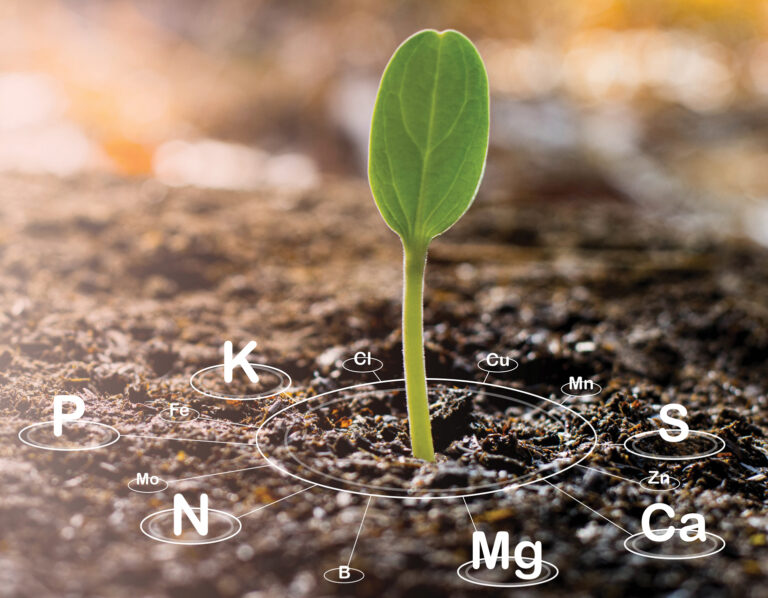
We know our plants need nutrients to grow, flower, and fruit. Some of these nutrients are called “macronutrients” because plants need them in higher quantities. Nitrogen (N), phosphorus (P), potassium (K), calcium (Ca), magnesium (Mg), and sulfur (S) are commonly classed as macronutrients. Plants also need other nutrients in lesser amounts for proper growth and function. We call those nutrients “micronutrients,” and examples include zinc, iron, boron, manganese, and copper. You’re on the right track if these remind you of the periodic table.
Air and water are the ingredients for photosynthesis, but plants’ complex proteins, enzymes, and carbohydrates require a soup of macro and micronutrients. Those nutrients, many of which are present as ions, come from the soil.
An ion is simply an atom or molecule with a net electrostatic charge. Remember the plus and minus signs you hated in high school chemistry or biology? Ions with a net positive charge — a plus sign — are cations. Remember this by thinking of a housecat: They have quite a positive opinion of themselves. K+ is a positively charged potassium ion — a cation. There are also negatively charged ions, like nitrate (NO3-), called anions.
Just like in magnetic fields, electrostatic charges are attracted to their opposite. A cation with a positive charge will be attracted to and stick somewhere it finds a negative charge. When a cation attaches to a soil particle, it’s adsorbed.
Soil clay particles and soil organic matter, especially the humus component (because of its chemical composition), are covered in sites with negative charges. When a lonely cation wanders by, it’s Valentine’s Day. Our potassium ion (K+) moves around in the soil solution and sees a clay particle with a negative charge. Pow! The cation is adsorbed and is stuck to the soil particle. In this example, the potassium ion is now “safe” from leaching and loss from the soil root zone — it won’t be carried away by water moving through the soil profile. That’s a good thing.
An adsorbed cation is safe from leaching but isn’t as available for direct root uptake, since it’s in the soil solution. Fortunately, adsorbed cations are easily exchanged with other cations in the root zone.
The number of charged sites available for cations to play musical chairs is the capacity part of CEC in your soil. It varies with three factors: soil texture (sand, silt, clay), soil organic matter percentage, and soil pH. CEC is measured in a soil lab and described in complex units called milliequivalents per 100 grams of soil (mEq/100g). For our purposes, you can ignore the units (don’t tell your science teacher) and say that soil with a CEC of 6 has fewer sites and, therefore, less exchange capacity than soil with a value of 15. Higher values indicate the capacity to store more nutrients, holding them for later use by plants and preventing them from leaching away.
Audio Article: Cation Exchange Capacity in the Garden
Factors Affecting CEC: What is CEC in Soil?
Your soil’s texture will greatly impact its CEC. Soil organic matter levels and soil pH also play a prominent role. A soil test can be helpful to determine the original state of your soil.
Soil Texture and Organic Matter
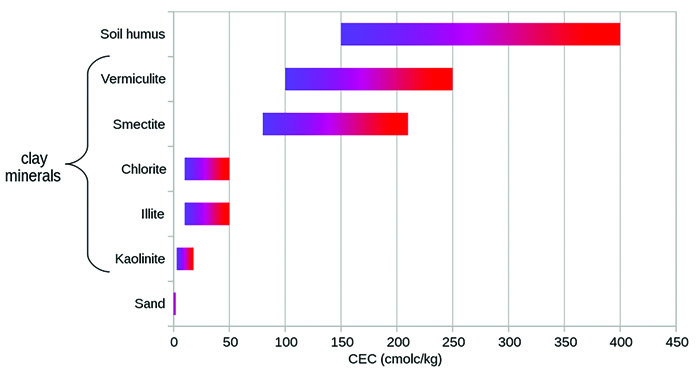
Sandy soils are made of large, coarse particles that are mostly inert. Sand particles themselves, unlike clay, have no electrostatic charge. As a result, they have very few of those particular sites where a cation can attach. Clay and humus particles tend to have a net negative charge and many sites for cations to attach. Additionally, sandy soils have a much lower soil particle surface area in a given volume than clay soil does.
Large particles, lower surface area, and fewer charged sites mean that sandy soils have a low CEC. Clay soils have more particles, more exchange sites per unit area, and a much higher surface area. Therefore, clay soils have a higher CEC. Loamy soils are in the middle. You’ve probably been introduced to this concept by the knowledge that sandy soils are less fertile — holding fewer nutrients — than clay soils.
Visualize a clay soil sample as a 5-gallon bucket of marbles and a sandy soil sample as a 5-gallon bucket of basketballs. Two basketballs is all that will fit. Although the marbles are smaller than the basketballs, the combined surface area of our bucket of marbles is more than 10 times higher. Now, imagine each marble has 10 charged sites available for cations. Sand has few, if any, exchange sites, so only every other basketball has a site.
Humus has an even higher number of charged sites than clay. Depending on the type of clay, humus can have as many as 5 to 30 times more sites. Humus can
truly supercharge your CEC numbers. It’s like throwing a couple handfuls of marbles in the bucket, each with 200 or 300 sites apiece.
Soil pH
The CEC for a given soil will rise as the pH rises, as long as it isn’t pure sand. Basically, the number of negatively charged sites on humus particles and some clay particles grows as the pH moves from acidic to alkaline. Because of this, most soil tests will reference CEC at a pH of 7.0 so different soils can be compared.
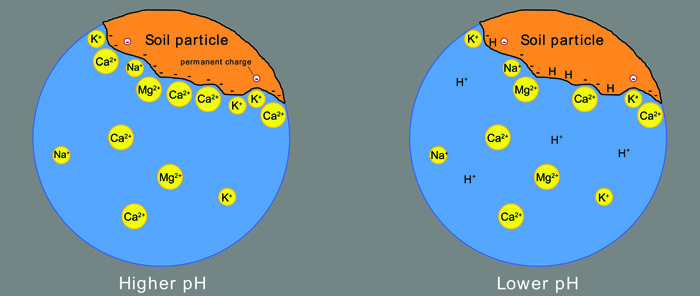
Soil pH is important for CEC and plant growth. You’ve likely heard that rhododendrons and blueberries love acidic soil and that most common vegetable crops grow best in a pH of 6.0 to 7.0. These preferred pH ranges have to do with plant nutrient availability and uptake, driven in part by CEC and solubility of nutrients.
Improving Soil: What Is a Good CEC in Soil?
Now that we know what CEC is and why it’s important, let’s talk about how we can improve our soil’s CEC. There are two practical ways do it this: raising the pH (if the soil is acidic), and adding more soil organic matter (SOM). Even raised beds can benefit from these methods.
Raising Soil pH
Liming is a time-tested technique farmers use to raise the pH of their fields. Gardeners can do it too. Many factors can contribute to the acidification of your soil over time. Bringing the soil pH back into that sweet spot of 6.0 to 7.0 can help nutrient availability by easing the movement of minerals in the soil. CEC is enhanced (more nutrients can be stored), and a slightly acidic to neutral pH is also the range many beneficial soil microbes like the best. Those microbes are most active breaking down soil organic matter, releasing nutrients, fixing nitrogen, and feeding plants when the soil is closer to neutral.
Don’t go hog wild with the lime. Soil pH can take up to a year to respond fully to treatment. Several small treatments with soil testing in between are better than one large dumping. A good soil test report will help determine your current pH, the buffering capacity of the soil (how much it will resist change), and how much amendment might be needed to bring change. Some specialty crops, like blueberries, thrive in acidic soils, and raising the pH isn’t advised for them.
Adding Soil Organic Matter
Increasing the percentage of SOM in your beds, gardens, or fields is the key to higher yields, lower disease, increased drought resistance, and even better flavor from your produce. Higher levels of SOM supply nutrients when broken down — nitrogen being a primary benefit — significantly increasing your CEC. Remember the marbles, and how a clay marble might have 10 exchange sites, but a humus marble can have 200 or 300 exchange sites? Here are a few ways to add some of those high-function marbles to your bucket.
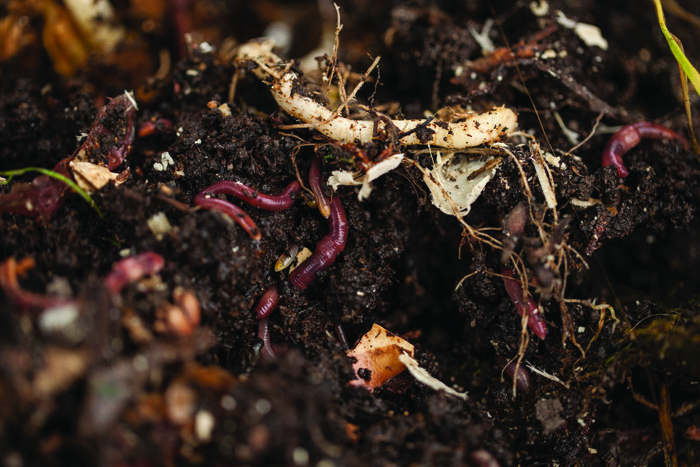
- Reduce Tillage: One of the easiest ways to increase SOM and benefit your soil microbial life is to park that rototiller or plow. You may think tillage is incorporating organic matter and loosening the soil, but it destroys soil aggregates, reduces drainage and aeration, kills soil microbial life, and reduces SOM. (It decomposes too quickly and is lost.)
- Manure: I’m always jealous when I see a large pile of old, rotting manure at a farm. There are considerations to be aware of when adding manure, such as allowing different types enough time to rot, the addition of weed seeds, etc., but you’ll be hard-pressed to find an easier way to bring up SOM and overall fertility than properly adding a bit of manure. If you don’t have a manure maker of your own, offer to shovel for a friend.
- Compost: Adding finished compost is the quickest way to see results in an otherwise mediocre garden plot. Work it into the top couple inches of soil to avoid disturbing our soil microbe friends too much. The humus in compost will raise your CEC, and compost will improve soil structure, fertility, porosity, and even drainage. You’ll also jump-start your soil microbial population. Natural mulch will suppress weeds and eventually become SOM as well.
- Cover Crops: Once you’ve added compost and maybe some manure to your soil, stopped tilling the heck out of it, kept it covered with mulch, and checked the pH, it’s time to dig in. Cover crops are a topic all their own, but their benefit, as far as CEC is concerned, is that they raise SOM levels. They can be used in regular gardens, raised beds, market garden plots, and full-scale fields. Specifics on which cover crops are suitable will depend on your crop rotation, climate, soil type, goals for the cover crop, severity of winters, and method of cover crop killing.
Understanding CEC and how to maintain or improve it is valuable knowledge. You’re empowered to improve your soil and grow more vigorous, healthy, happy crops. Growing your soil’s CEC involves holistic practices that benefit cation exchange as well as the soil microbial life hard at work behind the scenes. The effects are compounded, and you’ll enjoy the rewards.
Andy Wilcox is a freelance writer and flower farmer passionate about gardening, horticulture, and forestry, and who believes healthy soil leads to healthy people. He can be reached at Andy@ThatGardenWriterGuy.com.
Originally published as “Cation Exchange Capacity In the Garden” in the July/August 2023 issue of Grit magazine and regularly vetted for accuracy.