Where do bats live, and how many types of bats are there? Get all your batty questions answered by learning about bat habitat, bat predators, and the benefits of bats around your property.
I have a claw-foot bathtub on my covered deck that’s great for relaxing after a long day. During heavy rainfall, one or two bats fly under the deck awning for cover, swooping back and forth above me. This isn’t always the calming bath I’d imagined. Bats can feel disconcerting to me, much like many people’s reaction to spiders or snakes. I decided to learn more about them to understand their presence on my property better.
Bats Facts
According to Bat Conservation International, more than 1,500 species of bats exist throughout the world. The only places they don’t inhabit are extremely cold and extremely hot places – polar and desert areas. Forty-seven species are found in the U.S. and Canada. They live in all 50 states, with the highest number and variety in Texas. Whether you’re urban or rural, you probably have bats living near you – which is a good thing.
How Fast are Bats?
Bats are the second-largest order of mammals and the only mammals able to fly under their own power, reaching speeds up to 100 miles per hour.
How Long Do Bats Live?
Some species live only a few years, while others live about 40 years, which is amazing given their size. The little brown bat (Myotis lucifugus), common throughout much of the U.S., including Alaska, can live for 30 years. (This, or a cousin, is most likely the one interrupting my evening bath.) To learn which species live in your state, go to Bat Conservation International.
How Big are Bats?
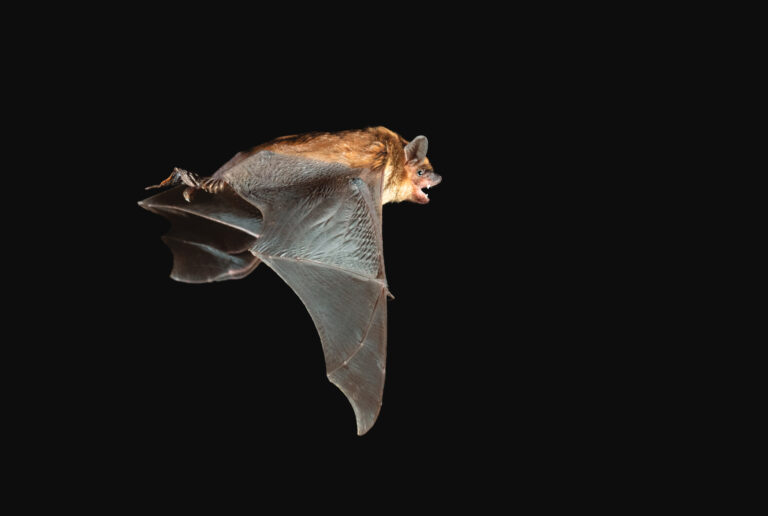
Bats are fur-bearing and range in color from tan to brown to reddish to gray. And, no, they aren’t just rats with wings. These flying creatures vary in size from a little over an inch long to having a 6-foot wingspan (I’m glad the ones swooping above me during my bath aren’t that big!). According to the National Wildlife Federation, the bone structure of the wings is similar to that of human hands, with bare webbing between the bones forming a wing.
Where Do Bats Live?
Most bats are social animals that live in colonies, although some live alone. This helps them share warmth and provides safety in numbers. During the day, these nocturnal mammals live in a wide variety of places, including trees, caves, barns, attics, under bridges, and in other structures.
Mating habits of bats vary widely; some species are monogamous, some species are promiscuous, and others live in social groups with one male and multiple females. Their gestation period is 6 to 9 weeks, but they often mate in fall and either store sperm for spring fertilization or delay gestation until conditions are better. Females give birth in early summer – normally to just one pup a year – while hanging upside down. By giving birth in early summer, they’re guaranteed a good supply of insect prey to nourish them for the 4 to 6 weeks that the pups normally nurse.
Some hibernate (from fall to spring), with their body temperature, heart rate, and respiratory rate decreasing. Their body temperature can drop significantly, leading to a condition called torpor. Torpor can last from an hour to a day. It allows the bat to conserve energy.

Like birds, other bats migrate in search of food and to get out of the cold in fall and return in spring. They migrate under the cover of darkness, covering up to 100 miles in a 24-hour period.
How Does Echolocation Work for Bats?
All bats in the United States have a superpower called echolocation – something found in about 1,000 vertebrates, such as dolphins, orcas, and shrews to name a few. This helps explain why bats tend to have larger ears. They use a range of sounds that bounce off objects and back to them, which allows them to determine what they’re hearing and how far away it is. Bats use echolocation to find insects for food and to know where they’re going in the dark. The frequency of the sound is above what humans can hear (ultrasound), but scientists have been able to record their calls and translate them to a frequency that’s audible to us.
This power of bats was first noted in 1793 by the Italian scientist Lazzaro Spallanzani, but it was disputed by others for many years, with research on the subject resuming in 1938.
The signals bats send can vary, depending on their purpose. For instance, when hunting for insects, once they’ve located one, they send out high-speed signals over a range of frequencies to pinpoint its exact location. This is called a “feeding buzz.”
The call pattern of each bat species is unique. Besides hunting, other calls are for object location and social purposes. For example, one 2012 study found that males produce aggressive vocalizations when hearing male echolocation calls and courtship vocalizations when hearing female echolocation calls.
We can expect to learn even more about how bats use this unique tool through ongoing research.
Bat Predators
Ten U.S. species of bats are listed as endangered, with one more listed as threatened by the U.S. Fish & Wildlife Service. Although they’re predators, they’re also prey. They’re food for owls, hawks, snakes, and even cats.
Owls, which are also nocturnal, can hear bat calls, which makes them easier to catch when they swoop through the air at night. Hawks and falcons also like to eat bats. Rather than catching them midair, as the owl does, they fly above and then swoop down to grab them.
Snakes also eat bats, which they can sense through vibrations of their wings, or when the bats are hanging from a tree.
Cats, including house cats, can find bats in their hiding places during the day and have a nice meal.
Finally, unexpected predators of bats include spiders and centipedes. Large spiders catch bats in their webs, just like other prey, while centipedes cohabiting in caves can kill them instantly with a poisonous bite.
In the past 20 years, some bats have been faced with a new risk: white-nose syndrome, which has killed and endangered a huge percentage of their population (see below).
Bats are also at risk from humans. The use of bats for food and medicine goes back many years and occurs predominantly in Africa and Asia. One study reported that bats are used for bushmeat in 71 countries and territories, and for medicine in 37 countries for over 40 different conditions.
In addition to being at risk of being killed for food or medicine, bats are also endangered by encroachment on their habitat; by climate change; and as a result of human fear, often irrational, which posits them as dangerous and leads to unnecessary culling of colonies.
Why Are People Afraid of Bats?
Bat phobia, called “chiroptophobia,” extends beyond the discomfort I feel when bats swoop overhead during an outdoor bath or when one flies into an open window. Chiroptophobia is an extreme, irrational fear. For those with this phobia, even thinking about bats can trigger a shiver or a panic attack.
A 2018 U.K. study found that 20 percent of respondents had an aversion to bats. This fear can be caused by different things. It’s been posited that because bats are nocturnal and fly quickly and seemingly erratically, humans’ primal, or inherent, fear is implicated. A traumatic experience of a bat flying into a child at night may be enough to instill a phobia. Fear of being bitten or getting a disease is another factor, which is closely related to a view of them as “blood-sucking” or vampires – a belief promoted by folklore and horror films.
COVID-19. A study in China conducted after the COVID-19 pandemic sought to understand people’s attitudes toward bats. The researchers found that four times as many people feared or disliked bats as those who were curious about or liked them. They also found that a majority were uneducated about bats, with 20 percent even believing that bats would purposely attack people. More women than men had negative attitudes. The study found that some negative attitudes were in part due to reporting that bats carried a virus genetically similar to COVID-19, which led to a false belief that they were the cause of the pandemic.
According to the researchers, no published papers have found that bats caused COVID-19. In fact, the closest-related coronavirus carried by bats “lacks five of the six critical amino acid residues at the receptor-binding domain for invading human cells.”
Rabies. Rabies is a virus that affects the nervous system of many mammals, including humans. It’s considered the greatest public health problem caused by bats, because of its high fatality rate. This fear isn’t irrational, but the belief that we’re all at high risk is. (See “Distemper vs Rabies” for more.)

Rabies was first discovered in U.S. bats in Florida in 1953. Since then, it’s been documented throughout the U.S., and bats are the main source of rabies infection in humans (since rabies vaccine campaigns for dogs eradicated it in them). Nearly all bat species in the U.S. can carry it, with only about 5 percent infected. According to the Centers for Disease Control and Prevention (CDC), “among the 42 U.S.-acquired human rabies cases reported during 2000-2024, bat contact was the cause in 35 (83 percent).”
The disease is mostly spread through animal bites, but in rare cases, it can be transmitted through saliva to the mucus membranes or wounds. The disease is fatal if untreated before the onset of symptoms.
In 2024, two rabies-caused human deaths were identified in the U.S. – one in Minnesota and one in California. Both women had exposure to a bat, but neither reported it nor received treatment. In one case, the woman killed the bat with a hammer and then disposed of it. She wasn’t bitten. In the other, the woman picked up with her bare hand a bat she thought was dead and disposed of it. She felt it move, and possibly bite, but found no mark. In neither case was the bat tested.
The CDC recommends that anyone with possible bat exposure report it immediately to a healthcare provider or public health official for risk assessment and, if needed, treatment.
Other diseases carried by bats. Bat guano is often infected with a microscopic fungus called histoplasmosis. It’s also found in the droppings of birds. The disease is airborne and spreads to humans when they inhale spores. It causes fever, body aches, fatigue, and a dry cough. While most people will experience only mild symptoms and recover, others – especially those with weakened immune systems – can develop pneumonia and need treatment with an antifungal. In some cases, it can be fatal.
To avoid infection when cleaning up bat guano, wear an N95 mask to prevent inhaling spores.
Bats can carry a few other diseases that are much less common and aren’t considered a risk to people.
Parasites. The risk of contracting parasites from bats is similar to that of many other mammals. In many cases, different species carry different parasites. In addition, it’s rare for bats and humans to have close physical contact. The mites, ticks, and fleas that we do share are more likely to come from other animals, such as dogs, that we spend a lot of time with.
Scary movies. Movies have presented bats as frightening for over 100 years. The French movie Le Manoir du Diable, made in 1896 and often considered the first-ever horror film, begins with a bat flapping its wings in a castle.
Since then, movies featuring bats have come out from time to time. Most play on fears of bats that attack people, drink blood, and cause terror and havoc. Although vampire bats do exist, only three of the 1,500 species drink blood, and none actually lives in the United States. Vampire bats normally feed on livestock and wild animals, and they certainly don’t lie in wait to assault people.
Culling bats. Ill-conceived proposals have been made to cull bats to prevent disease, an effort that would have profound impacts on agriculture and would be ineffective. Various studies have shown that successful culling would most likely lead to greater spread of bat-borne diseases, ultimately resulting in more human infections.
When vampire bats in Latin America were culled to prevent rabies spread to people, it increased transmission rather than reduced it. A similar outcome occurred when Egyptian fruit bats were culled to prevent the spread of Marburg virus; it doubled the amount found in surviving bat colonies. The ultimate outcome of culling can be an increased risk of disease in humans, because a higher percentage of bats would carry the disease.

Benefits of Bats at Work
The benefits of bats outweigh any disadvantages. They help control pest populations, ensure that plants are pollinated and their seeds dispersed, provide a source of fertilizer, and aid in medical research.
- Insect control. Most of the bats in the U.S. eat insects, such as moths, crickets, mosquitoes, and flies. They can eat from 50 to 100 percent of their weight in insects each night. Sharing space with them is worth it, in my opinion, just for the mosquito control. Beyond that, they help protect crops from pests and decrease the need for pesticides.
- Pollination. Insects and birds aren’t the only animals that pollinate plants. Some bats eat fruits, and, like bees, they drink plant nectar and eat pollen. In their search for pollen and nectar, they help pollinate plants, especially those that bloom at night and have fruity or musty scents. Some plants have evolved to attract bats, helping ensure the plants’ reproduction.
We have bats to thank for aiding in some of the world’s food production. For tropical fruit lovers, bats are essential for the reproduction of mango, banana, guava, and avocado plants. They also pollinate cacti, such as saguaro, organ pipe, and agave. Nectar from the agave cactus is used to make tequila and agave syrup. According to Maryland’s Agronomy News, bat pollination not only fertilizes certain plants but also positively impacts crop yield and fruit quality. - Seed dispersal. Some bats also play a unique role in seed dispersal. They eat fruit, digest it, and then excrete the seeds along with built-in fertilizer (guano), aiding in the widespread dispersal of new plants that would not otherwise grow in various areas.
- Guano. Bat guano (excrement) is harvested from caves for use as fertilizer. It’s high in phosphorus, nitrogen, and potassium, so it nourishes plants and improves soil. It has the advantage of not being “hot” like other manures, such as manure from chickens, pigs, and horses.
Guano was harvested from caves in Texas for use during the Civil War. Saltpeter (potassium nitrate) was extracted from the guano and mixed with sulfur and charcoal from burnt cedar trees to make gunpowder. The Confederacy relied on this method to make gunpowder when the Union blockade kept them from obtaining supplies. According to the Texas State Historical Association, “100 pounds of guano were needed to produce four pounds of saltpeter – requiring the shoveling of 2,500 pounds of bat guano a day to fill the quota of 100 pounds of saltpeter crystals.”
You can see a granite marker that still stands by the remains of a guano kiln in Landa Park, Texas.
Bat guano is also an essential part of cave ecosystems, providing food for crickets, mites, and beetles. These invertebrates are then food sources for frogs, spiders, centipedes, and some fish. - Medical research. While bats themselves have been used as medicine in other countries, in the U.S., they’re useful in medical research. Current research projects using bats include the development of a drug from vampire bat saliva, which helps break up blood clots in the brain for patients with stroke; the study of their immune systems to learn more about potential anti-inflammatory drugs; the investigation into their resistance to diseases, such as some viruses and even cancer; and the development of new vaccines.
Living in Harmony
Bats are under assault today, not only from purposeful culling because of fear or misunderstanding, but also because their habitats are continually being destroyed, they’re killed by wind turbines at a higher rate than even birds, and climate change continues to make life more inhospitable to them. In some countries, food and medicine harvests also contribute to their demise.
The solution to this problem is education – to learn about and safely live with them, to reverse the destruction of their habitat, and to stop unnecessarily killing them. Without taking steps now, we risk driving some species to extinction.
If you’d like to help endangered bats, in addition to educating people about their benefits, you can plant a bat garden or install a bat house on your property. The National Wildlife Federation provides tips on how to build a bat house and how to create a bat-friendly garden.
White-Nose Syndrome (WNS)
White-nose syndrome is a devastating disease caused by the fungus Pseudogymnoascus destructans. While it’s been known in Europe for a long time, it showed up in the U.S. only in the 2000s and has since been found in 44 states.

The fungus has had the greatest impact on just four species of bats – the little brown bat (Myotis lucifugus), the northern long-eared bat (M. septentrionalis), the Indiana bat (M. sodalis), and the tricolored bat (Perimyotis subflavus). Bats that have WNS develop a white nose from the fungus on the muzzle and wings, and, because of the irritation it causes, they leave their hibernation prematurely, ultimately dying from starvation or hypothermia because of lack of prey and loss of fat stores.
WNS spreads easily from bat to bat, from cave walls, and from humans tracking it into areas where bats hibernate. It doesn’t infect humans. Since the disease was first reported, it’s killed millions of bats in North America, with 90 percent of colonies destroyed by 2018 – and up to 99 percent in some areas.
Fortunately, scientists have had some success with recent treatments, such as applying probiotic bacteria to bats’ skin to counteract the fungus, adminanstering experimental vaccine, and sanitizing caves where they hibernate with UV light. In addition, some bats are developing natural resistance – much like the bats in Europe – and their numbers have slightly rebounded.
Cheryl K. Smith is a writer and editor in Low Pass, Oregon. She’s the author of Goat Health Care, Raising Goats for Dummies, and Goat Midwifery. She currently writes freelance magazine articles on a variety of subjects.
Originally published in the July/August 2026 issue of Grit magazine and regularly vetted for accuracy.
Frequently Asked Questions
Are bats mammals?
Yes, bats are warm-blooded, covered with fur, and are the second-largest order of mammals and the only mammals able to fly under their own power.
Do bats have fur?
Bats are fur-bearing and range in color from tan to brown to reddish to gray.
How many species of bats are there?
More than 1,500 species of bats exist throughout the world. The only places they don’t inhabit are extremely cold and extremely hot places — polar and desert areas. Forty-seven species are found in the U.S. and Canada. They live in all 50 states, with the highest number and variety in Texas.