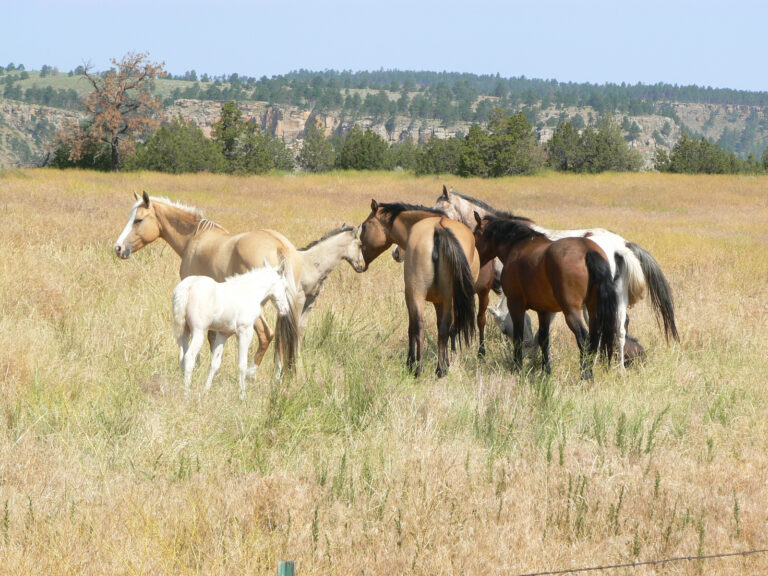
Learn about wild American horses, their history, where they came from, and what you can do to protect them.
Perhaps no other wild animal in the United States encapsulates the spirit of the American West like the horse. The wild horses of the United States, sometimes called “feral,” ignite heated debates – some people vilify them, others cherish them deeply. They’re revered as sacred by many Native nations and seen as adversaries by ranchers. Our wild horses are woven into the very fabric of our history. They’re vivid, living symbols of our resilient American spirit, embodying freedom and untamed beauty.
Wild American Horses
My fascination with wild horses began unexpectedly 30 years ago while on assignment in North Dakota – a job that had nothing to do with horses at all. One quiet afternoon, with a rare pause in my responsibilities, I ventured to Theodore Roosevelt National Park. That visit changed me forever; something profound awakened inside me among those rolling hills and open skies.
This was my first time visiting the western part of the United States (unless you count my time in the military). It was my first experience with pronghorns, bison, and, above all, wild horses. Being the novice that I was, when I saw my first wild horses, I immediately made my way to the nearest ranger station to report it. I thought someone’s domestic horses had gotten loose, and I “needed” to report it. I explained to the ranger what I’d seen and where I’d seen it. Despite my good Samaritan act, the ranger assured me that those weren’t domestic horses; they were part of a much larger herd of wild horses that reside in the park.
Back home in New Hampshire, I researched the park’s wild horses – specifically Nokota horses, believed by some to have appeared in North Dakota’s Badlands in the 1800s. They were nearly wiped out by ranchers seeking to graze cattle on Native lands. Fortunately, a few bands survived in the park. Since then, I’ve traveled to Nevada, Wyoming, and South Dakota to further study different herds of wild horses.
Though I’ve always been interested in horses, wild horses weren’t on my radar since my ancestors weren’t horse people. My trip to North Dakota marked the beginning of my research, and what I found was just how closely Indigenous peoples, such as the Lakota, Comanche, Blackfeet, Crow, Pawnee, and others, were connected to the horse, both historically and spiritually.
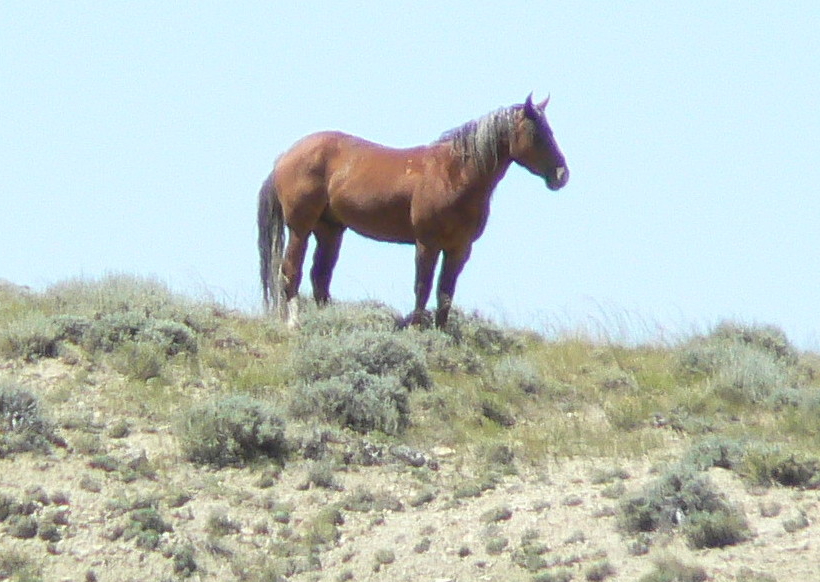
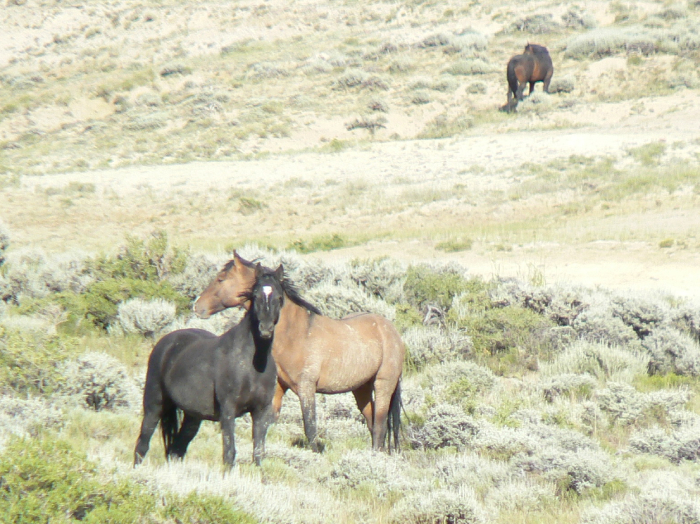
My next trip was to the Red Desert of Wyoming, near the town of Lander. This was the traditional home of the Shoshone people. It was also historically significant to Euro-American westward expansion, with the remains of the Oregon Trail still visible in the high desert soil. I was here in this high desert country hoping to see the reported herd of wild horses. It took about six hours of searching, but I found them – or perhaps they found me.
As I paused to catch my breath, a sudden flurry of elk swept past me – so close I felt the rush of their wild energy. Within minutes, the horses emerged, as if called forth. Silent, watchful scouts appeared on distant hills. Then, with a grace that took my breath away, mares and foals followed, and finally the stallions, their presence commanding yet gentle. Watching them, the herd unbothered as long as I remained in my vehicle, I was awestruck – a moment that still stirs my heart every time I recall it.
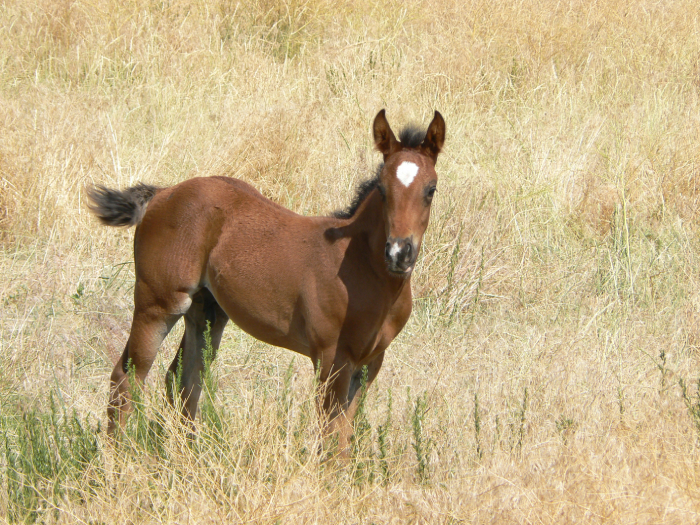
A few years later, I headed to the Black Hills region of South Dakota. I contacted the Pine Ridge Indian Reservation and asked permission to enter the Black Hills, sacred ground to the Lakota people. I was given permission and their blessing on my quest. Just south of the reservation in the town of Hot Springs, I visited the Black Hills Wild Horse Sanctuary, a place dedicated to protecting the mustangs that are the genetic descendants of early Spanish horses.
I was familiar with the term “mustang,” but I learned that it specifically refers to wild horses that are most closely related to the original Spanish horses brought to North America. While all mustangs are wild horses, not all wild horses are mustangs. Unique traits set mustangs apart, and once you see them, you’ll easily recognize them.
The more I dug into the subject of wild horses, the more I found, and the more I became involved with these animals and Indigenous peoples’ connection to them. Seeing horses in the wild stirs a range of emotions. On many levels, we can see “us” in “them.” These animals can be caring, protective, and loyal. Being with wild horses is a humbling and positive experience.
Herding Bureaucracy
Despite all the positives, wild horses are slaughtered on the open range every year or rounded up and sold at auction, with many sent for slaughter in Mexico and Canada. This is despite laws forbidding such actions, such as the Act of December 15, 1971, commonly known as the Wild Free-Roaming Horses and Burros Act of 1971. Government agencies, such as the Bureau of Land Management (BLM), the National Park Service (NPS), and the Bureau of Indian Affairs (BIA), to name a few, give the reasoning for such actions as “the carrying capacity of the land” and often refer to a particular regulation from the BLM: CFR Part 4700, titled “Protection, Management, and Control of Wild Free-Roaming Horses and Burros.” What they don’t tell us is that the carrying capacity of the land would be fine if it weren’t also being used to graze privately owned herds of cattle.
I read this BLM regulation, and while it sounds logical, I found loopholes upon a second read. As with all government documents, it’s all in the wording. One term keeps popping up: “authorizing officer.” The BLM defines this as “any employee of the Bureau of Land Management to whom has been delegated the authority to perform the duties described herein.” A vague description at the very least. Basically, it says that rule enforcement is up to one person whose qualifications are unknown.
What we do know is that there are laws in place protecting wild horses and burros living on public lands. We also know, per the BLM, that it’s up to the “authorizing officer” whether to enforce those laws. “Herd Management Areas” (4710.3-1) reads, “Herd management areas shall be established for the maintenance of wild horses and burro herds.” It goes on to say, “the authorizing officer shall consider the appropriate management level of the herd.” And according to “Closure to Livestock Grazing” (4710.5) and “Removal of Unauthorized Livestock in or Near Areas Occupied by Wild Horses or Burros” (4710.6), the authorizing officer is the one who determines whether livestock can be grazed on public lands.
This issue came rushing home in 2022, when officials at Theodore Roosevelt National Park – the place where my own journey with wild horses began – announced a devastating plan: to cull or even eradicate the park’s herds. Even as they admitted that the horses caused no harm, their justification felt cold and clinical. The horses were labeled livestock, not native, and deemed unworthy of protection.
Yet, my research – and the voices of local rangers – leads me to believe that these are the Nokota horses, integral to the Badlands for generations, wild and free. If we dare to question who belongs, shouldn’t we first look to the millions of domestic cattle roaming the same lands? It’s heartbreaking to think that these magnificent, living testaments to our past could simply be erased.
I have nothing but respect for the rangers and biologists of the NPS, but not for the appointed “suits” in charge. While the NPS isn’t the BLM, it’s just another government agency where the people at the top have no clue, and were appointed by other people who have no clue. Their way to work around rules and regulations is to turn words around. For example, changing the word “wild” to “free-roaming.” To the average person, this might not be a big thing, but in the world of litigation and the courts, words and their meaning make a big difference.
Before the plan was implemented, the NPS sought public input. It received 20,000 responses, and over 90 percent favored saving the wild horses. The general public didn’t consider the wild horses as livestock, but a part of the environment, culture, and history. As of this writing, the horses still roam the park.
Tracks in Time
Until recently colonial history claimed there were no horses in the Americas until Europeans brought them over in the 1400s. The term “feral” is thrown around a great deal because of this teaching. In fact, North America is the birthplace of the earliest ancestor to the modern horse, and they thrived here long into the last ice age. So “feral” is the wrong word to use. Even the word “reintroduced” suggests that the “American” horses disappeared entirely prior to European colonization. Did they really?
Paleontologists have recorded that the earliest ancestor of the modern horse evolved between 50 and 55 million years ago in North America. It’s called Eohippus or “Dawn horse.” Eohippus was a multi-toed herbivore about the size of a fox or small dog. As this was before the ice age, there was no genetic influence from other parts of the world, though this would change over time. This is the first bit of scientific evidence showing that the horse is truly a North American animal.
In his book Horses: A 4,000-year Genetic Journey Across the World, geneticist Ludovic Orlando worked to trace the genetics of modern horses and found that Eohippus evolved over millions of years into different branches of the Equidae family. One line became the precursor to modern horses, the caballine lineage, and another became zebras and donkeys, the stenonine lineage. Over time, the small animal with multiple toes on each foot grew larger, stood taller, developed legs made for running, and, most importantly, its multiple toes became hooves. Orlando goes on to say that as the environment changed, say from jungle to steppes and plains, the early equids adapted accordingly. Like with all creatures, those that can’t adapt soon die off, and so it was for some of the early horses. Starting about 4 million years ago, as the planet cooled and the first ice age began, America’s horses either moved to more favorable areas, adapted to their environments, or died off.
Almost 1 million years ago, ice encased much of the Northern Hemisphere. Sea levels dropped as more and more water formed into massive ice sheets. The land masses now covered with water were once exposed. On the East Coast, the continental shelf was dry land, and, most importantly for this research, the Bering Land Bridge was exposed. According to studies by geologists and paleontologists, this open land extended from the Lena River in Russia to the Mackenzie River in Canada.
This exposed land provided free access for animals, such as mammoths, bison, dire wolves, and horses, as well as people, to travel back and forth. It was at this time that horses began moving west into Eurasia, but not all did; some stayed right here in North America. Those that moved west eventually developed into the different breeds of horses we see today. It wasn’t only horses; the ancestors of modern-day donkeys and zebras moved west as well.
Tim Stephens spoke to numerous scientists and historians for the article “Ancient horse DNA reveals gene flow between Eurasian and North American horses,” which appeared in UC Santa Cruz News on May 18, 2021. Studies by Beth Shapiro, professor of ecology and evolutionary biology at UC Santa Cruz, indicate that horses moved from North America to Eurasia via the land bridge. The study also indicates, from DNA taken from archaeological horse remains discovered in the Yukon, Canada, that horses crossed back and forth numerous times and interbred.
The study shows that over thousands of years, as the horses moved west into Eurasia, they diversified genetically and laid the foundation for the modern horse. They also genetically changed from the horses still in North America. Despite these evolutionary changes, the evidence suggests that these different groups of horses were able to interbreed. This happened during two distinct periods: in the Middle Pleistocene and the Late Pleistocene. This evidence comes from DNA taken from archaeological remains recovered in North America and Eurasia.
The Native Connection
As an ethnohistorian with a Master of Education in heritage studies focusing on Native American history and culture, my work relies heavily on both physical evidence and oral traditions. I’ve learned that just because you can’t physically prove something doesn’t mean it isn’t true. So far, I’ve covered the scientific and historical evidence as seen through the Euro-American lens, but what about history through Indigenous eyes? What about the cultural and spiritual connections? Among Native peoples, history, culture, and spirituality are all one. These are the people who’ve been here much longer than the people who wrote the history we’re fed. The viewpoint of Native people differs greatly from that of later arrivals.
The Native story of the horse is an extensive oral history. This, and other Native oral stories, have been largely ignored by scientists and historians alike. You may wonder why. It’s simply because these stories either prove the existing narratives to be false or, at the very least, question what academics have believed and taught to be true.
According to oral histories of many Native nations, horses have always been part of their culture, and these traditions date back well before any contact with settlers. This is in stark contrast to our modern view of history, which has been based upon the often negative or incomplete observations of early European arrivals.
Native history conflicts with the accepted viewpoint that states horses weren’t in North America until Europeans arrived. That claim has now shifted slightly, but is still popular. Without a doubt, Europeans brought horses, but there’s much more to the story.
The scholars who make this claim also tell us that horses were present in North America as late as 5,000 to 6,000 years ago, only to die out. This amount of time is a small window, and, certainly, Native people were here as well. So it’s highly possible that the horse was part of Native culture long before the arrival of the first Europeans. Here’s another thing to think about: What if those horses never died out? What if some survived? How do we know that they didn’t? Just because the Europeans didn’t see them doesn’t mean that they didn’t exist.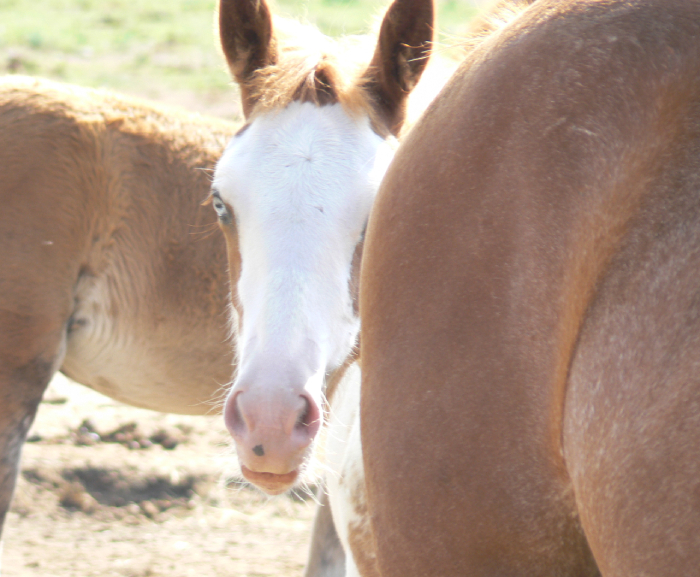
Some modern scholars, in a defense of the status quo, suggest that Native people got some of the Spanish horses, prior to actual physical contact with the Spanish, through long-established trade routes. They suggest that people such as the Comanche traveled the southern Great Plains, where they traded with people near the Spanish, then took the horses north. However, the oral histories of the Comanche and the Shoshone dispute that theory.
Inspired by the ethnography and social anthropology of Indigenous people, Yvette Running Horse Collin wrote her doctoral dissertation, “The Relationship Between the Indigenous Peoples of the Americas and the Horse: Deconstructing a Eurocentric Myth.” Within it, she drew on oral traditions from numerous Native nations. Running Horse Collin found in these oral histories that the horses brought to the Americas by the Spanish bred with the remaining bands of ancient American horses.
Sadly, many of today’s scholars give little credence to the oral histories of the Native people. Science, as it’s known today, is based on solid evidence. In other words, it isn’t evidence if you can’t touch it. In this case, we’re talking fossil remains, and no fossil remains have been found to support Running Horse Collin’s theory. Genetic markers in modern horses have become so diluted over time that modern scientists have “debunked” it. Well, I have a few theories of my own.
What if the American horse wasn’t actually gone, but instead in a period of decline, isolated in small bands at the time of European arrival? The Europeans weren’t everywhere, and it’s possible these horses went unseen by European eyes but were known to Native people. If this were the case, then fossil remains would be hard – if not impossible – to find if you didn’t know where to look. The Native people knew where to look; you just need to listen to the oral traditions.
Let’s ask the next question: How many American horse fossils have actually been found and simply ignored as just another old horse bone? Some farmers plowing up prairie grass in the 1800s aren’t going to care about some old bone, and at that time, science hadn’t advanced enough to tell the difference, even if the farmer did say something. Worse yet, even if the bone had been brought to someone’s attention and they realized something special had been found, it was never recorded. Things like that happened often. Keep in mind that the Eurocentric system long described the arrival of Europeans as “discovering” the Americas. The Native people and their culture didn’t matter, so what makes anyone think that they’d consider the animals found here any different?
What Can We Do?
The answer to this question starts with another question: How do you feel about wild horses? If you believe they’re just “feral” animals (like that stray cat visiting your house) and have no place on our public lands, then do nothing. Look the other way and let the government do what it’s doing. If, however, you feel that wild horses are important, are part of our culture and heritage, and deserve protection, then speak up. Make your voice heard. Write and call the NPS, BLM, BIA, National Forest Service, and your congressperson. There are laws in effect that protect wild horses and burros; make sure they’re enforced.
So there you have it. Is the “American” horse a relic from the distant past or is it still with us? Are the Nokota horse, the Choctaw pony, the Appaloosa, and others a living part of the “American” horse legacy? Are the oral traditions of our elders ever going to get the attention and respect they deserve? Are these traditions ever going to work with modern science to fully understand the true history not only of the wild horses but of the land we call home? I don’t have the answers to any of these questions.
What I do know is that the wild horses we have are special, almost magical, creatures. There’s something spiritual when you see a cloud of dust rising across the landscape and hear the thunderous sound of 1,000 hooves echoing off the canyon walls. These horses are part of our history and culture. It’s egregious to have them manipulated in some political move to benefit a rich few at the detriment of the American public as a whole. Just stare into the eyes of a stallion, and you’ll feel a kindred spirit whose eyes reach past your walls and into your soul.
Dana Benner has been writing about all aspects of the outdoors, the environment, sustainability, and Native American history and culture for over 35 years. His written work appears in Grit, Mother Earth News, Countryside & Small Stock Journal, Acreage Life, and others. He hosts and produces programs on HCTV in Hudson, New Hampshire.
Originally published in the July/August 2026 issue of Grit magazine and regularly vetted for accuracy.