If you had asked me in the early 1990s, I’d have told you I didn’t care for sheep. Fast-forward to 2023, and I’ve raised sheep for 30 years, served on a breed association’s board of directors for 15 years (and now work for the association), and count fellow breeders as some of my best friends. What happened? Shetland sheep came into my life!
Having cared for commercial flocks in the past, I thought of sheep as large, pushy, and maybe not too bright. But after inheriting the rocky, hilly family farm, my husband and I knew we needed to raise livestock to keep the farm active. While I grew up with high-maintenance dairy cows, sheep, while still plenty of work, seemed a more practical choice if we both wanted to keep our “real” jobs.
I chose the Shetland sheep breed, literally by the book. I learned from The Livestock Conservancy that dozens of livestock breeds are in danger of being forever lost because of their dwindling numbers worldwide. I knew about endangered wild animals but had never thought of endangered livestock. A whole new world opened up to me.
The Rise of Commercial Breeds
Threatened or endangered livestock breeds are sometimes referred to as “minor” or “heritage” breeds, to distinguish them from commercial breeds and allude to their often long histories on small farms. Heritage breeds are generalists, not specialists. In the 17th and 18th centuries, smallholders couldn’t afford to have several types of cows or sheep on their farms, each for different tasks. They needed multipurpose animals. For example, heritage Dexter cows don’t specialize in making milk, producing meat, or pulling loads – they do all three.
Another characteristic of heritage breeds is their ability to get along without a lot of coddling or specialized feed. Three hundred years ago, farmers didn’t have the resources to fuss over their families, much less worry about livestock. Likewise, grain was used to feed people, not animals.
As rural populations dwindled and urban centers grew, requiring produce and meat for sale, breeders opened to creating new breeds of livestock. Specialization and larger size were now key features for commercializing certain breeds. Chickens became layers or meat birds, not both. Cattle supplied dairy or beef, not both. Sheep also grew larger, providing bigger carcasses but less wool.
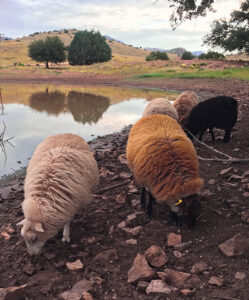
What’s more, farmers wanted consistency; they wanted to know what their livestock would look like. Breed standards were established. In the process of standardization, some livestock inadvertently lost defining characteristics. If a breed is persistently bred to grow to a larger size, then easy birthing or natural parasite resistance can disappear across generations.
Heritage sheep breeds have mostly retained their original traits of hardiness and self-sufficiency. They may be smaller than commercial breeds, but they tend to live longer. While heritage fleece breeds might produce less fiber annually, you’ll enjoy a greater yield across your animals’ lifetimes. All of this appealed to me as I started looking at livestock.
Shetlands’ Appeal
After researching the minor breeds listed, Shetlands quickly emerged as my top choice, offering many of the characteristics I was looking for: good mothering ability, ease of lambing, naturally short tails (no docking!), and, of course, that wonderful wool. They were also reported to be smart.
Shetland sheep are part of the Northern European short-tailed group, which also includes Finns, Icelandics, Gotlands, and Romanovs. The Shetland Islands, which give the sheep their name, are the northernmost island group in the British Isles. The region’s most outstanding climatic features may be the seemingly unceasing wind and more than 200 days per year with some precipitation. Average temperatures are milder than you might expect for such a northern latitude, ranging between 45 and 64 degrees Fahrenheit. On Shetland, the breed is kept on the “hill,” which means they’re out in all types of weather with little human intervention and thrive on marginal forage. Under these conditions, Shetland sheep are bred to be small, hardy, and long-lived, and to do well on a poor diet – traits of an adaptable breed that needs no coddling.
Shetland Sheep Characteristics
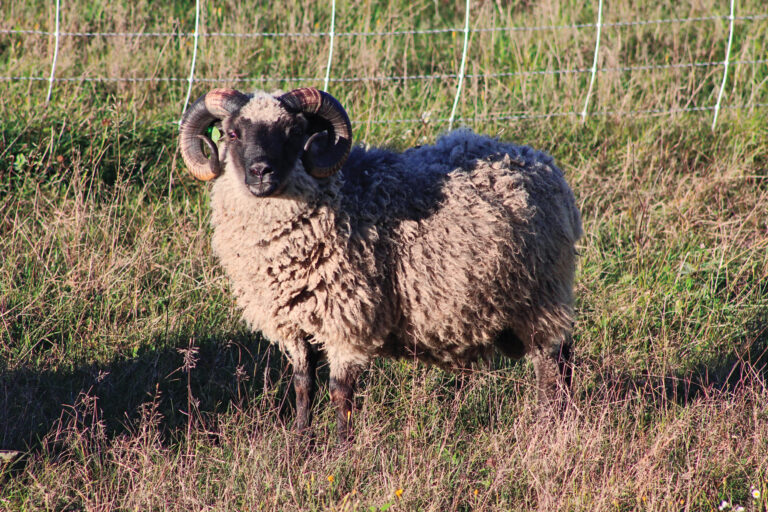
Physical traits. Shetlands are the smallest of the British sheep breeds, with rams weighing between 90 and 125 pounds and ewes between 75 and 100 pounds. Rams are known for their spiraled horns, while ewes are typically polled (although you can find polled rams and horned ewes). Shetlands have a dished face and good width between the ears, which are medium-sized and carried above the horizontal. Shetlands’ eyes are bright and expressive. Their fluke-shaped tails, rarely longer than 6 inches, are a distinctive Shetland trait.
- Breeding. Shetlands don’t typically breed out of season, though this characteristic is becoming less common. In northern parts of North America, breeding season starts in October and November, ensuring lambs will be born in spring rather than during winter. Twins are common, with lambs weighing between 4 and 7 pounds at birth.
- Instincts. Like many heritage breeds, they’ve retained their primitive survival instincts. When threatened, rather than flocking together, making an easy target for a predator, they scatter.
Shetland Sheep Wool
Historically, Shetland sheep were able to provide for all the wool needs the islanders required. Some Shetlands retain the ability to shed their fleece, a process called “rooing.” Fleece that will roo can be easily plucked by hand. They’re also known for having a fleece that can be spun into the lace-weight yarn used to make the famous “wedding-ring shawls” – so fine that the entire garment can be pulled through a wedding ring. However, Shetland wool can also be spun into heavier-weight yarn used for socks, sweaters, and even rugs.
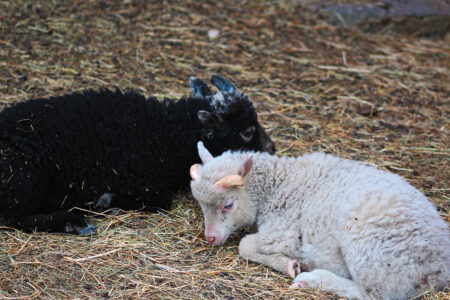
Shetland wool comes in 11 main colors, from black to white, with shades of gray and shades of brown. There are more than 30 recognized markings, many keeping their Shetland dialect names. Fleeces tend to weigh between 2 and 4 pounds, but heavier fleeces aren’t uncommon. Staple length ranges from 2 to 6 inches or more.
Prior to the early 1900s, markets for lacework, fine stockings, and other fancy knitwear provided income to the islanders. After the turn of the 20th century, the markets turned from lacework toward other knit goods. Sweaters, hats, and mittens, many in the Fair Isle style, became staples of the island knitting industry.
Road to Recovery
Despite its remoteness, change came to Shetland. Where once Shetland cows grazed on the better pastures and sheep were relegated to the hills, the cows lost their profitability with economic shifts, and the sheep moved to the better grazing. In the 1950s, crofters felt the pinch of a global desire for synthetic fibers, and fleeces lost market value. Shetlands were bred with Cheviots to increase carcass size. (The Shetland Cheviot is now a recognized breed.) Meat supplanted wool as the more important product, and many of the breed’s colors and marking patterns became rare. Industry-wide, knitting suffered from this cross-breeding for meat, leading to reduced wool quality.
By the 1970s, purebred Shetlands were hard to find. The Shetland breed description and standard still used today was created during this period, and in 1977, the Rare Breeds Survival Trust classified Shetland sheep as endangered, a designation that remained in place until 2002.
Only two major importations of Shetlands to North America have occurred. In 1948, a family with the last name Flett brought four sheep to Canada. But a larger importation took place in 1980, when Canadian military officer Col. Gordon Debenham Dailley brought four rams and 28 ewes into Ontario. He quarantined these sheep for five years before allowing their offspring to leave the farm. In 1986, Tut and Linda Doane brought the first Shetlands to the United States.
Today, Shetlands are listed as recovering by The Livestock Conservancy and can be found in nearly every state and province in North America. The main registry and database for Shetlands in North America is the North American Shetland Sheepbreeders Association (NASSA). To learn more about this remarkable, hardy breed, North American Shetland Sheep Association or email Secretary2@Shetland-Sheep.org.