Companion planting for vegetable gardens involves not only plants beneficial to each other but also to predatory insects.
Did you ever notice that Mother Nature tends to garden using what seems to be randomly distributed mixtures of plant species? Or that ancient agriculturists tended to sow a hodgepodge of crops in the same field? Surely you’ve encountered the phrase, “three sisters,” which describes a kind of cropping where corn stalks support vining beans and squash or pumpkins shade out the weeds. No matter how you harvest it, companion planting in the garden has the capability to offer larger and more diverse yields with fewer fertility and pest problems. Here’s how.
Plants form relationships with their environment and the other life forms around them, whether that be other plants, insects, soil microbes or even the gardeners who nurture them. Some of those relationships can weaken the crop (think weedy lamb’s ears overtaking your onion patch), while others can strengthen it (three sisters, for example). Some would promote companion planting as a means to keep this or that pest away rather than how to make a garden ecosystem healthier and, therefore, more productive. The fact of the matter is that if you avoid monocultural blocks in the garden and place certain species in close proximity of others, you will foil all kinds of pesky problems.

Marigolds and Nasturtiums
Take, for instance, the marigold. Although its insect repelling properties are legendary in even a beginning gardener’s vocabulary, the fact is often overlooked that it also plays a vital role as an attractor. Hoverflies, whose larvae are voracious eaters of pests like aphids and that as adults play an important role in the garden as pollinators, are attracted to the bright yellow and orange flowers.
Nasturtiums, too, are well-regarded for their natural repelling of pests like cucumber beetles, white-fly and, my personal nemesis, the squash bug, but they also are a strongly attractive plant. Planting nasturtiums, whose long vines curl in and out of the area around plants like zucchini, can help to greatly increase your yields from those plants by attracting significantly more insect pollinators than squash blossoms are able to alone — all the while keeping squash bugs at bay.

Consider Microclimates
Plants also can directly benefit other plants in the garden, either through creating amiable microclimates, adding nutrients to the soil, or providing needed structure. Probably the most recognizable example of this is the “three sisters” gardening technique used by early Native American gardeners.
By growing maize (corn), squash and beans together, each plant was able to benefit from the others, resulting in a healthier whole. Pole beans, as the name suggests, grow best when they have a tall pole-like structure to vine on; corn provides this perfectly. At the same time, the beans, being of the legume family, are able to “fix” atmospheric nitrogen and deposit it in the soil. This helps feed the nitrogen-loving corn plants. But what of the squash? Being long, vining plants with large leaves, the squash plants are able to quickly cover the exposed ground between the corn and beans. The shade under their leaves keeps the ground cool and moist in the heat of summer and deters weeds from growing and taking the nutrients from the lot of them.
Companion planting, or really companion gardening, doesn’t have to be just about learning what plants can keep pests at bay, or how you can use plants to benefit each other directly. When planning a garden, consider the species and the type of microclimate where each will thrive before locating the plants. For instance, over a few years of growing in my backyard garden, I learned that young plants set out in the main garden area, regardless of species, would end up getting beaten flat, their stems broken by the seasonal winds we encounter as spring transitions into summer. To counter that, I planted the area with well-staked peas, which offered some protection for surrounding crops, while delivering tasty morsels to boot.

Garden-Sized Grove
While planning my garden last year, I decided to try a new location for my peas. As a companion to the rest of the garden, I planted a thick row of peas along the 30-foot length of the garden bed. The early season peas grew quickly, as they tend to do, and provided a perfect low-level wind break as the later spring planting season progressed. Tender seedlings that would have been lost to the gusting winds fared so well that I had no losses to speak of, and all because, over time, I was able to watch the cues that my garden was giving me, find a companion planting that could help to solve that problem, and implement the plan.
While I used peas in this instance as a seasonal hedge against the wind, I might have used a more permanent hedge as a barrier to other unwanted garden problems. Perhaps the thorny holly bush to help deter wildlife, or a curved hedgerow uphill from a garden to help redirect the cool air of the early and late seasons as it settles around the garden.
Make Room: Spacing Companion Plants
I never seem to have enough room in my garden for each season’s ambitions. For instance, if I want to grow broccoli in the spring, I know it’s going to take a significant part of my garden. However, I also know that while the full-grown plant may require 2 square feet, it’s going to take a couple of months before it gets to that size. If I were to plant just those seedlings on their own, there would be a lot of wasted ground left barren around them. By pairing a primary planting — like broccoli, kale, brussels sprouts or some other spring-planted, longer-season crop — with a secondary spring-planted short-season crop — like mesclun, baby lettuce greens, radishes or green onions — we can maximize the gardening space while helping to keep the ground’s moisture level even during the wetter early months and the soil cool as the season progresses.
Another benefit is reaped as the longer-season leafy plants grow larger in the early summer sun. While lettuce will bolt as it experiences too much warmth from the longer days, another couple of plantings of tender greens can often be harvested from beneath the shady canopy of the maturing primary plants.
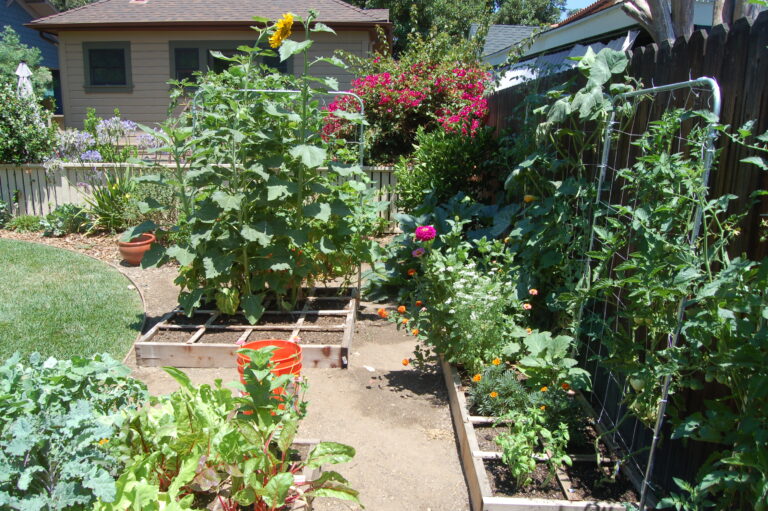
Another way of providing partial shade for plants that don’t need a full day of sun can be accomplished with taller plants like corn, sunflowers or even vertically grown tomatoes placed throughout the garden in north-south rows. By sowing the taller plants in this orientation, plants on either side of them are offered roughly a half-day of shade. It’s also a great way to define a small microclimate for starting cool-season crops in the middle of summer for holding over into the fall.

Companion Planting with Sunflowers
One of my favorite companion plants is the versatile sunflower. I’ve planted so many in the past that I just thin volunteer seedlings to select where I want them to grow. Sure, sunflowers throughout the garden can be an asset in building microclimates or providing structure for vines, but that’s not my favorite aspect of the beauties. The tall stalks and bright, colorful flowers are like nature’s own billboards to the many bees and pollinators I want to attract to my garden. As much as I love that, it’s still not my favorite part about them.
Sunflowers in the garden are like a buffet to a whole world of insect life. The large, juicy leaves provide a seemingly endless source of sap for myriad aphids that congregate on the undersides. The simple presence of so many aphids brings another wave of insects that help control them such as parasitic wasps and, of course, lady beetles, both welcome in any organic garden — but the cycle goes further.
As the aphids under the leaves feed on sap, they excrete a substance called “honeydew” that is very high in sugars. This honeydew is often found as either a bright shine on an otherwise muted green leaf-top or as the black “sooty mold” that grows on leaves where the sugars have been left. This sugary honeydew also is a prized food source for yellow jackets that are a valuable insect-control friend to the gardener. Simply put, when the yellow jackets are well-fed and happy, they leave me alone. Lastly, as a final benefit to the garden, the sunflower stalk itself lends a hand as a nursery for the next generation of lady beetles whose larvae form pupae that hold fast to it and emerge days later as new lady beetles ready to go to work for me and the garden.
So you can see, there are many ways to make the simple sunflower a powerful companion plant for both the garden and the gardener alike.

Companion Planting for Vegetable Gardens is a Learning Process
I wish I could say I knew everything there is to know about companion planting, but honestly, I don’t see how anyone ever could. Each year brings a new understanding and an opportunity to try a new way of combining different elements of the garden to benefit the plants, attract beneficial insects, create better growing conditions, or even simply maximize the area with which we have to work.
More than anything else, companion planting isn’t so much a recipe book for which plants to grow together. Companion planting is an ecosystem approach to gardening: Taking note of how the different pieces of the garden puzzle fit together, and then doing what we can to foster the best relationships among those pieces adds another dynamite dimension to growing your own food.
Paul Gardener and his family enjoy the fruits of their labor throughout most of the year at their suburban Utah home.