

When Andrew and I first purchased this farm, it was for the purpose of raising meat sheep and poultry. Although we both had experience with numerous other types of livestock, sheep were new to us. Andrew was raised with chickens and cows. I had chickens, horses, and starting in my teen years alpacas. We had talked since high school about having a farm one day. However the one thing we never seemed to agree on was what we were going to have on the farm! Over the years we watched market trends and feed prices shift, attended numerous livestock auctions and farm events, and spent many hours discussing what “product” would work best for our lifestyle and goals. We both knew we wanted to raise a healthy meat as several members of our family required special diets for medical reasons. After a short stint with meat rabbits, we quickly decided that wasn’t for us. We both agreed chickens were a must, since we love both the birds and the yummy baked goods I use so many eggs on. I am not a big fan of large cows, and their slow growth and long gestation didn’t quit match with what we wanted as our main product. So, we began looking into sheep.
WHY KATAHDINS?
After three years of investigating sheep, reading and studying about the different breeds, and comparing growth charts and traits we finally selected our breed. We decided the katahdin hair sheep was the breed for us. This breed stood out to us for several reasons. For starters, I had just spent 10 years working with alpacas. Alpacas, like wool sheep, must be shorn yearly. This is not a task I have ever enjoyed and it can be quit expensive. We did not want a wool type breed that required shearing. So we narrowed it down to hair sheep. Hair sheep also have the advantage of not requiring tail docks, another task which I can do but would really rather not. There are several different hair sheep breeds in America. The most common ones are Barbados, Dorper, and Katahdin with Painted Desert, St. Croix, and several other breeds growing in popularity across America. The two fastest growing hair sheep breeds in North America are the Dorper and Katahdin.
Here we see an assortment of hair sheep breeds. Starting on the far left is a young Dorper ram. Next to him in front is a Barbados ewe, with a painted desert ewe behind her. Standing alone in the middle is a ½ dorper x ½ wool sheep cross. Far right is a dorper x katahdin cross ram.
So besides not wanting to shear our sheep, we also wanted a breed naturally resistant to parasites and ailments, with fast growth, good foraging ability, and a high reproductive rate. The Katahdin is an “improved” hair sheep breed, meaning it does not have a “true” continuous hair coat. Instead, it grows hair which sheds out naturally each year. This is perfect for our climate, since they have a thick hair coat in the winter and shed out during the spring just in time for our hot and humid summer to arrive. The Katahdin is known for it’s parasite and hoof rot resistance, excellent mothering ability, high lambing percentage, and above average milk production. While many other breeds occasionally twin, the katahdin has an average reproductive rate of 2-2.5 meaning they almost always twin, and can successfully raise triplets. They reach puberty early, will breed year round (where some breeds only mate seasonally), and are hardy and long-lived. Some breeds of sheep have a prime breeding length of only a few years, while some katahdin females have been known to breed well into their teen years.
The final deciding factor for us what the meat quality of the Katahdin breed. While it does grow out slightly slower than the Dorper, the Katahdin is the first hair sheep breed to meet or exceed the North American carcass quality standards. Hair sheep in general produce a very lean, delicate-flavored meat which does not acquire the “mutton” taste as easily as other wool varieties. This is a very important feature in areas of high ethnic population where un-blemished (not castrated) lambs are preferred.
At our stage right now, we are mainly interested in the sheep for meat. However, there is also a secondary market worth pursuing. Hair sheep hides are in high demand in the United States. In fact, the U.S. currently imports over one million hair sheep hides each year to use in the production of leather goods. Over 250,000 hides alone are ordered by the Department of Defense to use as liners in fighter pilot helmets, seat upholstery, and gloves! The reason for this growing popularity comes from the lack of wool follicles on the hide which cause blemishes. The absence of these leaves the hide soft, strong and elastic. Most hair sheep also lack lanolin in their coat which many people are allergic to. Lanolin is what produces the “itch” factor in many woolen garments.
WHAT NOW?
So now we have chosen our breed. The reason I just spent so much time outlining why we chose the Katahdin is simple. The breed you choose is perhaps the most important decision you will make! Do your homework first, and make sure you know as much about the breed you are getting as possible before you bring home your first sheep. The fewer surprises the better!
The second most important thing to figure out is where to buy your sheep. This may seem quit simple as there is never a shortage of sheep to be found at livestock barns, stockyard sales, and in newspapers and online ad’s. But be warned, cheap sheep are a lot like cheap cars. You get what you pay for, and often inherit someone else’s problems.
In November of 2010 we found a reputable breeder of registered Katahdin hair sheep in Virginia. Now most of you know by now that we are in Middle Tennessee. We spent three months trying to locate registered herds in the state of Tennessee. After several failed attempts to purchase sheep from existing in state breeders, we had to expand our search. Though there were several we found in our own state, several would not sell breeding stock or were sold out through the following year. Others may have had 1 or 2 head available, but we were needing an entire starter flock. So off to the Kathadin Hair Sheep Registry we went to look for more breeders. Initially I sent out a dozen or so e-mails to different breeders in several states. Seven returned our messages. Five had small flocks available/ soon available for purchase. Of those, we narrowed it down to one breeder who really stood out due to his willingness to answer questions and provide excellent advice on everything from fencing to feed. He was also willing to deliver to us, which saved us not only time but the trouble of renting a trailer and borrowing a truck. Only down side was our starter flock wouldn’t be ready for several months as several of our new girls were currently bred, and others not born yet! So we agreed on a summer 2011 delivery date. Over those next several months, and still today both Jim and Sally Hash have kept in contact with us to check on the flock and answer any new questions that pop up. Finding a reputable and helpful breeder who is willing to work with you not only now, but also in the future is VERY important!
So with our sheep on order, and our fence and barn projects currently under construction things were moving along nicely here at ANS Farms. In February while browsing local online sales ad’s we found a sheep breeder just 40 minutes away selling off much of his flock. With no sheep experience, and a nice herd of registered sheep on order, we thought it may be worth the money to invest in some “cheap sheep” to practice on before the real deal arrived. So we headed on over to his place the next day with my father-in-law’s truck and my parents trailer to take a look.
Lesson #1: Beware of cheap sheep! Especially when there is mud.
Yes, I am saying be wary of mud. Why? Well let me explain. The sheep we went to look at were an assortment of both pure bred and crossed hair sheep. It was February, and we had recently experienced three weeks of non-stop rain and snow. When we arrived, the mud around the barn and in the pasture was so bad the truck and trailer could not come in. We slipped and slid around ourselves trying to get to the barn. When the sheep came in, they had mud up to their knees. So they were dirty. What was the problem? Most people don’t carefully inspect mud-soaked sheep! Which brings us to…
Lesson #2: Don’t buy anything from someone you don’t know, without a guarantee, unless you thoroughly inspect it!
These two lessons pretty much go hand in hand. The problem with lots of moisture and mud is foot rot. Mud and moisture are the perfect breeding ground for the bacteria that causes foot rot. Foot rot is the most commonly battled sheep ailment. It can occur even in the most carefully run operations regardless of season, breed of sheep, age, or other conditions. Now Andrew and I had studied the different things that affect sheep, but I must confess we did not look thoroughly at the beginning stages of this ailment. We saw pictures of full blown, hoof rooted off, open sores foot rot. Neither of us realized that foot rot can start with a simple “wet spot” between the toes, and a faint odor which soon becomes an extremely pungent stink!
After only 20 minutes or standing in the rain, in 38 degree weather, in a muddy pasture we agreed to purchase every ewe he had for sale including a young ram. This purchase included 5 adult ewes, 1 ewe lamb, 1 ram lamb, and 1 breeding ram.
Lesson #3: Check the plumbing.
You would expect to buy ewes and come home with ewes right? Well, guess what. It doesn’t always work that way! Two days after coming home with our new flock we discovered our ewe lamb was actually a young ram. Ironically, we did not want the mother to this lamb but the baby was so pretty we bought her for her ewe lamb baby! Joke was on us huh?
So, here we were with our “practice” herd and had already learned three important lessons in the first week! It took us a few days beyond learning our ewe lamb was a ram to discover the biggest problem though. The first pretty day after buying our flock we headed out to trim toenails and worm everyone. It was now 4 days post-purchase. The day before we had noticed two girls limping, and I immediately notified the previous owner who said they probably just had a rock or something stuck in a hoof so clean them out. Simple enough. So we head up the hill with foot shears and a hoof pick in hand. As Andrew held the sheep and I worked on toenails I noticed a “goo” between the front toes on those two sheep. There was a faint sweet odor, which reminded me of long ago when we had a horse get hoof rot. Uh-oh. Again, we headed back to the house and I contacted that previous owner. I was once again told they probably picked something up in those feet and it had caused irritation. Give it a few more days he said. Three weeks later, we were treating all but 2 sheep for full blown foot rot, and the previous owner was no where to be found or heard from. Lesson #1 and #2 we learned the hard way!
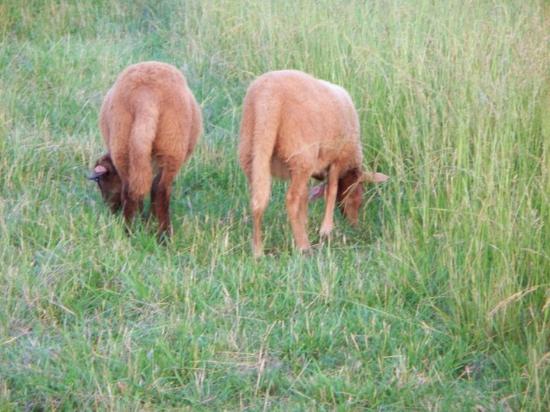
Unfortunately, 4 of those 8 sheep became re-infected only six weeks after being “healed.” After five months of on again off again treatment of those sheep we made the decision to permanently cull them from the flock. Below you see 3 of the 4 survivors of our first foot rot cull. Here is where lesson #4 comes in.
Lesson #4: Once infected, always contaminated.
Ok, while not technically true this is still a valid point. It is possible to completely cure foot rot. However, an animal that was susceptible to the infection to begin with will always have a lower tolerance to the bacteria and may become more easily infected than other members of the herd in the future. You have heard of survival of the fittest? Well, this is one of those truly heritable traits that can make or break your success at raising a healthy herd. Best to cull those sheep, and keep those more tolerant and less susceptible. It is now November, and the only sheep from that original purchase of 8 that remain here are a painted desert sheep who never became infected (despite being in the same pasture with them for five months!) and a Barbados ewe who had it mildly in her front feet, but hasn’t come down with a “severe” infection or secondary symptoms.
Here are our foot rot survivors, with their 2011 spring lambs. As you can see, the Barbados had not finished shedding her winter coat yet.
Lesson #5: Secondary symptoms can be as costly as primary!
During our first mass treatment for foot rot, we had our first spring lamb born to one of our “contaminated” mothers. Dolly was a very healthy and vigorous baby. Unfortunately, there was no way we could keep her completely separated from the contaminated herd at the time. At 6 weeks old she got foot rot. We treated her immediately both topically and with antibiotics, but her growth was severely stunted and at 6 months of age she was only 32 pounds versus the 62 pounds an un-infected ram lamb weighed. At 8 months of age, we had to cull a very small and un-healthy looking Dolly although she had been foot-rot free for months. Here she is, at 7 months old and obviously not of breeding quality.
Lesson #6: Organic and Natural are great, but alive and healthy is better!
Andrew and I had originally wanted to go organic with our operation. However after seeing all of the restrictions and qualifications for organic status, we decided that wasn’t the route for us. We did decide to go as natural as possible with all of our livestock. So in the beginning we only treated topically and with natural treatment. However, this did not totally eradicate our problem and our sheep were not only staying infected with foot rot, but also loosing weight and body condition, not breeding, and just lacking in healthy appearance. In April, we separated our favorite ewe, a full blooded Barbados girl we call Barbie. Barbie was moved to a dog pen (I told you those things come in handy!) well away from any other sheep. At this time, she was 4 months pregnant. We did not want a repeat of Dolly, so Barbie became our “guinea pig” for foot rot treatment. We hit her hard with both topical and oral treatments, vitamins and antibiotics. She improved much faster, and with no further weight loss or secondary symptoms.
Barbie delivered twins on our anniversary, May 18th. Both were large ewe lambs, and just beautiful! We did loose one of the twins, and we will never know if it was just a natural loss, or caused by Barbie’s treatments. However, Annie the surviving lamb is now 5 ½ months old, healthy and normal size, without any symptoms of foot rot or ill health. So I would consider it a successful treatment. Here is Annie at 1 day old, shown in that trusty ol’ dog pen with Barbie.
So after several months of heart ache and frequent treatments to “fix” our starter herd we came away with several lessons learned the hard way, and much more knowledge of foot rot and treatment then we knew we needed! I believe the most important thing we were to learn about sheep this year though was how valuable a reputable breeder is.
THE KATAHDINS ARRIVE!
When May rolled around and our delivery date for our registered Katahdins came closer, we were very nervous. Our main worry was we were about to go through a whole new round of treatments and trouble now that we were almost through treating our starter flock. The most important thing on our list was ensuring that our new flock could not be contaminated by our “old” flock. By this time our front pasture was fenced and a small barn built up front. There were 3 acres separately the two herds, with no other livestock in between to serve as carriers. With good sanitation and proper management, the new flock should be safe.
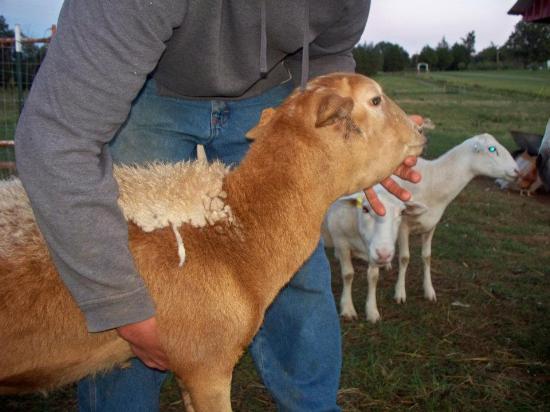
Our Katahdins arrives on a beautiful weekend the end of May. This initial delivery was our girls only, as the ram was headed to a Virginia test station before coming this way. Our ewe purchase included 8 girls, with the oldest being five years old and the youngest girls being just 6 months old. Six of the girls were solid white, and two of the girls were solid red. Below you see our five year old girl, what a large healthy girl she is!
Our nerves began to settle within minutes of the sheep arriving. Not only was Mr. Hash friendly and personable, but he gave us his assurance that if we had any problems we just had to let him know. He wanted us to be happy with our purchase, and has been good on his word to lend advice or assistance when ever needed. Now it’s easy to just say those words, but the true test comes when you are asked to live up to those words.
The first thing we did that next day was head to the barn to check everyone’s feet, give wormer and vaccines. We wormed everyone with Safeguard sheep wormer, which was what the co-op had recommended we use months before. Several weeks later, we were amazed at the difference in these sheep and our initial flock. These girls were large, healthy, and just simply easy keepers!
The last week of June while out in the garden I noticed one of our red girls laying in the grass away from the rest of the flock. Now one of the first things you realize when raising sheep is that a sheep alone is not a good thing! They are strongly herd oriented, and don’t usually wonder away by themselves. So the kids and I went to investigate, and found a very lethargic girl who I thought was surely near death. There was no obvious reason why, so I came inside and called the vet. His recommendation was a shot of penicillin and a double dose of wormer, followed by another treatment 3 days later. I immediately treated her, and by the next afternoon she was back with the flock. We did the same dosage 3 days later, and she was still eating, drinking, and staying with the flock. On the 4th of July we were headed to a festival in town when we again saw her by herself behind the barn. Within 10 minutes of us going to her side, she was dead. I again called the vet, who suggested we bring in a stool sample for testing. What they found was astounding. Despite a double dose of wormer administered twice in the last two weeks, her level of strongyles was ten times above average! I was devastated. We had followed medical advice, thought we were through it, and still lost her. The one we lost is pictured below on the left, just one week before her illness.
After testing some other stool samples and them coming in normal, we thought perhaps this loss was just a fluke. Another case of a genetic weakness, and not a further threat. A few weeks later, her twin sister (the other red girl) began acting weak. Now this girl had puffy cheeks, but her cheeks had always been more full than the others. I thought this was cute, since it reminded me of our alpacas. Time for another lesson!
Lesson #7: Puffy cheeks are cute on alpacas, but deadly on sheep!
Sheep may have many similarities with alpacas, but when it comes to puffy cheeks the similarity ends! When Lil’ Red began showing symptoms it was a weekend. There was no vet to call, this far out in the country there is no “emergency clinic” unless you drive a few hours away. So I put in a message to our sheep breeder. Although he delivered all of the girls to us, this girl and her sister were not bred by him but by a friend of his in a neighboring county. When I described her to him, he immediately zoned in on the puffy cheeks. What we thought was cute, was actually Bottle Jaw! Bottle Jaw is a serious secondary symptom and indication of a heavy worm load. By the time Bottle Jaw appears to this extent, you don’t just have a problem you have a potentially fatal threat that requires immediate action.
During our conversations with Mr. Hash, I learned another important lesson.
Lesson #8:When purchasing sheep from other states, be sure to ask what wormer to NOT use.
Yes, ask what wormer you should NOT use. Why? Different areas of the country have different parasite resistance to certain drugs. While Safeguard wormer (what we were using on all of our sheep) was still pretty effective here, it is not working as well in the area where our sheep came from. Mr. Hash recommended we use two different wormers. We treated Lil’ Red that day with Ivomec. The next day, I called our vet who seconded Mr. Hash’s opinion on the wormer, but followed it again with the recommendation that we use penicillin. After a week of two doses of ivomec and the penicillin Lil’ Red was not looking better. In fact, she was getting worse. Her gums and eye lids were nearly white, she would not eat or drink, and just wanted to lay down and not walk. At this point, I hit the internet looking for anything that might could save her. Now there are times when I definitely recommend following a vet’s advice to the letter. But around here, sheep are looked at as cheap and easily replaceable. That was not the case for us, as we had invested a good bit of time and money in this girl already. Rather than sit back and loose her as we had done her sister, we chose to treat her with our own combination of vitamins, iron, antibiotics, and wormer. After a week of daily vitamin B, iron, probios, and penicillin, and wormer every three days she was still alive. We followed that up with two weeks of every other day vitamins, probios, iron and penicillin with twice weekly wormer. We used ivomec the first week, and valbazen the 2nd and 3rd week. We also added electrolytes to the stock tank for everyone, and wormed everyone else with the ivomec as well. Mr. Hash had recommended the ivomec, but not the valbazen as it can cause their heat cycle to be interrupted. However the vet did recommend valbazen despite this because our area was being so heavily hit by strongyle infection this year. In fact, a goat dairy down the road from us had already lost 25 head to the same thing in the same amount of time that we had only lost one! They were also on an every month worming cycle.
So after three weeks of this treatment not only was Lil’ Red surviving, she was thriving! Her normal pink color had returned to her gums and eye lids, she was eating and drinking normally, and was staying in the herd. Here she is, 21 days after we began treatment. Notice how tight her throat and cheeks are, no more puffiness.
Lesson #9: Use any method available to you to lessen parasite exposure!
So this year our entire area was heavily hit by strongyle worms, it wasn’t just us. Since we did have a death and another severe infestation though we were told to stay on an every 3 week worming cycle until after our first heavy frost, which we are expecting in the next few weeks. Since changing wormers and going to the 3 week rotation, our fecals have been clean and no one else has become ill. Once the frost comes, we can go back to a monthly wormer. We will rotate which wormers we use every 6 months to try and prevent resistance. We are also using another method to lower our risk of infestations. Integrating livestock is an excellent way to reduce your risk of not only worms, but also other diseases carried by slugs, snails, and other creepy crawlies. Our sheep currently reside with a flock of chickens, 5 turkeys, 2 ducks, and several annoying guineas. These birds just love hovering over the poopy piles, around the feed trough, and at the stock tanks snatching up bugs which could cause disease.
We currently have our 8 katahdins (we lost a girl, and added a ram) in a 2 acre field with poultry. The adjoining 2 acres is almost finished fencing and will soon be available for rotation, along with 3 acres that will be finished next summer behind our house. Rotating pastures is another proven method of reducing worm loads in a pasture. It is our hope that with rotational grazing, integrated pastures and rotating wormers we will not suffer another lose from parasites.
Red John. The new Katahdin stud.
Mr. Hash recently returned with our new ram. This boy was fresh from the VA testing station and was absolutely HUGE! I was shocked to see the size on this boy at just six months of age! We are absolutely thrilled with the quality of stock we have received from the Hashes, as well as the support and advice that they continue to provide. Our experience with them has been completely opposite of our initial “practice” flock fiasco. With all of the many things we have learned since beginning our sheep experience, the best advice I can give anyone considering sheep (regardless of breed) is to find someone experienced, reputable, and willing to stand by their flock well in advance of making your first purchase. Learn from them, pick their brain, and do plenty of your own research. Then, even when problems do come up you will at least have someone to seek advice from. And if you are lucky, once your business is through you will be able to call them friend.