This step-by-step guide will help you get through the first season of keeping bees, including how to kill Varroa mites with natural solutions.
I wish I could walk with you through every week that follows and tell you exactly what to expect and do in learning how to keep bees, within a precise calendar. For better or worse beekeeping is not predictable enough to make that possible. Many variables play into the development of a colony, including:
- Region: Hive management tasks are tied to the region where you keep your bees. The time of year when flowers are producing nectar, for example, is geographically specific.
- Weather: Even within one region, varying weather patterns from year to year have a huge influence on your colonies. A particularly cold, wet spring or hot, dry summer, for example, will impact the growth of plants and affect the foraging success of bees.
- Quality of queen: Even colonies with the same external conditions will fare better or worse, depending on how productive the queen is and the quality of the bees she produces. Some bees, for example, might be more hardy and disease resistant.
- Skill of beekeeper: And, of course, some colonies will fare better or worse depending on how skillful their keeper is. But this isn’t an invitation to beat yourself up over weak hives or take all the credit for strong ones. There is a lot that just isn’t within your control.
With such unpredictability from colony to colony and year to year, I can’t lay down a weekly schedule, but I can set out a seasonal one.
You started your colony in a single hive body, and so far you’ve been inspecting for the presence of the queen and brood. At some point in the spring or summer, you’ll notice the box begin to fill up. When two-thirds of the frames are in use, with honey, pollen, or brood stored in the cells, your bees are ready to expand, and it’s time to add a second deep box on top of the first. When two-thirds of the second box is in use, add a super on top of the deeps, and so on.
If bees don’t have enough space to accommodate their growing population, they will swarm.
Setting Up a Bee Hive
More is not better when it comes to adding boxes. It’s not good practice to expand the hive before the colony needs the space. A really big house is hard for a small family to keep clean, so pests such as wax moths can move in and wreak havoc. Additionally, bees gravitate to the center of the hive, and if you stack another box on too soon, they may move up and develop the frames in the center, leaving the outside frames in the box below unused (the chimney effect).
Remember that I advised you not to rearrange the frames? There are exceptions to the rule, one of which is to fix the chimney effect. If your bees are not drawing out comb on the outer frames, you can swap those with frames closer to the center that have just comb or comb and honey but no brood. Do not move frames with brood. Brood frames must remain together where the nurses cluster over and attend to them. Any brood that is separated from the heart of the nest may be neglected or catch a chill and die.
A frame with comb but no brood can be swapped with an undeveloped frame to attract the colony’s interest in moving out as well as up.
Honey Flow
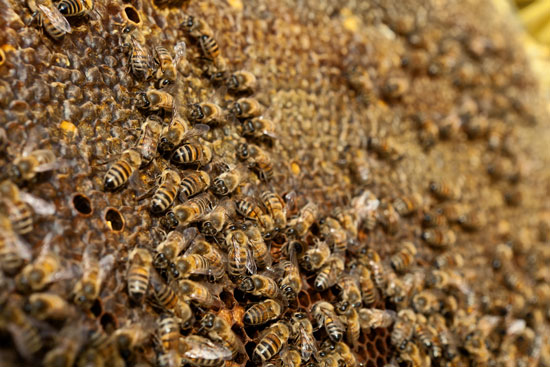
Experienced beekeepers are keenly aware of which flowers provide bees with nectar, when those flowers are in bloom, and whether the right balance of rain and shine has encouraged them to bloom in abundance. In beekeeping jargon, when there is a bounty of nectar for bees to forage, a honey flow is said to be on.
Honey flows are regional to the highest degree, and the only effective way to figure out if you’re having one is local observation. If you’ve made connections with other beekeepers in your area, you can take advantage of their seasoned surveillance. Otherwise, here are some signs to look for:
- Lots of blooming nectar sources. This isn’t as easy as it sounds. Not every flower is a nectar source, so you need to educate yourself about which ones are destinations for honey bees. Also, bees can travel several miles in foraging expeditions, so it’s not a matter of looking out your window and seeing what’s up in the backyard. Keep an eye out as you travel around your town, noticing where honey bees are gathering.
- Lots of nectar in the comb. This is a great indication of a honey flow, but if you’re feeding the bees, you won’t know whether you’re seeing sugar syrup or floral nectar. If the bees stop taking the syrup, however, you know a whopper of a honey flow is on and they are getting all they need from the land. That’s worth celebrating!
- Lots of fresh, white wax. For a colony of bees, plentiful nectar and pollen is equivalent to wealth. Flush with resources, they begin a building boom and rapidly expand the comb to make room for more brood and more food.
- Lots of foraging. During a honey flow, your hive will bustle with activity. Bees come and go from morning to evening in greater numbers than you can count.
- Rapid weight gain. Give your hive a heft test each time you visit it. Heave it up a smidge by the handle of the bottom box. Weight gain is always a good thing, and a rapid increase probably means a honey flow is on.
- Strong, sweet scent. If walking by your hive feels like passing through a cloud of ambrosia, there is probably lots of honey ripening inside. Happy day.
A honey flow can last days or weeks, depending on the bloom time of the nectar-rich flowers. If you’ve positively identified that a honey flow is on, pause or slow down the frequency of your inspections so you don’t hamper the colony’s burst in productivity. Your main task at this point is to provide enough space for the bees to store their bounty.
Depending on where you live and what the weather is doing, your first honey flow might be in the spring.
What’s In Bloom?
By no means a complete list, here are some nectar sources you might find in your area:
Acacia, Alfalfa, Apple, Aster, Avocado, Basswood, Blackberry, Black locust, Blueberry, Buckwheat, Chestnut, Clover, Cranberry, Eucalyptus, Fireweed, Goldenrod, Huckleberry, Lavender, Linden, Orange, Poplar, Pumpkin, Raspberry, Rosemary, Sage, Saw palmetto, Silkweed, Snowberry, Sunflower, Thyme
A bee sucks nectar from a blossom with a long, tubelike tongue called a proboscis. She stores it in her honey stomach, an internal organ separate from the stomach that digests the food she eats. When she returns to the hive, house bees will suck out the nectar and ripen it into honey.
To collect pollen, a bee scrapes it from a flower with her hind legs, which are covered in tiny hairs. She spits out a bit of nectar so the pollen sticks together, packs it into a pellet, and presses it into a cavity, called a pollen basket, on each hind leg.
Mandibles are for chewing. For example, workers masticate wax they have secreted from a gland in order to form comb.
What You Could Face Your First Season of Keeping Bees
As the population of the colony expands, there are new challenges to master. If all has gone according to plan, you have lots more bees than you did when you started. If this outward sign of success causes some inner turmoil, don’t feel alone. Working a hive of forty to sixty thousand bees is understandably more daunting than working one with ten thousand. Your skills as a beekeeper have been growing along with the size of your colony, but if the former haven’t quite kept pace, don’t worry, my friend. Stay steady and you’ll get there.
Every couple of weeks, continue to monitor your growing hive for the presence of all stages of bee life, including eggs, larvae, and capped pupae. Ideally you will see a tight arrangement of cells in use, without a high proportion of empty cells mixed among brood cells. Brood of the same age should be grouped together: capped cells together and larvae together, for example.
Another key to summer management is monitoring storage space within the hive, adding boxes in time to allow for population expansion and honey hoarding. If you are starting a new colony, it’s possible you will not be able to harvest much, if any, honey the first year. Though you may see lots of honey in your deeps, if you take it away, your bees could starve during a nectar dearth. What you are waiting for is any surplus stockpiled in the supers.
If you have a particularly strong colony or a particularly strong year for nectar flows, you may find yourself with a super full of capped honey, in which case pass Go and collect your reward (see chapter 8). Trial and error will boost your proficiency as a beekeeper. Here are some tips I’ve picked up along the way.
- If inspecting all layers of the hive, work from the bottom up, so you aren’t driving more and more bees into the boxes as you inspect each one.
- When the boxes stick together, use your hive tool to pry them apart. If there is a lot of burr comb holding the frames together, you’ll need to twist the boxes apart.
- To help prevent queen loss and so the boxes don’t pick up dirt and grass on the ground as you remove them during inspection, use the outer cover as a platform. Invert the cover so there are fewer points touching (thus fewer crushed bees). Place the box perpendicular to the cover.
Beating the Heat
I’m lucky that summers aren’t very hot where I live (but unlucky that winters are very cold). If the mercury sits above 90°F in your yard for months at a time, give the bees some help to fight the heat.
- Ventilation: Air circulation is key to a hive’s health in extreme temperatures, whether hot or cold. A screened bottom board or a slatted rack will ventilate the hive from the bottom.
- Sunscreen: You can’t really slather your hives in zinc oxide, but you can paint them white, which will reflect rather than absorb much of the sun’s heat.
- Water: Bees need access to water, which they evaporate to cool the hive.
Colony Collapse Disorder
When colony collapse disorder (CCD) hits a colony, the bees literally disappear. You open the hive, and no one is home. No dead bees. No signs of disease. Just nothingness. And its scale is shocking. Some commercial beekeepers have lost thousands of hives in the blink of an eye. The losses have been dramatic enough to create a crisis in agriculture, with fewer and fewer colonies available to pollinate crops.
The drama and mystery of CCD is juicy fodder for the media. While media attention is certainly deserved, and I wish it were sustained, there are other scourges affecting the viability of honey bees that no one outside the beekeeping community ever hears about. For backyard beekeepers, public enemy number one is the Varroa mite, not colony collapse disorder. If you have a colony of bees, you have Varroa mites, too. They are inescapable.
There are three basic approaches to dealing with Varroa mites. Pick one, try them all, or use them in combination, but don’t ignore the elephant in the room. These little buggers are small in size, but they loom large in a colony’s life.
Some beekeepers are putting natural selection to work through nonintervention. If you don’t treat a colony and it survives the mites for three years or longer, it has qualities that make it stronger than the colony that succumbs the first or second year. Those are the bees you want more of, not the ones you have to prop up artificially.
Your typical bee package from a large commercial supplier will not hold out against mites for long without intervention, but if you seek out people who are breeding survivor stock, you will have a better chance of success with this strategy. Survivor bees have a genetic trait called Varroa-sensitive hygiene, making workers more likely to identify and remove pupae infected with mites. There are also the options of raising Russian honey bees, a mite-resistant strain, or using small-cell or foundationless frames.
How to Kill Varroa Mites with Natural Solutions
To help your bees battle Varroa mites, there are chemical-free weapons in the beekeeper’s arsenal.
- Support nutritional health. You know that when your body is stressed, from poor eating habits, for example, you’re much more likely to get sick. Honey and pollen that bees forage from the land are the best food for them. Never take more honey from the hive than the bees need for themselves and assume that you can replace it with sugar syrup. Never feed them honey from the supermarket, which can actually introduce disease.
- Dust with sugar. Giving your bees a bath of powdered sugar will dislodge many mites and send them falling through the screened bottom board.
- Trap mites in drone comb. Mites reproduce most successfully within drone comb and have evolved to seek out the cells of drone brood first, before resorting to worker brood. Use this to your advantage by baiting mites into frames filled with drone pupae that you remove and freeze to kill your quarry (see page 116 for details).
- Break the brood cycle. Mites depend on bee brood for their life cycle. If you keep your queen from laying, either by caging her for several weeks or by removing her and letting the bees raise a new queen, you have stopped not only the bees but also the mites from reproducing. This technique is effective for established colonies, not those in their first year.
Mites do not survive without bees as their hosts. When a colony dies from Varroa predation, the mites die also.
Chemical Controls
Chemical control is a touchy subject. People who use hard pesticides often think this is the only efficient and effective way to control Varroa mites. There are considerable downsides, however, including these:
- Because of extensive use, mites have developed resistance to the hard chemicals on the market. Using these chemicals as a preventive measure, rather than to treat a verifiably high level of infestation, is irresponsible and unsustainable.
- Long-term exposure compromises the health of the queen. Beeswax absorbs the chemicals, becoming permanently contaminated. Miticides in combination with other chemicals (either that you introduce or that the bees bring back to the hive from the landscape) may have unintended effects that compromise a colony’s health.
- Increasingly popular as an alternative are so-called soft chemicals, including thymol-based essential oils and formic acid pads or strips. Though these products don’t kill mites as forcefully as the hard chemicals, they are gentler on the bees, don’t pollute the wax, and are thought to be less likely to breed resistance. Nevertheless, no matter what commercially available treatment you use (if any), follow the directions exactly. Sloppy practices, such as leaving a treatment on the hive longer than the directions indicate, expose parasites to weakened chemicals that are below a verifiably lethal threshold. Those that survive the exposure are the ones with resistance to that chemical.
Sugar Instead of Miticide
A lot of us get into beekeeping because we want to have a positive impact on the environment and an enjoyable intersection with the natural world. Messing with chemicals that can burn your eyes, skin, or lungs if improperly handled probably didn’t fit your vision when you started. The good news is that you don’t have to use chemicals if you don’t want to. There are some Varroa controls as harmless as sugar and ice.
Birds are born with an instinct to take dust baths, which loosen mites that have burrowed through their feathers. Most honey bees do not yet have a genetic instinct to groom away Varroa mites, since the parasite has been invading bee colonies only since 1987 and most beekeepers remediate chemically rather than breeding for hygienic traits. Taking the principle of this strategy from other animal species, some beekeepers coat bees with a dusting of powdered sugar. As the bees clean the sugar away, many mites drop off and fall through the screened bottom board. Here’s how to do it:
- At each hive inspection, remove the supers (if you have any on top).
- Sift confectioner’s sugar into the top hive body, making sure that sugar falls in between all of the frames. Use a half cup if there is only one deep or a full cup if there are two deeps.
- Use a bee brush to sweep sugar off the top bars of the frames.
Sugar dusting removes only adult mites that are feeding on adult bees. Two-thirds of the mites are safely nestled inside brood cells and won’t be affected by the sugar dusting. A sticky-board mite count taken a week after your first dusting will show the same level of mites that you had before, but this is because new mites have hatched out. What the sticky-board count can’t show is that fewer adult females succeeded in moving into cells and laying eggs.
Freezing Mites
Mites prefer to lay eggs in drone cells. Drones take a few days longer than workers to hatch into bees once their cells are capped, which increases the reproductive success of mites threefold. We can use this knowledge to lure the mites into a trap.
The basis of the trap is a frame with drone-comb foundation, which looks much like other plastic foundation except that the cells are larger, signaling the queen to lay drone eggs there. Here’s how to do it:
- Beginning in June or whenever the colony seems strong enough to sacrifice some brood-rearing energy, insert a drone-comb frame close to other brood frames within each deep. To make room you need to remove a regular frame. Choose one that has no or little brood.
- Wait until the queen lays eggs and many of the cells are capped before removing the frames — three to four weeks. Timing is critical! If you don’t wait until the cells are capped, you can’t guarantee that there are mites inside, but if you wait too long and the mites hatch, you will have reared a bumper crop of parasites, which is worse than doing nothing at all.
- Put the frames in plastic bags inside your freezer, which will kill the enemy and, sadly, the drones, too.
- Before the next hive inspection, remove the frames and let them warm to room temperature. Break the cells open with a cappings scratcher and reinsert the frames into the deeps. Worker bees will haul the mortal remains out of the cells and start the cycle all over again. Tip: If you have a bird feeder, you can scrape the drone frame clean after freezing and the birds will eat those tasty grubs up!
- Continue trapping monthly, but stop when brood rearing drops off for the season.
Sugar dusting and drone trapping are most effective when used in combination, since each strategy on its own does not pack enough punch to manage Varroa adequately.
Last Harvest
In the United States, even in the southern states, winter-blooming plants are rare, so if you have any harvest at all your first year, the last will be in the fall.
My hope is that you’ll say no to chemicals, but if you are medicating your hives for mites, nosema, or any other pest or disease, just after the last harvest is the time to do it. Note that medications are often temperature sensitive and require up to six weeks of consistently warm weather to be effective, so don’t wait too long for your harvest or the window of opportunity will close. Again, let me stress the vital importance of following a pesticide’s directions exactly and using only approved methods.
Protecting the Comb
Mice sometimes eat and nest in the wax comb in the winter when cozy outdoor burrows with well-stocked larders are scarce. Storing unused frames in sealed spaces is a good idea: stacked hive boxes with an outer cover on top and no entrance at the bottom is one option; an unused refrigerator or chest freezer would work too.
Mold grows on comb when the air is warm and humid. The bees will clean a moderate amount of mold off the wax, but it’s best to store the frames in a dry location to avoid problems. I use a dehumidifier in my basement and store the frames there.
Often the most significant threat to stored frames, wax moths are a common pest that will destroy the comb. Wax moth eggs may be in your frames even if you’ve never seen evidence of the insects in your hive. A healthy colony will keep the nuisance in check, but once the super is separated from the bees’ diligent attention, it is vulnerable to an infestation. Here are a few different ideas for protecting the comb so you can reuse it next year:
Freeze the frames for at least twenty-four hours to kill any eggs before storing them. Afterward, put the frames into large plastic trash bags and seal with packing tape to prevent later wax moth entry. This is a surefire solution that will eliminate further risk.
Spray the comb with Bacillus thuringiensis (Bt), a bacterium that attacks the gut of wax moth larvae but is harmless to bees and humans. It is available commercially under the names Thuricide, Dipel, or Certan. Air-dry the frames before storing. Put the frames back in their supers, with sheets of newspaper between the boxes to impede the moths from traveling from one box to the next. This is considered an organic solution.
Use paradichlorobenzene (PDB), sold under the name Para-moth. While these crystals are effective at controlling wax moths, I encourage you to try one of the chemical-free solutions above. In any case, PDB should only be used on frames with empty wax comb. It will ruin pollen or stored honey. After PDB exposure, the wax comb must be aired for several days before reintroducing it to the hive.
Keep the frames exposed to light and air while in storage. Wax moths favor close, dark spaces, so this will minimize the risk.
Stayin’ Alive
In the fall the queen begins to cut back dramatically on egg laying, downsizing the colony for the lean months ahead. She also begins rearing “winter bees,” which have fatter bodies to sustain themselves through the cold season.
Bees are smart cookies, planning ahead. Take their lead and do the same. If you live in a cold climate, you have to get ready for winter early, since you can’t work the hive once the weather is consistently cool. Opening the boxes when the temperature is below 60°F is not ideal, and exposing the brood to temperatures below 50°F is very risky.
You may see workers kicking drones out the door in the fall. They don’t want to feed extra mouths through the winter.
Feast or Famine
Check that your hives have enough stored honey to feed themselves through the winter. How much is enough varies by how long your winter dearth is, but a good rule of thumb for colder climates is to leave the hive with two full deeps. If the size of your colony is robust and there weren’t floods, drought, or other adverse environmental conditions, the bees probably collected enough winter stores, but inspect all the frames to be sure, and answer these questions.
Are all the frames chock-full of honey, pollen, or brood? If your answer is yes, you’re probably in good shape.
Have the bees filled the first deep but haven’t yet filled the second? If you have extra frames of honey from other colonies, you can put them in, in place of the empties. If the frames are sized for supers rather than deeps, open the honey cells with a cappings scratcher and place them in a super above the inner cover. Since bees usually don’t recognize anything above the inner cover as being part of the hive, they will move the honey from these frames into the deeps below. It will seem like manna from heaven.
If you don’t have extra honey, feed them with a 2:1 sugar syrup solution. Be sure to do this early enough that the bees have time to cure the syrup, reducing the water content to a level where it won’t freeze. That’s why feeding is a fall activity, not a winter one.
Did the bees use the first deep earlier in the summer, then move up to the second box and neglect the bottom? Bees have an instinct to move up to find stores, so it’s important that the cluster start the winter in the bottom box. You can guarantee this by making sure the brood is concentrated in the center of the bottom deep with honey stores at the sides and in the top deep. If the bees didn’t get the memo, make an exception to the rule of not moving the frames around.
Again, if both deeps aren’t full, you’ll need to feed the bees to supplement their winter stores or they may starve to death.
Surviving Winter
When the nights turn cold, everyone wants to hunker down in a snuggery. Mice get positively desperate and are exceedingly resourceful in wriggling their way into private homes, including beehives. While I sympathize, the bees and I aren’t really willing to share, especially since mice help themselves to more than just nest space. As soon as the fall flow is over, it’s time to install a sturdy entrance reducer that is screwed securely to the hive furniture. Mice can chew through wood, so metal is a better choice. If you make your own entrance reducer out of hardware cloth, you can leave it on year-round.
Critters start early in securing a cold-weather nest, so don’t wait for winter to reduce the entrance.
When the temperature falls to 57°F, the bees huddle together in a compact mass called a winter cluster. If you could see a cross section of the hive, the cluster would look like a sphere, separated into slices by the frames. The cluster concentrates body heat, much like snuggling with your family on a cold night. Bees have a warming exercise, too: by vibrating their wing muscles, which appropriately looks a lot like shivering, the bees increase their body heat. Of course, it’s a lot warmer in the center of the cluster than it is on the outside. Always team players, bees rotate positions so no one freezes her butt off for too long.
When it’s merely cool, the cluster is loose and large. The colder the temperature, the tighter they huddle, so the sphere gets smaller. If a severe cold spell lasts too long or the cluster is small because of low population numbers, the bees may eat all the honey within their tight mass and not be able to move to other stores. It’s a common tragedy for a colony of bees to starve within inches of an abundance of food. Honey, honey, everywhere, nor any drop to drink.
Worker bees that are born in the winter, when less or no forage is available, live for months rather than weeks because they don’t wear themselves out with incessant labor.
Bees do a gangbuster job of keeping themselves warm. All that activity and body heat in the cluster make it downright humid. In fact, what kills a colony more often than cold temperatures outside the hive is lack of ventilation inside. If the humidity isn’t vented, moisture will condense and either drip onto the bees, or freeze, making your hive boxes into iceboxes. The following techniques will keep the hive fresh and the bees dry:
Use a screened bottom board. In addition to helping manage Varroa mites, the screen provides ventilation at the lower level.
Improve drainage by inserting a small wedge underneath the bottom board, tilting the hive forward about an inch. Be sure the support is wide enough to keep the hive stable. It shouldn’t be tippy. Siting the hives on a slight slope is a permanent solution.
Turn your inner cover so the side with the rim hole is down. If your inner cover doesn’t have a ventilation hole in the rim, make one by cutting out a notch. Alternatively, insert a small wedge to prop the inner cover up about half an inch. This hole or space not only vents the hive at the top but also provides the bees with an emergency escape, should the main entrance become blocked by snow or the accumulation of dead bees.
Now is a good time to take a critical look at how you’ve sited the hive and evaluate if you’re serving your bees as well as you can. At the most basic level, they need plenty of sun. When temperatures are cold, the more sunlight the better. Too much shade is never ideal, but in winter it can spell disaster.
Preparing for Keeping Bees in Winter
Siting Correctly
If your beeyard is exposed to winter gusts, a windbreak on the north side will help the colony survive. When you were deciding on a site for the hives, you probably considered the following features to minimize wind exposure:
- Evergreen trees or shrubs
- Densely planted deciduous trees or shrubs
- Permanent hardscape, such as fences, walls, or buildings
- Hillsides or other topographical features
Build Windbreaks
If those aren’t viable options, you can still make temporary windbreaks by doing one of the following:
- Stacking hay or straw bales
- Assembling a temporary fence from scrap plywood (though temporary, it must be very secure so strong winter winds don’t blow it over and take the hive down with it)
- Remember to keep a brick or heavy rock on the outer cover so the top of the hive doesn’t blow off.
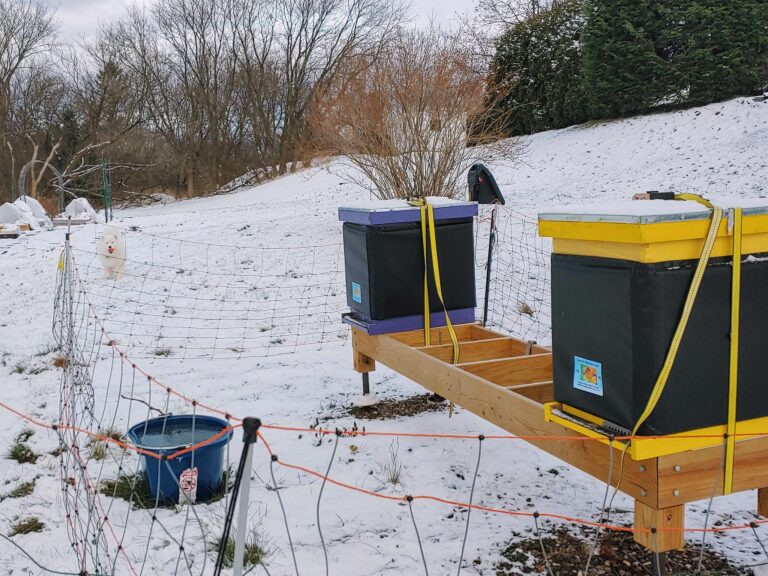
- Sunlight, sufficient honey stores, a sturdy entrance reducer, and ventilation are essential for winter management. Wind protection increases your colony’s chance of survival if your winters are particularly cold. A lot of people stop there, but if you want to go the extra mile, you can also insulate the hive. Wrapping the hive in tar paper not only offers a layer of wind protection, but its dark color has the added advantage of absorbing heat. Be sure to leave the entrances clear.
Now it’s time to let the bees alone. Don’t snap open the hive and disturb the cluster unless you have an incredibly compelling reason. Remember that low temperatures chill the brood. If you are lucky enough to have some warm winter days, you can periodically check that the bees aren’t running out of stores. As long as the days or nights don’t get below freezing, you can feed sugar syrup. If temperatures do get below freezing, you can feed emergency rations of fondant, a heavy icing sugar often used for decorating wedding cakes. Place a sheet of rolled fondant on top of the frames, and add an empty super so the cover will still fit snugly on the box. If you’re anxious to know whether the bees are still alive, give the box a good rap and put your ear up to it. The knock will stir the cluster, and you should hear buzzing.

Excerpted from Homegrown Honey Bees © Alethea Morrison, photography © Mars Vilaubi, used with permission from Storey Publishing. Homegrown Honey Bees (Storey Publishing, 2012) is a beginner’s guide that clearly explains everything you need to know on how to keep bees successfully, from getting your first bees to harvesting your first crop of honey. Spectacular macro photography by Mars Vilaubi brings the inner workings of the hive to life, and the playful text by Alethea Morrison gives you the information you need to make it through your first year. Everything is addressed here, from hive structure, colony hierarchy and bee behavior to allergies, permits and restrictions, and how to deal with the neighbors. The following excerpt is a guide to a new beekeeper’s very first season.