Learn how to build a dog house step by step with these modern dog house plans. It just takes a little bit of time and skill to build the perfect pad for your pet.
After our faithful golden retriever, Chance, died at the grand old age of 15, I knew I’d need to do two things. First, head back to his breeder: Anybody who could produce a sweet-tempered dog that lived that long deserved repeat business. Second, build a doghouse to replace the one I’d made for Chance when he was a puppy. The old house had held up well, but it was beginning to show its age. Besides, every new dog deserves new digs.
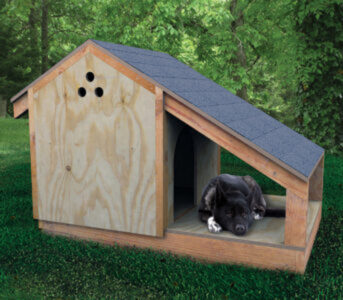
My design for our new pal, Chase, incorporates a porch and extended “saltbox” roof attached to the basic doghouse design.
The basic house is simple to build, and if you want to add extras, as I did, you’ll see that the underlying structure is easy to adapt.
Design Basics
Size the house to fit the dog: It’s tempting to make a really roomy doghouse, but your dog won’t appreciate it. During cold months, your dog’s body heat keeps him or her warm. If the house is too big, the dog can’t generate enough heat to warm it. How big should a doghouse be? There’s no exact formula, but a good rule of thumb is to build it so your full-grown dog can walk in, turn around inside and stretch out completely.
Vent it well: In hot weather, good airflow will keep your dog from overheating. And in damp weather or cold weather, when the dog’s moist breath is steaming up the house, proper ventilation prevents mold from forming. Vents in the peaks of the roof will do the job as long as you leave the doorway open or just loosely cover it with a flap so there’s an adequate updraft.
Build it off the ground: This keeps the dog out of contact with damp soil. It also prevents the wood from rotting and extends the life of the doghouse.
Make it safe from the elements: Be sure water, wind and rain can’t enter. Generally, this means overhangs for doorways and vents, and tight seams everywhere.
Use dog-friendly materials: Anything that comes into contact with your pet must be safe for animals. That means you’ll make the floor, frame and walls from untreated softwood and plywood, rather than pressure-treated wood.
Customize to suit: Once the basics were covered, I looked at ways to improve on my previous design. First, I added a sheltered porch so our new dog could stay out of the sun and rain. I moved the doorway from the gable end to the porch side, for easy access. (I made the door pup-size for now. It can be enlarged later.) I also added insulation under the floor (to keep out cold in winter) and under the roof (to reduce heat in summer and retain it in winter). Finally, and this was a big improvement, I added a large clean-out door at the back of the house so I could easily tidy up inside. The result is a house with the flavor of a New England saltbox home. It’s based on the following basic design.
Basic Digs for Your Dog:
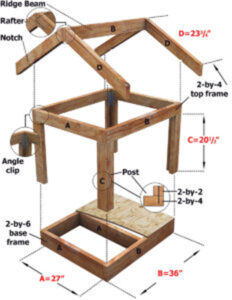
My house took about 12 hours to build, and the materials cost about $100. But you don’t need to go to these lengths to build a comfortable house for your pet. You can build a basic version in an afternoon from plywood, lumber and shingles. It’s a simple, sound design that handles a dog of 70 pounds or so. All framing is cut to just four lengths, shown as dimensions A, B, C and D in the diagram above. To change the overall size of the house, just change the four framing dimensions. For my saltbox design, I simply extended the rafters and base frame on one side to create the covered porch shown in the image that kicks off this article (Image 1).
Step-by-Step Instructions: Framing
- Build the base: With a tape measure, carpenter’s pencil and speed square, measure two 2-by-6s for lengths A and B, and cut those pieces to length with a chop saw or circular saw. Fasten the parts together with galvanized 12d nails or 3-inch outdoor screws (often sold as “deck” screws). Align the base frame with one corner of a plywood sheet, square up the frame if necessary, and then trace around it onto the plywood. Cut out the plywood floor with a circular saw and attach it to the base with galvanized 4d nails and a framing hammer. If you want to insulate the floor, do it now. Flip the base over and attach hard foam exterior-grade insulation with construction adhesive.
- Build and attach the wall framing: First, make the corner posts; these are marked C on the illustration. You’ll need one 8-foot 2-by-4 and one 8-foot 2-by-2. Mark and cut each of these into four C lengths. Then nail the 2-by-2s to the 2-by-4s with 4d nails, as shown.
Next, build the top frame. You’ll need two 8-feet-long 2-by-4s. Mark and cut them to make two A lengths and two B lengths. Nail them together with 12d galvanized nails. Finally, attach the top frame to the posts with 7-inch angle clips and 4d nails, as shown.
Attach the completed wall-frame assembly to the base with 3-inch outdoor screws, two in each corner, driving them diagonally through pilot holes in the posts and into the base. This securely “tacks” the wall frame to the base; final fastening comes when you add the house walls. - Add the roof frame: To make the first rafter, mark and cut the last 8-foot 2-by-4 to length D. Then use a speed square to mark 30-degree angles at each end of the rafter. Cut the angles with a circular saw, and then use that rafter as a guide to mark and cut three more. Now cut the ridge beam – length B – from one 4-foot 2-by-4.
Drill pilot holes, then screw the rafters temporarily to the ends of the ridge beam with 3-inch outdoor screws. Test-fit the resulting roof frame on the wall frame, and mark where the rafters fit over the wall frame, as you’ll need to cut notches there. (The speed square will help you with the exact angles.) Unscrew the frame and cut the notches with a jigsaw or handsaw. Reassemble the roof frame with the screws, and then nail it to the top frame with 12d nails, or screw it in place with 3-inch outdoor screws. - Add the walls: Lay out the wall panels on the plywood, taking actual dimensions from the frame itself. Cut and install the sides first, then measure, cut and install the front and back (the gable ends). Note that the ends overlap the sides. All four pieces need to overhang the base by 11/2 inches. Fasten the siding to the wall framing and base with 4d galvanized nails or 11/2-inch outdoor screws.
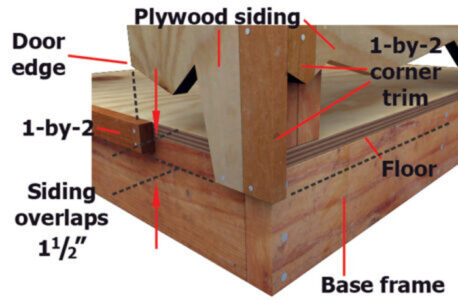
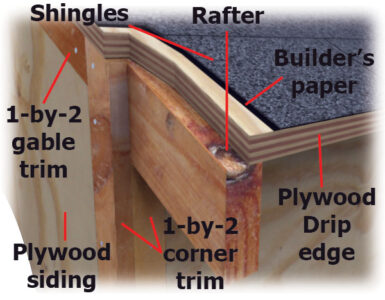
Lay out and cut a door opening in one of the ends before you install it, sizing it to your dog. (An opening that’s a hair small will retain heat better than one that’s too big. Don’t worry, your dog will get in.) To draw the top for a round-top door, make a string compass. Cut the opening with a jigsaw fitted with a coarse woodcutting blade. After this end is installed, fill in the door bottom with a piece of 1-by-2, as shown in the drawing. This adds a bit of threshold and makes for a neat appearance. Use a power drill and a hole saw to make the optional 2-inch vent holes. Finish by cutting 1-by-2 trim to hide the corners where the plywood walls meet, and run it along the tops of the gables as well (see Image 3 and Image 4 below). Caulk the plywood corner seams before you nail the 1-by-2s in place; use 4d nails to attach the trim pieces.
![]()
![]()
- Roof the house: Lay out and attach the plywood roof the same way you did the walls. Butt the pieces at the ridge, and make sure the roof overhangs the rafter ends by 2 inches on each side and 4 inches at each gable end. Add more insulation if you like: Use construction adhesive to glue rigid insulation inside the roof panels before you install them. With a hacksaw, cut the aluminum drip edge that will protect the plywood edges. Attach it to the roof with aluminum roofing nails. With a utility knife, cut strips of builder’s paper to fit across the roof, making them long enough to cover the drip edges. Install the paper with a staple gun, starting at the bottom of the roof and working up. When you add a new piece, overlap the lower one by 2 or 3 inches. Finally, cut and install the shingles, staggering the seams and attaching them with aluminum roofing nails. Stain or paint the doghouse, or leave it plain. Now you can call your dog! /G
Kevin Ireland is a former managing editor at American Woodworker. Reprinted with permission from www.CornerHardware.com.
Dimension Lumber for a Basic Doghouse
| Nominal size and length | Quantity needed | Lengths to cut (see Image 2) | Number to cut |
| 2-by-6, 8 foot | 2 | A, B | 2, 2 |
| 2-by-2, 8 foot | 1 | C | 4 |
| 2-by-4, 8 foot | 5 | C, A, B, D | 4, 2, 3, 4 |
| 1-by-2, 8 foot | 4 | C, D | Threshold: 8, 4 |