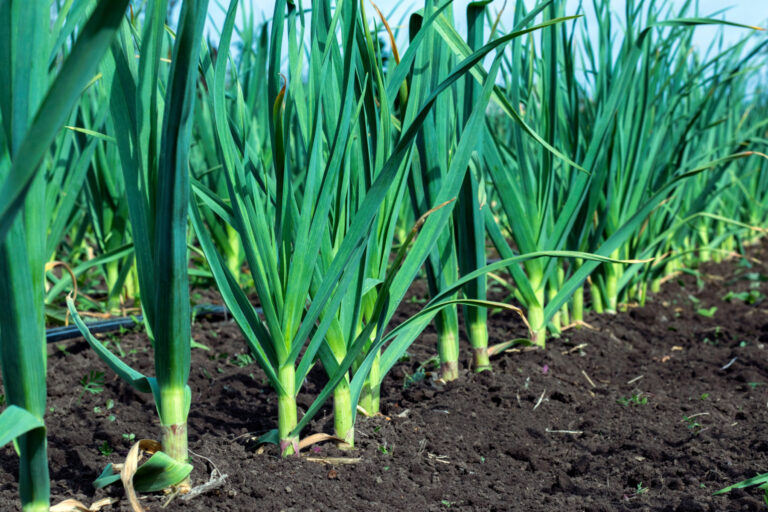
In the snowy high country of the Rocky Mountains, it seems a miracle each year when the slender green shoots of garlic emerge from the nearly frozen ground.
Along with the crocus, garlic pushing its way out of the cold earth is a sure sign that spring is here, even if we have yet to endure a few late snowstorms (which, by the way, garlic doesn’t seem to mind a bit).
Of all the things to grow in your garden, garlic is perhaps one of the most profoundly satisfying, and it is one of the crops with the longest growing season around. In most North American climates, it takes a full nine months to grow a good garlic crop – about the same amount of time it takes for a human to grow a baby. We’re talking serious dedication here.
Garlic is one of few crops that gardeners and farmers plant in the autumn – after the pumpkins have been pulled from the field, after the corn is nothing but dry stalk, after the tomatoes are all turned to sauce.
Only then, when the nights are crisp and the days are getting short, do you pull out your dibble, punch little holes in the ground, drop little cloves of garlic into their burrows (pointy-end up) and tuck them into bed with a little soil.
And then, you rest – and hope the snow falls. Garlic loves nothing more than a blanket.
Gourmet Garlic
The first thing you need to know about growing garlic is also the reason why you should grow it: Not all garlic is created equal. Although it’s a common belief that each bulb of garlic is just like any other bulb of garlic, this belief is false, even bordering blasphemy for the passionate garlic grower. Those of us who grow a lot of garlic know there is good garlic, and hot garlic, and mellow garlic, garlic that is good raw, and garlic that will rot your stomach if you dare to eat it raw. And, yes, there is even bland garlic. Really.
The garlic you get in the grocery store, for most of the year, is a basic silverskin or artichoke – a softneck garlic, likely grown along the coast in California or Oregon. These varieties – usually California Early or California Late – keep well and are easy to grow.
And yes, this is all good stuff – there’s no such thing as “bad” garlic. But here at our farm, we think of that garlic as, well, grocery garlic. There’s a difference.
A whole world of garlic flavors is out there for growers who decide to try something different – rocamboles and porcelains, purple stripes and turbans. You can grow garlic from China, from Japan, from the Czech Republic, from Italy. Our favorites include Chesnok Red (also known as Shvelisi), Cichi, German Extra Hardy and our own local heirloom, a rocambole similar to the famed gourmet garlic, Spanish Roja.
If all that is too confusing for you, here’s what you really need to know in order to grow garlic.
If you live in a more Southern area, where winter frosts are nonexistent or mild, consider the softnecks – creoles, artichokes, silverskins. If you live in a cold climate, where winters are severe, first try a hardneck – a rocambole or a porcelain. Now it’s not that you can’t grow a softneck in the Upper Peninsula of Michigan, only that you might have better luck with a hardneck.
Garlic-growing guru Ron Engeland, author of Growing Great Garlic, says there are approximately 450 types of garlic commonly grown across the world. But a 2004 New York Times article attempted to poke a hole in the garlic grower’s entire belief system, telling us that botanical researchers in Colorado found that all garlic boils down to pretty much the same genetic thing. To be precise: On a DNA level, there are only six types of garlic, not 450. Try telling that to my tongue.
And, as for that stuffy New York Times ruining all our fun? CBS News Correspondent Morley Safer once said, “You can never have enough garlic. With enough garlic, you can eat the New York Times.”
Planting and Growing Garlic
Garlic does not produce a true botanical seed, so you don’t plant garlic seeds. Instead, most garlic is planted from cloves broken off the main garlic bulb.
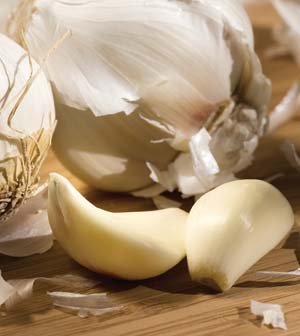
Take the bulb of garlic – yes, you can even plant the bulb you buy at the grocery store – and break it up into its individual cloves. Keep the large- and medium-sized cloves for planting; squash the little ones into your soup. As a general rule, big bulbs come from big cloves.
Plant your garlic somewhere between September 15 and November 15. Some research has shown bulb size increases with plantings in September and October rather than later, but even here in our cold climate, we get large 3-inch bulbs with early November plantings. More than once, we have found ourselves behind on farm work and end up planting in the season’s first snowstorm.
With some softnecks, we have had luck planting as soon as the ground thaws in the spring, but it’s generally safe to say spring plantings of garlic are rarely successful. Garlic requires a period of “vernalization,” which means it needs several weeks of dark and cold in order to get growing. Spring planting typically does not provide enough, and the garlic won’t bulb out properly.
Plant cloves 2 or 3 inches deep. We use a British tool called a “dibble.” (Imagine the fun we have dibbling! We dibble until we drop!)
The rules say you can plant anywhere from 3 to 12 inches apart – somewhere around 6 inches between cloves is probably best. Rows should be about 12 inches apart.
Fertilization? You can apply some well-aged manure and compost, if your soil is deficient or hard. But garlic is not finicky – it grows well with just about any food, and it will grow in just about any soil that isn’t too compacted. We have found some response to an application of kelp meal or Yum Yum Mix (www.SoilMender.com), perhaps due to the mineral content of these fertilizers. Garlic actually contains, pound for pound, more minerals than nearly any other vegetable. So you can make your own call about what to put on your garlic bed, based on your soil conditions.
Especially in cold areas, garlic benefits greatly from a good layer of mulch – about 2 inches of weed-free straw or pine needles is an excellent idea before snow flies. We think this also helps prevent certain growing problems and consider mulching more important than fertilization.
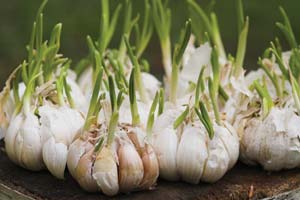
In the spring, garlic starts peeking its sharp shoots above the soil line around the time the first crocus blooms. As it just gets growing, you can give it a dose of fertilizer – but don’t overfertilize, and don’t fertilize late in the season closer to harvest. It’s good to remember, as it gets on toward late spring, that you want your garlic to stop putting too much energy into making green leaf – and instead push its energy into making a fat bulb.
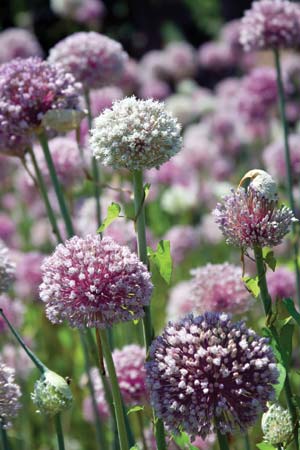
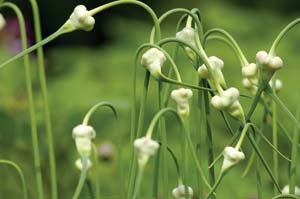
Water deeply about once a week, unless your early-summer temperatures go over about 95, in which case, you might water more often. If you are growing a stiffneck variety, you will start to see the garlic sending up a reproductive stalk – in most North American climates that happens in early June. On garlic, we call this a “scape.” Unless you have some desire to see the scape – actually a stiff-necked stalk that forms little bulbils on the end – snip this growing stalk off near where it comes out of the leaf (use it in salads). The plant will then put its energy into the bulb, rather than above-ground reproduction.
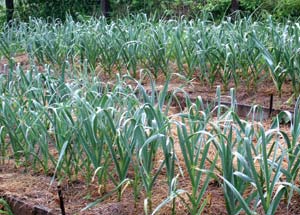
Garlic starts to bulb out around the time this scape appears. From here, it all happens fast. Within weeks, what was only a sliver of root and stalk in mid-May – something like a scallion – bulges out and makes a nice fat bulb (we hope).
When to Harvest Garlic
Toward mid-June, you will notice some of the outer leaves of the garlic plant beginning to die back. The official rules of garlic growing say to dig the garlic when one half of the leaves have died.
But all growing instructions are theoretical and subject to whims of weather and the mood of the soil. In our cool summers, the leaves never really do die back to that extent, so we guess harvest by digging up a bulb here and there and just looking at it.
“Does it look ready?” my husband asks me.
“No, not really,” I say. “Let’s give it another week.”
“Looks ready to me,” he says. So we start digging. Highly scientific, you see.
Still, as a rule of thumb, in most North American climates, garlic is ready to harvest the last week of June to the first week of July. But the harvest is not an exact science, and readiness will be determined by the variety (Colorado Purple is our earliest; Locati is our latest) as well as climate, weather, mulch thickness, moon in Scorpio, political winds, etc. In southern Texas, for instance, you will probably have varieties that mature by late May.
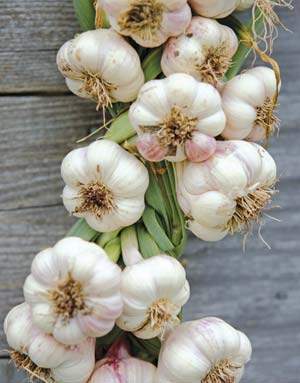
Try this: Just dig up a bulb. If the cloves seem well-formed, it might be time. Ask your significant other what she or he thinks. Either way, it’s not too big of a deal. If you leave the garlic too long, it will start to split apart. It will still taste fine – great, even. But it will look ugly, and it won’t last as long in storage.
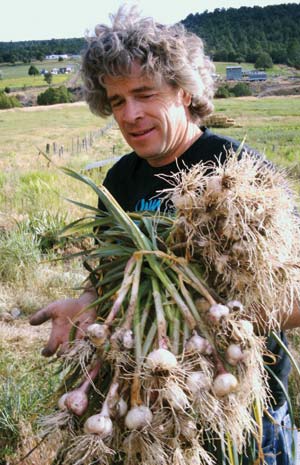
After-harvest rules are clearer. Absolutely do not wash your garlic in water, and do not leave it out in the sunlight. Snip the roots off and brush off the dirt with an old toothbrush or rough rag. Then hang it in a well-ventilated area out of bright light to dry as quickly as possible. Garlic will cure for several weeks, up to two months – you can do some taste tests along the way. Freshly dug garlic has a more mild, vegetable-like flavor.
With time, it cures into rich, hot, potent, knock-your-socks off garlic. You’ll never do grocery garlic again.
Recommended Hardneck Varieties:
- Spanish Roja
- Chesnok Red
- Music
- German Hardy
- Bavarian
Recommended Softneck Varieties:
- Polish White
- Locati
- Chet’s Italian Red
Resources
For all garlic growers:
Filaree Farm www.FilareeFarm.com
The Garlic Store www.TheGarlicStore.com
Nichols Garden Nursery www.NicholsGardenNursery.com
For Southern garlic growers:
Gourmet Garlic Gardens www.GourmetGarlicGardens.com
Kristen Davenport raises garlic, goats, geese, chickens, vegetables, cut flowers and several human kids (not necessarily in that order) on a 32-acre farm in the mountains of northern New Mexico.