When I was growing up in rural Alabama, some people called snapping turtles “thunder turtles.” As the folk tale went, if a snapping turtle bit you, it wouldn’t let go until it heard thunder. While that didn’t turn out to be quite the case, you still don’t want to be bitten by a snapping turtle, no matter when it lets go.
To most folks, the word turtle conjures up one of two images. The first one is that of the slow, plodding, docile cartoon character pitted hopelessly against the fast, agile hare. The other image is that of the snapping turtle. With its hooked beak, ill temperament and quick reflexes, the common snapping turtle (Chelydra serpentina), sometimes called a “snapper” or “loggerhead,” is anything but plodding and docile.
Snapping turtles are among the most widespread turtle species in the Americas, ranging from southern Canada to Ecuador. The common snapping turtle is found throughout the United States east of the Rocky Mountains, except Florida and southern Georgia, where it is replaced by another subspecies, the Florida snapping turtle. This species has also been introduced to a couple of areas in the states of California and Washington. In Canada, snapping turtles are found from Nova Scotia to southeastern Alberta.
What to look for
The common snapping turtle has some distinctive characteristics that set it apart from most other species of turtle, except its closest relative, the alligator snapping turtle. Alligator snapping turtles, however, have a much more restricted range, being found only in the Deep South and the southern Midwest of the United States. If you live anywhere else in the common snapping turtle’s range, you won’t confuse it with any other turtle. At first glance, they look like something out of a movie about prehistoric monsters, and that’s not too far from the truth. Turtles have been around since the time of the dinosaurs, more than 200 million years, and snapping turtles are among the most primitive of all living turtle species.
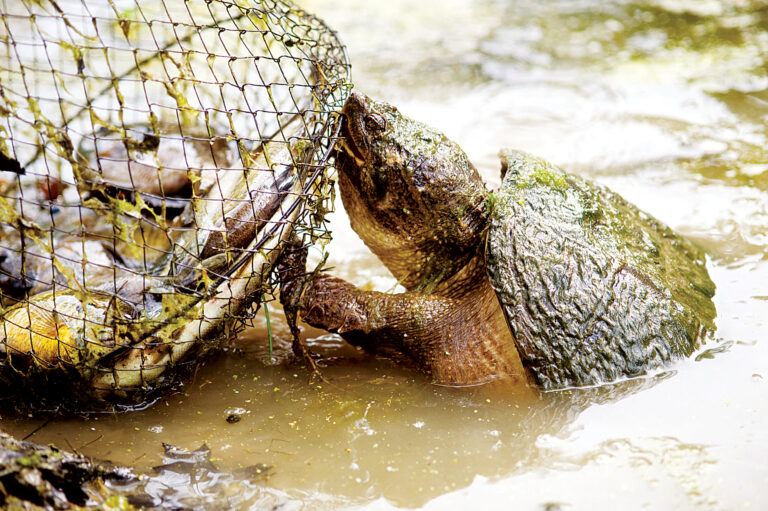
The snapping turtle’s most noticeable trait is its hooked, parrot-like beak, which is used for both obtaining food and self defense. The neck is long and flexible, giving the turtle the ability to reach from around its shell and deliver a nasty bite to anything (or anyone) that threatens it. There are two small, skin-like projections on the chin of a snapping turtle called barbels.
The top shell, or carapace, is smooth in larger animals, while young snapping turtles have small, tooth-like ridges, called keels. The carapace is made up of a series of bony plates, called scutes. The outer-most scutes in juvenile snapping turtles have a white spot on their underside. The tail also has tooth-like ridges, giving a very primitive appearance. Unlike other turtles, snapping turtles cannot pull their head or legs all the way into their shells for protection. The bottom shell, or plastron, is small and cross-shaped, meaning at the four corner points of the shell the legs are left exposed.

Snappers are usually brown or black, although they often have algae growing on their shells, giving them a green appearance. Since they spend most of their time near the bottom of water bodies often buried in mud, this helps them blend with their environment.
Snapping turtles vary in size depending on where they live, how old they are and what sex they are. Female snapping turtles average about 11 inches (carapace length), while males average about 13 inches and can weigh 35 to 40 pounds. Some snappers have been measured at over a foot and a half long, weighing almost 70 pounds. The common snapping turtle continues to grow its entire life, with the growth rates slowing down as the turtle gets older. Especially large specimens can be more than 100 years old.
Snapping turtle habitat
Common snapping turtles can be found in just about any permanent body of water, from rivers to farm ponds. They prefer areas with muddy bottoms, vegetation and other forms of cover (such as leaves or submerged timber). In shallow water, they will often burrow into the mud and poke their heads above the surface every now and then for a gulp of air. Here the turtle waits for prey to come within range or just sits quietly to conserve energy and stay cool during the heat of the day.

Snapping turtles are most active at night. Unlike most other aquatic turtles that spend much of the day basking on logs, snapping turtles rarely bask, preferring the safety of mud and weeds. The best time to see snapping turtles in daylight is during spring and early summer, when female turtles move out of the water in search of suitable nesting sites. These movements may take them anywhere from a few feet from the water’s edge to hundreds of yards away. Unfortunately, this movement often leads them to cross roads, where their ferocious reputation is no match for cars and trucks.
Snappers prefer to lay their eggs in open, grassy areas or bare soil. The female digs a small hole, several inches deep, and deposits her eggs in it. The number of eggs may be anywhere from one to 50, depending on the size and physical condition of the female. Some turtles have been known to lay more than 100 eggs in one nest. For snapping turtles, laying lots of eggs helps ensure that some of those eggs will hatch and maybe a few of those turtles will manage to survive to adulthood.

The female snapping turtle, like her other turtle kin, does not guard the nest or the young. Once the eggs have been deposited in the nest and the nest covered, they are on their own. The incubation period for the eggs varies, but is usually about 100 days. During that time, a whole host of predators will be looking for a tasty meal of turtle eggs, including raccoons, mink, otters, feral hogs and even ants. The turtles lucky enough to hatch then have to contend with other predators, including herons, snakes, alligators and large fish like bass and pike.
Temperature and sex determination
Unlike humans and other mammals, birds and even snakes and lizards, snappers do not have specialized genes that determine their sex. The temperature at which the eggs incubate determines the sex of the turtles. Cool temperatures produce mostly male turtles and warm temperatures produce mostly females, and temperatures in between the two extremes produce about half males and half females. The location of the nest site (sunny or shady area) and the local climate (cool or hot summer) both have an important impact on the sex of the turtles that hatch.
Opportunists with attitude
Snapping turtles are assumed to be predators because of their hooked beaks and dangerous reputation. In reality, snappers are opportunists. They will eat pretty much anything they can find, including fish, insects, crayfish, tadpoles and even ducklings. As a result, a lot of landowners consider them pests, best relocated or eliminated. Research shows that the most common kinds of food in their diet are plants and algae.

The common snapping turtle has a reputation for having a nasty attitude. This is mostly due to folks who encounter them out of the water. Because they do not have much of a shell to withdraw into when in danger, they actively defend themselves. When threatened on land, snapping turtles will raise up on their hind legs, making themselves look larger than they really are, and lunge and snap at anything that gets close. When encountering a snapping turtle it is best to leave it alone. If you must pick one up, grab hold of the carapace behind the head with one hand and hold the rear of the carapace above the tail with the other. Make sure you hold the head of the turtle well away from your body. Many folks have received a nasty bite when picking up a snapping turtle by its tail (which can also injure the turtle’s spine) and letting the head get too close to their legs.
Conservation
Many a farm family has been treated to the delicacy of turtle soup through a chance encounter with a common snapping turtle. Because of their secretive habits, encounters are usually just that, chance. Both common and alligator snapping turtles were once trapped extensively for the commercial turtle soup market, which caused serious declines of both species in some areas. While the alligator snapper is now fully protected throughout its range, the common snapper is not. Its widespread distribution and ability to adapt to a wide range of environments has helped keep the overall population from serious decline.

While some states may still permit landowners to harvest turtles for their own consumption, commercial harvest has been eliminated throughout most of the United States. If you think you might like to eat that big snapper you’ve seen in your pond, make sure you check with your state wildlife agency first. And since the animals are slow to reach sexual maturity, you might just think twice and let the turtle make its contributions to future generations instead.

The common snapping turtle has been around for millions of years, and while it is not currently in any danger of extinction that may not always be the case. History has shown that a species that is common one day may become extinct just a few years down the road (the passenger pigeon). Landowners provide vital habitat to much of America’s wildlife, and the snapping turtle is no exception. If you are lucky enough to have some of these fascinating animals on your property, enjoy them and help ensure they continue to be part of our rich wildlife heritage.
John Marshal teaches environmental and safety technology and biology at Pulaski Technical College in North Little Rock, Arkansas. He grew up on a small farm in north Alabama and has never lost his love of the land. John, his wife, three children, a dog, a cat and a parakeet live in the small town of Benton.