Learn the best scythe fit for you, how to use a scythe to cut grass quietly, and sharpening a scythe with peening and honing with a hammer and stone.
Few people over the age of 8 feel like gangsters with string trimmers in their hands. But when you walk into a field or a weed patch carrying a razor-edged scythe with a blade the length of your arm, you may as well be wearing a sleeve patch that says “I collect debts on behalf of The Gardener.”
You don’t even need earplugs. You can be out in nature and enjoy the whoosh of the implement and the satisfaction of the work without going deaf or worrying about it flinging supersonic pebbles at you. If you feel like mowing your yard at midnight with a scythe, it makes you creepy but not a noisy, inconsiderate neighbor. Likewise, you’ll never need to rebuild the carburetor, and if you want to cut dry weeds in a windstorm during wildfire season, the risk of throwing a spark is low.
Blades of Farms Past
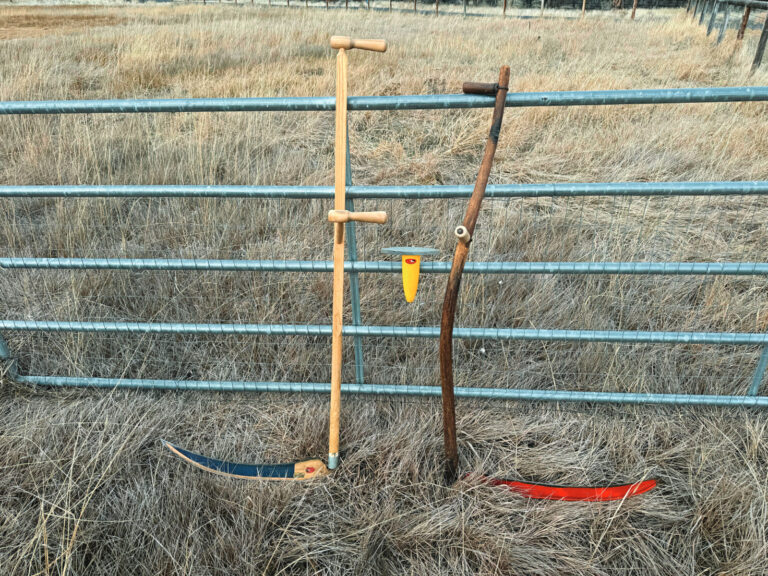
Around 100 years ago, somebody got salesperson of the year for slinging heavy-duty, brushcutter-type scythes across the United States. Over countless antique stores and garage sales, I’ve seen dozens of brush-cutting scythes and exactly one mowing scythe. These antique scythes were the brush hogs of their era for clearing out blackberry bushes, saplings, and heavy undergrowth. They were built like tanks with commensurate weight and long blades that were industrially forged thick and not peened by hand. My antique brush-cutting scythe blade without a snath (the “stick” part of the scythe) weighs in at 745 grams (almost 1.75 pounds!). Meanwhile, my grass-cutting blade has a delicate feel and a fighting weight of 400 grams (about 14 ounces).

Their intended usages are vastly different, as are the differences in wielding them. You wouldn’t limb a tree with your razor, and you wouldn’t cut veggies with an axe. The grass cutter is thin and limber, forged by hand to draw a thick piece of metal into an ever-thinner edge that scratches like a speaker cone when touched. But when aspen suckers threaten to take over the yard, I reach for the heat-treated antique warhorse and mow them down. Most of us won’t buy a specialty scythe for every occasion, but it would be a mistake not to own at least one.
If I had to choose one, it wouldn’t be the antique brush cutter. The weight makes it a chore, and the blade, while less delicate, is also less sharp. Modern bush blades are shorter and sturdier than their haying and grass-cutting cousins, but not as sturdy as ditch blades, the modern counterpart to my archaic, machine-stamped sapling guillotine. These shorter blades are also lighter and more deft for detail work along fence lines or between garden rows. In-between blades are also readily available on today’s market.
Pick the Best Scythe Fit
Some hand positions are more comfortable than others. Choose a snath that requires assembly, and wield it gently before tightening everything down. In a few quick strokes, you can get an excellent feel for where things should be for you, and if you choose one with nibs (handles) that rotate about their posts, you can dry-fit them and experiment with positioning before glue-up or bolt-down.
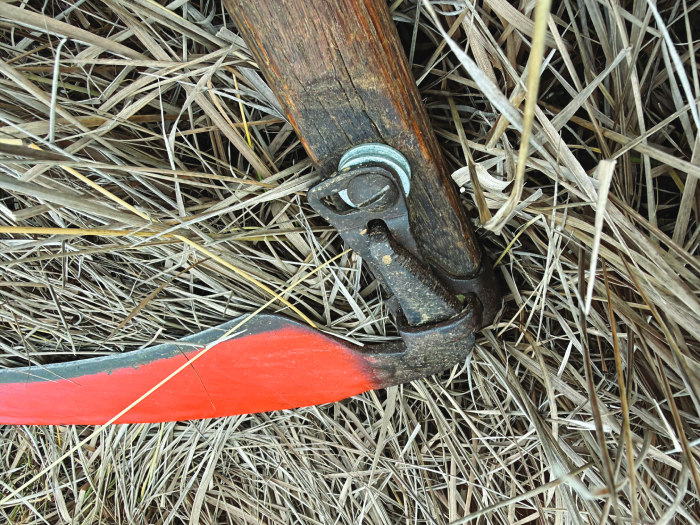
Around the world and throughout time, styles go from short and awkward to lithe and comfortable. In higher-volume stores in the U.S., you may find a one-size-fits-most, unadjustable snath, but specialty scythe shops, such as Scythe Supply and One Scythe Revolution, will ask for measurements and then get you what you need. Snaths are typically aluminum or ash wood, and you can find middle-ground fitment on a one-size-fits-most snath with adjustable nibs, which should be about 1 cubit (from your elbow to your fingertips) apart. With the blade side on the ground and the snath vertical, the first nib should be at the ball joint of your hip.
How to Use a Scythe to Cut Grass
Every single piece of matter has a resonant frequency, and a scythe is no exception. It wants to move at a certain pace, and if you try to move it at something other than that, you’re just fighting yourself. I like to think of it like trying to swing faster or slower than a swing set wants to move. At the right cadence, it’s hard to tell if a string trimmer or a scythe is less work, but there’s no question which is more enjoyable.
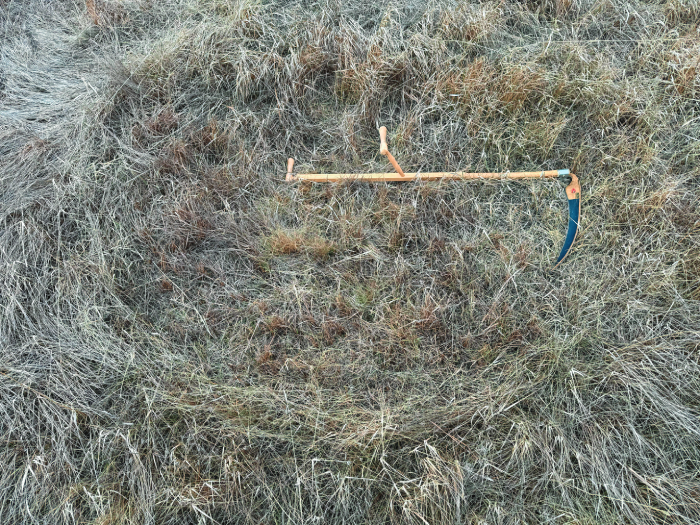
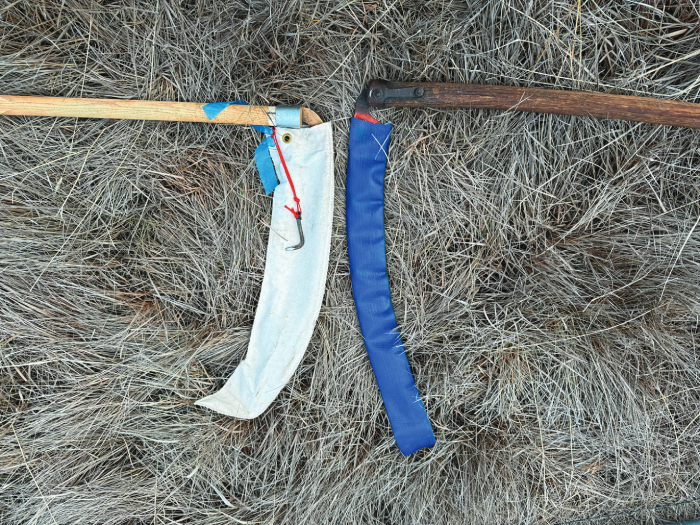
I suppose the same goes for safety. The grim reaper carries a scythe over his shoulder to symbolize the harvesting of souls, but I can see how that metaphor could come about by a careless young farmer harvesting their own soul by carrying an unguarded blade and finding a hidden stump with their foot. The lay-flat, rubberized drain hose sold at most irrigation- or plumbing-supply stores makes a sturdy sheath for the otherwise goosebumps-inspiring blade. All blade covers, particularly rubber ones, will retain moisture, so don’t put the blade away wet or dirty. A handful of clean grass makes a convenient first wipe-down rag, so a real rag can finish cleanup.
Resist the urge to target a specific plant and behead it with a chopping or pulling motion – this isn’t a chopping tool. A scythe is meant to slice in a clean and elegant manner. Pulling back to use it like a cleaver builds bad habits and bad muscle memory, both of which will make you tired and inefficient. The correct stroke takes just a little bite out of the next bit of grass but also shears it sideways. The swing shouldn’t feel like a lot of work: It should make a semicircle on the ground as you inch your feet forward according to how big a bite feels appropriate to you. If your posture is uncomfortable, you’re doing it wrong.
Position your feet a little wider than your shoulders, and don’t bend over. Shuffle your feet forward after every swing – not much, just a few inches. Keep them pointed in the direction you’re going and parallel to each other. Scything used to be the primary way to bring in the harvest: If your cadence, range, posture, and effort are uncomfortable after 10 minutes, make some adjustments so you can do it all day.
Keep your blade close to the ground to avoid wasted movement and to maximize your yield. Even very short grass can be mowed with proper ground pressure and a sharp blade. This work will strengthen your core, maybe a little asymmetrically, and give you a good cardio workout, but build up to it without trying to hay a half-acre in a day like a professional hay cutter.
Sharpening a Scythe
These things have got to be sharp to work. Real sharp. Sharp like an infomercial kitchen knife. To be this sharp, it needs to be thin enough that you can push the edge aside with your fingernail. It gets this way by peening (pounding with a hammer or on a jig) and then honing with a stone, which eventually wears down the edge until it needs to be peened again. Honing needs to happen often, a timeline measured in minutes of mowing. The peening timeline is measured in hours, but it needs to happen often enough that some mowers will bring a small specialty anvil out into the field and pound it into the ground to save a trip back to the barn during mowing.
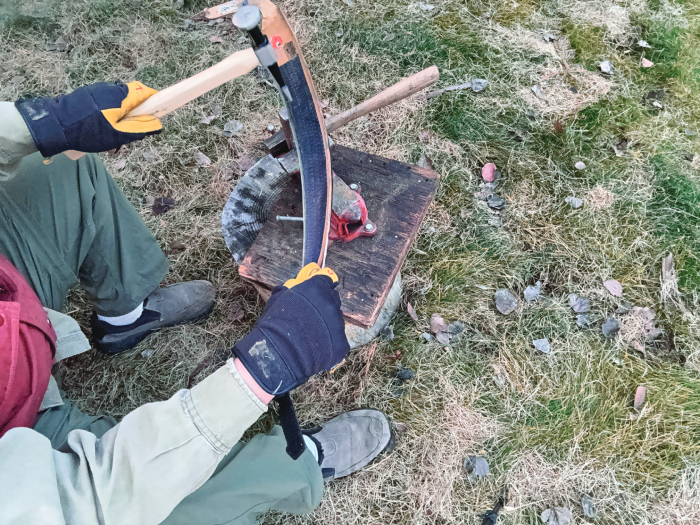
Keeping the blade sharp means you’re constantly dressing it with a stone. A holster or sheath will keep the leaf-shaped honing stone on a belt, and you can bring the stone out often for a few quick licks across the blade. After some rough mowing, you may have to do more extensive dressing, aggressively filing out dings like working out snags with a hairbrush. Once the blade is straight and free of incongruities, it will need to be peened into an edge before re-honing with a stone.
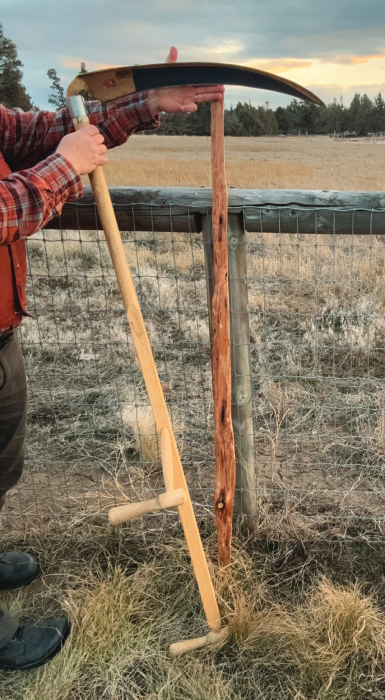
Peening does two magical things: It thins and sharpens the blade, and it strengthens it in a process called “work hardening.” That is to say, mashing the metal will change its properties, making it less prone to dulling. Modern, purpose-built peening jigs can make this easy, but a cross peen hammer on a flat anvil will let you push the metal out in stages and finesse the job to your liking. You can’t sharpen the blade without a modicum of finesse and technique, and it will take some time to get the hang of it.
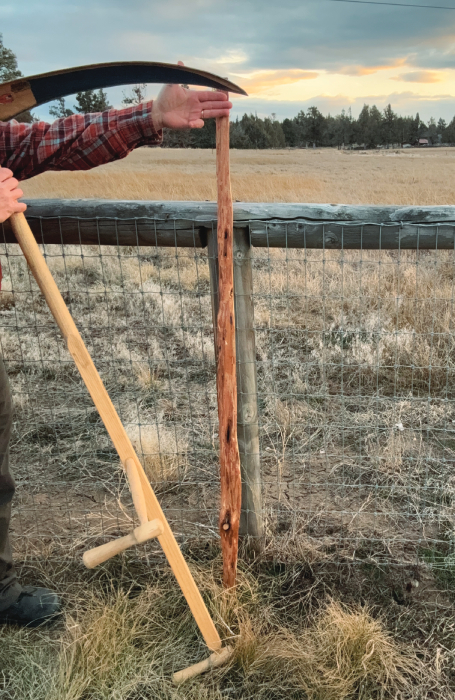
All of this sharpening and peening won’t be awesome without the blade at the proper angle in relation to the snath, the “hafting angle,” which works in conjunction with your body to take a right-sized bite out of the grass. With the snath vertical and the blade side up, measure or mark the height of the blade at its root (this part of the blade is called “the beard”), then tilt the snath until the tip of the blade is at your mark. It should be three finger widths lower than your beard mark. Don’t lose the weirdly sized square wrench used to tighten it down; it seems to be a tool unique to scythe adjustment. I’ve taken to fastening mine on a lanyard to the blade cover so I can keep track of it.
Most U.S. scythe suppliers sell a beginner kit with everything you need to bring the sound of silence into your lawn-care routine. Here’s some more to consider.
• The Scythe Book (1981) by David Tresemer
• The Scything Handbook (2016) by Ian Miller
• Slåttergubben’s YouTube channel: www.YouTube.com/@slattergubben6702
Josh Lau is a writer, an engineer, an inventor, an Eagle Scout, and a centimarathoner. He raises chickens and steers in the Pacific Northwest with his patient wife and awesome kids.
Originally published in the July/August 2026 issue of Grit magazine and regularly vetted for accuracy.