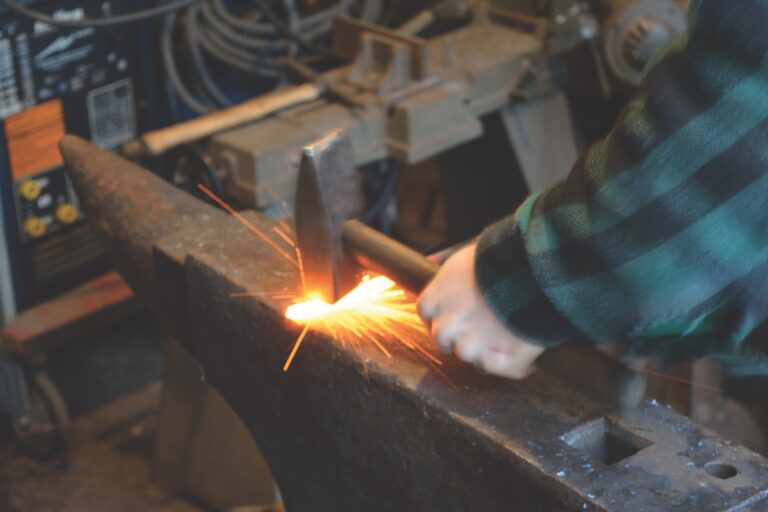
Learn how to start blacksmithing at home on a budget by using inexpensive, quality tools.
Thousands of years ago, ironworking revolutionized society by making more efficient and longer-lasting tools. While the village blacksmith has been replaced by modern machine shops and welders in the last century, traditional blacksmithing techniques are still relevant in any small-farm repair shop, as it does not require expensive tools. Blacksmithing also provides the opportunity to earn extra income selling forged tools, household items and metal artwork at craft fairs or online. It is important to realize that blacksmithing is characterized by the way in which metal is shaped; it is in the techniques rather than the tools themselves. To get metal to move and bend, we use heat and tools with varying shapes. Looking around the world, most regions have developed unique anvils, forges and hammers, but they all use the same techniques. Once you understand the methodology of working metal with heat, tools are suddenly everywhere, and you can save both money and time searching for materials when you set up your own shop.
How to Start Blacksmithing at Home
Today, regardless of the different hammers and anvils used, the basics of blacksmithing are the same across the world: Heat the metal to make it malleable, and hit it between two hard surfaces. From there, all the other tools that have driven society through the modern ages can be made. All a fully functional blacksmith shop requires is an anvil, forge, vise and hammer. Other tools that make life in the shop easier, but are not required, include files, taps and dies, a welder, cutting torch, drill press, and an angle grinder or bench grinder.
Starting out, you will need to find an anvil, vise and hammer. From there, you can make all your other tools. To avoid breaking the bank, scrap yards, antique stores, farm auctions, Craigslist.org, and classified ads will be your best friends, and look beyond traditional tools. You’ll soon develop an eye for picking out tools from unlikely materials — half of an old heat exchanger might be used for the basin of your forge.
The anvil
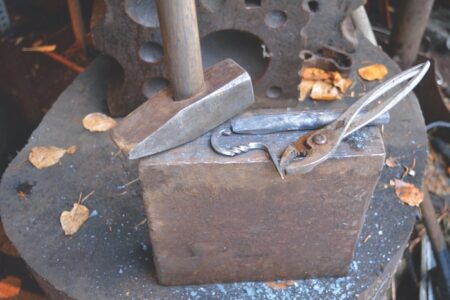
This is usually where people get into trouble when learning how to start blacksmithing, believing that they need a London pattern anvil. This classic style with a horn and heel is iconic indeed, but not absolutely necessary for your first anvil. This style of anvil only evolved over the last few hundred years in Western Europe and North America. For thousands of years before that, simple, rectangular blocks of metal were used, and still are today throughout most of the world.
When looking for an anvil, regardless if it’s a London pattern or a block of steel, you need to look at three things. First, it needs to have a 4-by-4-inch flat face. While rectangular or square faces work best for farm anvils, you can use a round hydraulic piston set on its end.
Second is to make sure it has good rebound. For a piece of metal to be a good anvil, it should rebound a hammer or ball bearing to at least 70 percent — preferably 80 or 90 percent — of the height it was dropped from. This rebound will save work for your arm muscles and make forging much easier, as you won’t have to labor as much lifting the hammer for each swing. It also means more of the force will go into the hot metal you are working, rather than be absorbed by the anvil underneath. A lack of rebound is the reason why many anvils made of cast iron and railroad track don’t work well. In fact, many old London pattern anvils that have been through a fire have lost their rebound because they have not been rehardened, making them less effective than a simple block of steel.
The third thing to look for is mass under the anvil face. A good anvil will have enough mass to keep it still when you are hammering away on it. At least 100 pounds is required in most instances, and upwards of 200 pounds for heavy forging, especially if you begin to utilize a helper with a sledge hammer. If you are able to bolt it to a heavy stand, you can use lighter anvils, but anything less than 75 pounds doesn’t last very long before it begins to break apart from wear and tear. Aside from lacking rebound, anvils made of solid cast iron often chip and wear out quickly. Unfortunately, most cheap new anvils sold today are made from cast iron, and many aspiring blacksmiths end up frustrated and quit blacksmithing because of them.
Great places to look for inexpensive quality anvils are farm auctions, heavy mechanic shops and scrap yards. Keep your eye out on travels, and let your neighbors know you’re looking for blacksmithing tools. You will be surprised how many farmers have one they are willing to part with. Remember to not be limited by the traditionally shaped anvil; function is most important. Sometimes it’s cheaper and easier to find a good piece of scrap steel that will work as well or better than the elusive London anvil.
The forge
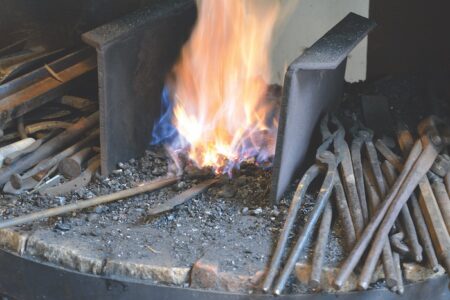
To work steel properly, you need to get it hot enough. Depending on the type of metal you are forging, this will be anywhere between 700 and 2,000 degrees Fahrenheit. Once it’s hot enough, steel becomes more like clay and is easier to work with. To heat the metal, you need three things: a fuel source capable of producing adequate heat, an air source to maximize the BTUs it produces, and a place to combine the two. A forge can range from a simple fire pit dug into the earth to a modern insulated propane-fired and refractory-insulated metal box. Regardless of the forge type, if your shop is inside, make sure you have adequate ventilation and a carbon monoxide alarm to prevent suffocation and injury.
There are several types of fuel you can use — gas and coal being used mostly by professionals — but charcoal is the most common among small-scale blacksmiths. The good news is that for farmstead blacksmiths, wood for charcoal is generally easy to obtain. Most farms have a pile of wood scraps from shops, fences or shelterbelts.
While you can sometimes get a forge cheaply from farm auctions, antique shops and neighbors, it’s also very easy to make one out of scrap plate or old brake drums and pipe. There are many plans out there for the traditional side-blast forge and more modern duck’s-nest tuyeres, and all work well with charcoal. If you are using charcoal from softwood, I would recommend either a side-blast or a deeper tuyere than you would use with coal. This will help maintain the heat if using charcoal, as charcoal does not burn as hot as coal. The depth of my duck’s-nest fire pot is 5-1/2 inches, compared to a commercial coal depth of 3-1/2 to 4 inches, and it sufficiently heats the metal.
The vise
Unless you are very creative, it is easiest to purchase a post vise from an antique store or a farm auction. They often go for very little cost, especially if they are missing a spring or post, which can be repaired easily.
Hammers
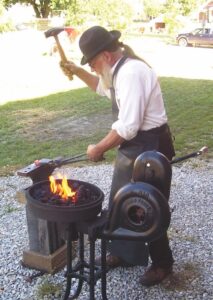
If you really want to save money, you can often pick these up cheap at farm auctions or yard sales. Otherwise, you can simply pick up a cross-peen hammer from your local hardware or farm supply store. A good size for a hammer is between 2 and 3 pounds to maximize weight without tiring yourself out too quickly. Hammer control is more important for efficiency than weight. Once you have a hammer, grind off the sharp edges for a smooth finish on your work.
With these basic tools, you can make any other tools you might need. First on the list should be tongs to hold small pieces of metal, a fire rake, and a few different sized chisels and punches. Making your own repairs with tools you made will leave you feeling a satisfaction similar to other blacksmiths throughout history.
Want to learn more about blacksmithing? Read all about DIY axe-making in How to Make an Axe.
Ryan Ridgway has been a blacksmith for over 15 years. His blacksmithing career began on the family farm where he found it was easier to make repairs himself. He used his skills to help pay his way through college selling his ironwork online and at local craft fairs.