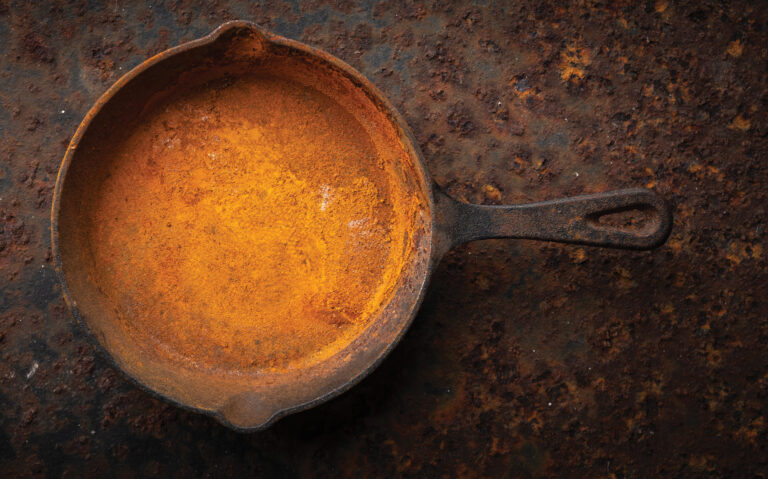
Kick rust to the curb by learning to clean pans with DIY electrolysis for cast iron and seasoning it with a specially made product or a common cooking oil.
Water and electricity don’t mix, except in the case of electrolysis. People who collect and restore old cast-iron cookware use electrolysis tanks (E-tanks) to remove rust and even seasoning. Creating and using a homemade E-tank is relatively safe if done properly. But before we dive into the details, let’s take a look at what electrolysis for cast iron is and how it works.
Explaining Electrolysis
Electrolysis has many uses. In the case of rust removal, it involves an electrical charge that travels from one piece of metal to another through an electrolyte solution (a liquid containing charged ions that make it capable of conducting an electrical current). This effects a chemical change in the metal pieces, damaging a sacrificial piece (called the “sacrificial anode”) while repairing the other item in the tank (your grandmother’s cast-iron skillet).
In electrochemical terms, electrolysis decomposes chemical compounds. Some resultant atoms are liberated as hydrogen and oxygen, while others are deposited as a solid on the electrodes (black sodium carbonate and rust). As for the rust on your pan, it either detaches from the surface of the cast iron or is converted into a deposit that can be easily removed. Electrolysis is, technically, a rust reduction method, not rust removal, because it reduces hard, red rust to soft, black rust that you can then remove. Because electrolysis for cast iron doesn’t cause scarring or pitting on the pan, it’s the preferred method of nearly all collectors and restorers of cast iron.
Build Your Own E-Tank
Here’s a list of supplies and materials you’ll need to build a homemade E-tank to reduce the rust on your cast-iron cookware.
- Heavy-duty plastic container, such as a 20-gallon garbage can, large enough to suspend the cast-iron pan with a little room around the edge for placing the anodes. You could also use a 55-gallon plastic barrel with the top cut out of the rim, but not all E-tanks need to be large. The smaller the E-tank, the more efficient it’ll be. Just make sure it’s big enough to hold your largest piece of cast iron and the anodes.
- Sacrificial anodes made of regular steel, also known as “carbon steel” (not stainless steel). Good sources include old rebar and plain steel sheeting.
- Zip ties to mount the anodes to the tank.
- Wire to connect the anodes, rated for at least double the load the charger is rated for. Instead of wire, you can use a few sets of cheap jumper cables and make a series of short jumpers from them.
- Washing soda, aka sodium carbonate (not baking soda, which is sodium bicarbonate). This will be used to create the electrolyte solution that carries the current.
- Bare steel wire, such as rebar tie wire, for hanging your pan(s) inside the E-tank.
- Piece of 2×4 lumber, or a piece of rebar, from which to hang the cast iron.
- Water to submerge the cast iron.
- Manual car battery charger, between 2 and 10 amps. An automatic charger won’t work, because the safety feature will cause it to shut down automatically.
- Steel-wool pad or a steel-wire brush for cleaning the cast iron following electrolysis.
- Rubber gloves to protect your hands while removing cookware from the tank.
Identify a safe location with adequate ventilation for your E-tank, because it’ll produce hydrogen in small amounts. Hydrogen is highly flammable, so don’t put the tank next to your cooking grill or burn barrel. You may also need to dump the tank at some point, so if you’re using a large container that’s difficult to move, place it in an area where it can be tipped to dump when you want to refresh the water. (The water isn’t toxic, because you’re using plain steel anodes.) Finally, this project will produce a small electrical charge, so exercise caution during use.
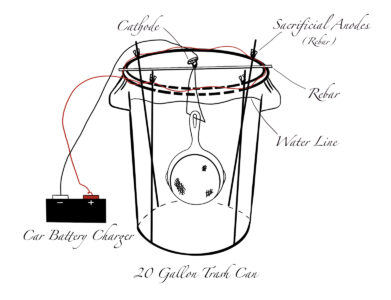
Refer to the illustration to assemble your E-tank. Begin by drilling holes at the top of the container. Use zip ties to loosely mount the anodes to the tank, and then attach the anodes together using wire. A single wire should be wrapped around each anode until all anodes are connected. If you’re using copper wire, make sure it doesn’t come into contact with the water, because it can further corrode the iron.
Now you’re ready to begin the electrolysis for cast iron process. First, add washing soda to the empty tank and then pour in water. Use 1⁄2 cup washing soda for every 10 gallons water. Stir until the washing soda has dissolved.
Wrap one end of the steel wire around the 2×4 and the other end around the handle of your cast-iron cookware. Rest the 2×4 across the top of the tank, allowing the pan to hang in the water. Be sure the cookware doesn’t come into contact with the anodes.
Attach the negative (black) lead to the rebar tie wire attached to the cast iron. Don’t hook these up backward! If you attach the positive (red) lead to your cast iron, it’ll cause it to rust and dissolve. An easy way to remember this is the phrase “Red will rust.” Attach the positive (red) lead to the sacrificial anodes.
Turn on the battery charger and set the voltage and current to the lowest setting. The cast iron should start to bubble in the water. Check on the pan periodically by first turning off the power supply and then lifting the cast iron out of the tank by the 2×4.
The electrolysis for cast iron process is complete when all the reddish-brown rust is gone or has turned black. This can take from an hour to a day, depending on the amount of rust, the size and position of the anodes, and the amperage of your power supply.
Place the cast-iron vessel in a sink and clean off any remaining residue with steel wool or a steel-wire brush. If you have trouble removing the black residue, you may need to put the pan back in the tank for a while.
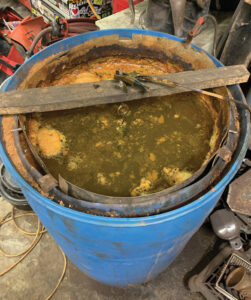
The electrolyte solution will turn black after repeated use, but you can continue to use it indefinitely. Simply add water to replace any that’s evaporated. When you want to refresh the solution, you can dump it onto the grass. For this reason, you should never use stainless-steel anodes in an E-tank (see “Safe Sacrificial Anodes”). Be sure to clean the anodes periodically, because dirty anodes are inefficient at removing rust.
Final Cleanup and Seasoning
After you’ve removed the rust, give your pan a final scrub on all surfaces with a steel scrubbing pad. Add some mild dish detergent and continue scrubbing until clean. Rinse thoroughly with cold water and dry. If the towels become noticeably dirty, scrub the pan again with soap.
After your cast iron is clean and towel-dried, place it in a warm oven (between 200- and 350-degrees Fahrenheit) for 15 minutes to dry thoroughly. Then, you’re ready to re-season the pan.
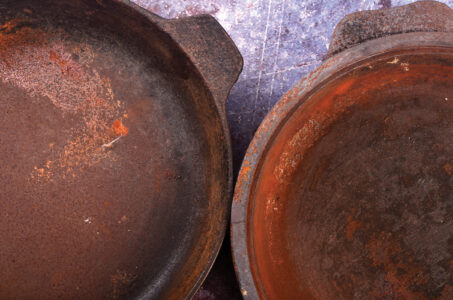
A lot of information exists online about the best oils and temperatures to use when seasoning. To determine which method is best for you, it helps to understand the science. During the seasoning process, oil is applied to the cast iron and then heated. The heat causes the oil to polymerize, meaning hundreds of molecules link together through chemical bonds. These polymers become trapped within the pitted surface of the pan and become partly bonded to the pan itself, creating the nonstick layer that we call seasoning.
The level of heat required for proper seasoning is a hot topic in the collector community. One camp insists the oil must be heated past the smoke point, while another argues that the oil should never be heated past the smoke point. The issue is safety: The smoke point is the temperature at which the oil begins to decompose and emit carcinogenic fumes. Folks like me who want to avoid breathing in these fumes will take care to season their pans below the smoke point. (Some common smoke points from my book Modern Cast Iron are listed in the “Common Smoke Points” chart below.)
Lovers of cast iron who insist the seasoning process works best when pans are heated beyond the oil’s smoke point say the process gives their pans a deep, dark color – and they’re right. But this is carbonization, not polymerization. Sam Rosolina, a scientist whose background is in analytical chemistry, puts it this way: “Polymerization is when the polymer is initially formed (and carbon chains stick to the iron and line up together to form a natural plastic); carbonization is essentially burning it after it’s all lined up and organized so that it’s harder and more resistant to acidity, for example.”
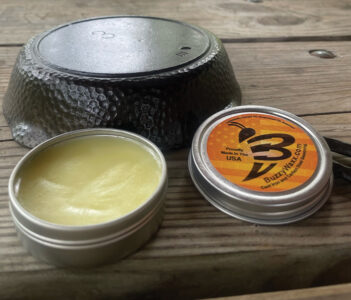
Carbonization is attractive but not necessary for everyday cooking. Rosolina makes an educated guess based on his combined experiences in the lab and in the kitchen: “I think once [a pan] is polymerized, continued cooking will help the carbonization process over time; it may just not be as efficient. It probably means that re-seasoning will need to happen more often compared to [pans heated] past the smoke point during the seasoning process.”
Rosolina has a practical approach regarding carcinogenic fumes. “Anytime something burns, smoke is produced, which is inherently carcinogenic. However, with a good hood vent, it shouldn’t be a problem. Remember that grilling and smoking foods is also inherently carcinogenic, so it’s worth adding that context and weighing those risks. As long as you’re not directly breathing in the smoke for long periods of time, the health risk is low.”
Common Smoke Point
Here are smoke points for oils and fats frequently used in cooking (listed in Fahrenheit).
- Butter 350 degrees
- Canola oil (expeller-pressed) 400 degrees
- Coconut oil 350 degrees
- Extra-virgin olive oil 320 degrees
- Ghee 485 degrees
- Grapeseed oil 420 degrees
- Lard 370 degrees
- Palm kernel oil 450 degrees
- Peanut oil (refined) 450 degrees
- Safflower oil (semi-refined) 320 degrees
- Sesame oil 410 degrees
- Sesame oil (unrefined) 350 degrees
- Sunflower oil (semi-refined) 450 degrees
- Vegetable shortening 360 degrees
Safe Sacrificial Anodes
Some collectors use stainless steel for the sacrificial anodes in their E-tanks, claiming that stainless doesn’t corrode like regular steel and therefore requires less cleanup. In fact, stainless steel does corrode, just at a slower rate – and the resulting electrolysis water will contain carcinogenic compounds, because of the chromium used in creating stainless steel.
I recommend using plain steel anodes in a DIY E-tank. If you use stainless steel, the chromium (0) will corrode and oxidize during electrolysis right along with the steel, turning it into chromium (III) and then chromium (VI), known as “hexavalent chromium” or “chromium 6.” “Hex-chrome,” as it’s commonly called, is a known carcinogen that must be legally disposed of as a hazardous waste.
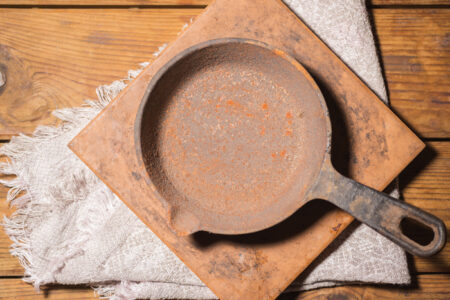
Can a little homemade E-tank actually produce hex-chrome? I contacted Sam Rosolina, who holds a doctorate in analytical chemistry from the University of Tennessee and has researched trace-level environmental toxins. He says, “Chromium (VI) is carcinogenic, but chromium (III) is an essential trace element for humans. The amount of chromium (VI) produced compared to chromium (III) is really dependent on the setup. If you can control the voltage in your E-tank, you may be able to keep it below the voltage required to produce chromium (VI). In general, it’s really unlikely that a home setup will produce chromium (VI) in a high enough amount to be a serious human health or environmental threat, but I say it’s safest to just use a plain steel anode or a graphite carbon anode.”
Bottom line: Use regular – not stainless – steel for the sacrificial anodes in your homemade E-tank.
Try your own DIY electrolysis for cast iron and let us know how it turns out!
Ashley L. Jones is a teacher and collector of cast iron cookware who’s authored two books on restoring and cooking with cast iron. This excerpt on electrolysis for cast iron is taken from Skilletheads (Red Lightning Books).