Puffball recipes and puffball mushroom facts: forage, cook, and enjoy one of America’s most prolific wild mushrooms.
Various edible mushroom families offer many charms. Come spring, the sheer joy of finding the first yellow, black, tulip, or half-free morel is electrifying. The diverse species of chicken of the woods arguably rank as the best-tasting and most versatile American mushrooms for cooking.
But I’m most passionate about foraging the puffball clan. Perhaps it’s because of the wide variety of sizes. For example, the giant puffball (Calvatia gigantea) boasts the size, color, and shape of a soccer ball, while the diminutive Curtis’s (Lycoperdon curtisii) is barely the diameter of a penny and an inch or so tall. Maybe I crave it because I can forage for the gem-studded (L. perlatum) as early as June and the purple-spored (C. cyathiformis) well into December.
Giant Puffball
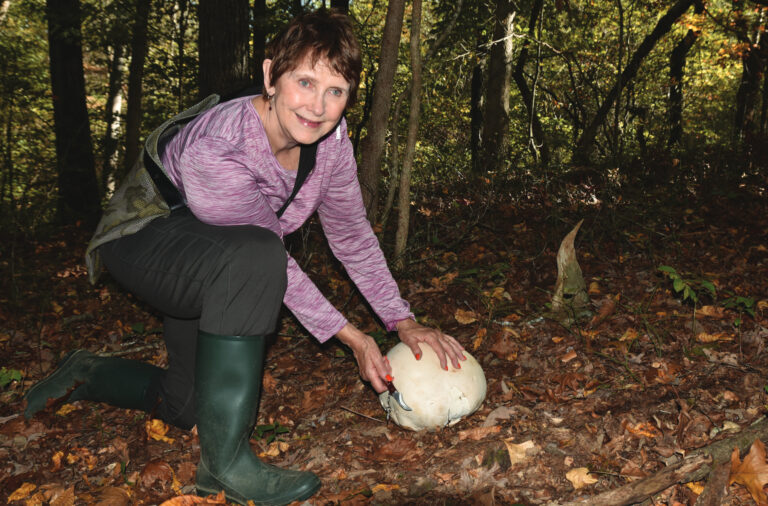
 One of my biggest foraging thrills came in October 2024, high on a West Virginia mountain, as I hunted turkeys. Walking across a pasture, I espied (growing under a wild grape arbor along a fence line) a giant puffball, my first ever of this species. This pure-white freak of nature can top 10 inches in height and commonly approaches 2 feet in width. And reports of much bigger specimens exist. I found a second giant an hour or so later, and a third several days later. Heavy rains had pelted the area, summoning these behemoths from the soil bank.
Giant puffballs can appear as early as May, though they’re much more common from summer through October. Like all the puffballs covered in this story, they feature white flesh and are edible while they remain white. When the giant’s insides begin to turn yellowish-green, that means spores have formed, rendering it inedible. This species dwells in eastern and central North America as well as California. A similar species, the Western giant puffball (C. booniana), lives in the Rockies and westward.
Skull-Shaped Puffball
The skull-shaped puffball could be confused with several other puffball species when just emerging from the ground. But when fully formed, C. craniiformis‘ identity is abundantly clear. Not many mushrooms look like skull-shaped human brains anchored in the soil.

I most recently found this choice mushroom while walking through the woods in pitch dark during Virginia’s October bow season for deer. My flashlight’s beam glanced off the forest floor, highlighting a skull-shaped puffball partially hidden in the forest duff. Though I was in a hurry to reach my ladder stand, I took time to harvest this prize.
This specimen grew in an oak stand, but I found three growing in a grassy lawn later that October. Foragers can typically find this white-to-tan-colored species, sometimes called the “brain-shaped puffball,” from August through October. If you cut it open and discover yellowish-brown spores, it’s inedible. Skull-shaped puffballs typically grow 3 to 8 inches tall and wide.
Purple-Spored Puffball

My wife, Elaine, and I thought our first purple-spored puffball looked like a baseball glued to a softball and tilted over. The mushroom identification books describe this shape as hemispherical, a fancy way of stating what I just wrote. C. cyathiformis thrives over much of the eastern and southern regions of the U.S. and typically grows 3 to 8 inches tall and wide. I’ve mostly found specimens about 6 inches tall and 3 inches wide, growing in pastures or open fields from October through December. However, the species can appear as early as July.
The purple-spored puffball hosts spores that are … purple. The hollowed-out violet-hued spent mushrooms persist well into winter, and I’m thrilled to find their cup-like remains in January and February so I can forage in that same area come early autumn.
Pear-Shaped Puffball

While the previous three puffballs grow to considerable sizes, the next three do not. L. pyriforme is often a little over an inch high and an inch or so wide. Unlike its larger members, which grow in loam, the light-brown pear-shaped puffball thrives on dead wood, such as rotting logs and stumps, typically in large colonies. In short, find one, and you can harvest scores until the greenish-yellow spores form.
To be sure they’re puffballs, gently tap the darker-looking members and watch as their tops expel spores through a top pore. I’ve only found this species in October and November, but they’re reputed to appear as early as July. This is one of the most widespread mushrooms in the eastern and central United States.
Gem-Studded Puffball
Gem-studded puffballs (L. perlatum) look like white turbans with tiny spines adorning them. About 1 to 3 inches tall and 1 to 2-1/2 inches wide, this fungus often experiences breaking spines. This species also hosts a top pore where it expels greenish-brown spores.
I’ve found gem-studded puffballs at the tail end of June, but July and August are prime gathering times, and they can even be found into October. Natural haunts include open woods and grassy roads and fields; the species can occur in singles but also regularly occurs in small colonies, and it’s one of the most widespread puffball species in North America.

Curtis’s Puffball
Curtis’s puffball (L. curtisii) is one of the smallest mushrooms, puffball or otherwise, usually less than 3/4 inch in diameter. This petite white mushroom with tiny spikes typically grows in dense colonies in grassy areas, beside old logging roads, in ditches, and along roadsides. Curtis’s emit olive-green spores.
Because of their small size, Curtis’s puffballs are never the main ingredient in entrées. Elaine stir-fries them for a minute or two, then adds them to salads. For soups and egg dishes, she just tosses them in at the last minute of cooking.

Always cook all puffballs and most other wild edible mushrooms before eating. I sauté mushroom slices in half olive oil, half butter, then sprinkle salt and garlic butter seasoning to taste and cook on low for about 8 minutes. If using mushrooms with an entrée, simply cook them as the recipe indicates.
How to Cook Puffball Recipes
Below are some of Elaine’s creations.
Cockerel Pot Pie with Skull-Shaped Mushrooms Recipe
Come fall, we often cull cockerels, but any chicken will work well in this dish. Yield: 1 full-sized pie.

Ingredients
- 2 prepared pie crusts
- 2 tablespoons olive oil
- 1 cup chopped skull-shaped puffball mushrooms; any puffball or other mushrooms will suffice
- 1/4 cup chopped shallots
- 2 cloves garlic, minced
- 1 cup asparagus, cut into 1-inch pieces
- 1 teaspoon fresh thyme
- 3 tablespoons butter
- 1/3 cup, plus 1 tablespoon flour
- 1-1/2 cups chicken broth
- 3/4 cup milk
- 1/4 cup cream
- 3 cups precooked chicken, cut into chunks
- 1/4 teaspoon salt
- 1/4 teaspoon pepper
- Preheat oven to 400 F.
- Line a pie pan with one pie crust. Bake uncovered for 10 minutes. Remove from the oven and set aside.
- Heat a large skillet over medium. Add olive oil. Once the oil shimmers with heat, add mushrooms and shallots. Sauté about 5 minutes.
- Add minced garlic and cook another minute; add asparagus and thyme, then sauté 3 to 4 minutes more.
- Add butter to the skillet. When melted, stir in flour and cook about 2 minutes.
- Pour broth over the vegetable mix. Add milk and cream, stirring to mix well. Allow to cook a minute or two to thicken.
- Stir in chopped chicken. Season with salt and pepper, adjusting according to taste.
- Spoon contents of pan onto prebaked pie crust. Top with the second crust.
- Cut 4 or 5 slices in the top crust to allow steam to escape. Bake at 400 F for 35 to 40 minutes, until the top crust is golden and the internal temperature is 165 F.
- Cool 10 minutes before slicing.
Venison Tenderloin with Giant Puffball Mushroom Sauce Recipe
The only red meat we eat comes from deer Bruce has killed, so I’ve created numerous venison-themed meals. You can substitute various beef or pork cuts for venison in either of these latter two recipes. Yield: 4 servings.

Ingredients
- 1-1/2 pounds venison tenderloin cutlet
- 1/4 cup Allegro Original Marinade
- 2 tablespoons butter
- 1 tablespoon olive oil
- 1/2 cup sliced shallots
- 1 cup giant puffball mushrooms, cubed
- 1/4 to 1/2 teaspoon salt
- 1/4 teaspoon ground pepper
- 1/4 teaspoon garlic powder
- 2 tablespoons flour
- 3/4 cup broth (venison, chicken, or vegetable)
- 1 to 2 tablespoons cream
- About 1 hour before cooking, place venison tenderloin cutlets in a bowl and cover with marinade. Refrigerate until ready to use.
- Preheat oven to 400 F. Cover a baking sheet with a piece of parchment paper.
- Place cutlets in a single layer on parchment paper. Bake in oven for 10 minutes or until desired doneness.
- While baking cutlets, prepare the sauce. In a medium skillet, heat butter and oil over medium heat.
- Add shallots and giant puffball pieces. Cook until the shallots have tenderized, for about 8 minutes.
- When tender, sprinkle with salt, pepper, and garlic powder. Stir. Sprinkle in flour and stir about 2 minutes more.
- Add part of the broth, stirring as you add. Add more as needed to get the desired thickness.
- Remove from heat and stir in cream.
- Spoon sauce over tenderloin cutlets.
Open-Faced Tenderloin with Giant Puffball Slabs Recipe
Our mushroom mentor, Jeff Huffman, slices giant puffballs and cooks them with or without a batter coating. Then he employs the slices as a bread substitute for an open-faced sandwich.
Yield: 4 sandwiches.

- 1 pound venison tenderloin, cut and shaped into 4 pieces or patties
- 2 to 3 tablespoons Allegro Original Marinade
- 1 tablespoon olive oil
- 1 tablespoon butter
- 4 slices giant puffball, each about 1/2 inch thick and approximately the size of a playing card
- 1/8 teaspoon salt
- 1/8 teaspoon garlic powder
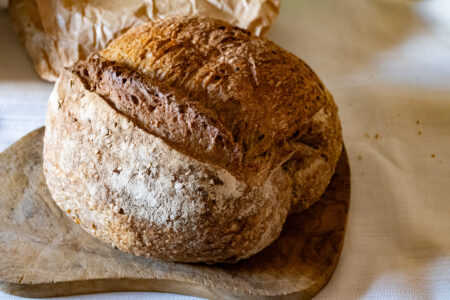
- 4 slices homemade sourdough bread (you can also use store-bought sourdough bread)
- Mustard or condiments of your choice
- 1/2 cup fresh spinach
- Sliced cheddar cheese
- Combine venison tenderloin and marinade in a shallow bowl. Refrigerate for 1 to 2 hours.
- Preheat the oven to 400 F. Let the loins come to room temperature while the oven preheats.
- Place tenderloin on parchment paper on a baking sheet. Bake 10 to 12 minutes, flipping pieces over once during baking.
- While tenderloins bake, heat oil and butter in a large skillet over medium-high heat.
- When the butter is foamy, place puffball slices into the skillet. Sprinkle with salt and garlic powder. Cook 3 to 4 minutes per side.
- Remove puffball slices and drain on a paper towel.
- Assemble sandwiches atop sourdough with mustard, spinach, puffball slices, tenderloin, and cheese.
Bruce and Elaine Ingram are the authors of Living the Locavore Lifestyle, a book about hunting, fishing, and gathering for food. For more information, email them at BruceIngramOutdoors@Gmail.com.
Originally published in the September/October 2026 issue of Grit magazine and regularly vetted for accuracy.