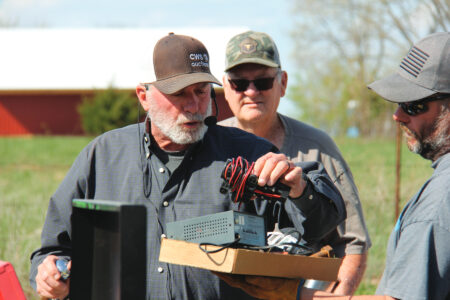
Most people probably wouldn’t think of an auctioneer as the central pillar of a community, but in Gravette, Arkansas, Dwayne Craig is certainly that. He’s a fundraiser, cattleman, realtor, teacher, civic leader, and auctioneer all rolled into one – and the locals appreciate it. But mostly, he’s behind a microphone somewhere, ensuring the hiring party gets paid and the folks placing the bid pay up and get their treasure.
Save for 10 years spent in pipeline construction from the mid-’70s to the mid-’80s, Craig is a lifelong resident of this small town in northwest Arkansas along the confluence of the Oklahoma and Missouri borders. But those years spent in Kearney, Missouri, turned into the magic that makes for a special life. He found an ad in the local paper for the Missouri Auction School, advertised as “the world’s oldest and largest auction school.” Since he had some downtime on a Thursday, Craig called the 800 number for the school, and by Monday, he was enrolled.
Getting Started
“I had no idea that people could make a living as an auctioneer, that it’d be a profession. So, I went because I wanted to be able to talk fast and I was impressed by how an auctioneer could hold a crowd’s attention and mesmerize the crowd,” says Craig. “And that’s what I wanted to be able to do. But I was also influenced a little bit by Leroy Van Dyke, the singer-songwriter behind the song ‘The Auctioneer.’ I went to the school not knowing if you could make a living as an auctioneer or not.”
Although he remained in the construction business even as he stuck a toe in the water of conducting public sales, he stayed close to his mentors at the auction school. “I told them, ‘In a couple of years, I’m thinking about making a change – a career change – and I would be interested in auctioneering.’ I’d see school owner Dick DeWeese at conventions and other auctions, but he never pushed me. About two years after I told him about making a change, he called me one evening to talk about becoming an instructor.” Craig’s first experience as an instructor with the Missouri school came in December of 1990, and he’s been with the school ever since.
During this time, Craig came back to Gravette to set up shop permanently. “My last name was pretty well-known because my father was a mechanic for the John Deere dealership [in nearby Southwest City, Missouri], and my mom was a nurse at the hospital,” says Craig. “I attribute my success in the auction business to the strength of my last name. We’ve been really blessed and very successful at it. I’ve worked hard and I’ve got a good team, probably the best auction team in the country and they’ve been with me for years.”
In the Business
Craig has around 100 auctioneer engagements a year, not including charity programs, such as fundraising for Sheep Dog Impact Assistance, a nonprofit dedicated to disaster-response and veterans-assistance programs, and for a young outdoorsman program in McDonald County, Missouri. In addition, he works on fundraisers for a number of local organizations that offer education scholarships, plus one-off efforts, such as an auction to benefit a local man who had a heart transplant.
“We do all types of auctions, a lot of farm- and household-type auctions. The ideal auction for me would be in spring when it’s a nice, sunny day, not hot, and it’s a farm auction where somebody’s retired, not a bankruptcy or a divorce situation, but somebody’s moving to town because they can’t take care of the farm like they used to,” says Craig. “If the seller is a well-respected member of the community, everybody turns out. So, you’ll have a large crowd, and usually prices are good when you have a large crowd. That would be one of my favorite auctions.”
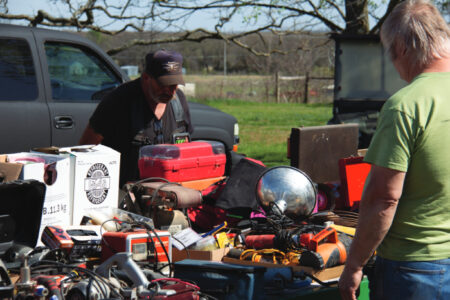
At the opposite end of the scale is a bankruptcy or someone falling on hard times and a bank or lending institution has moved for a sale. In that situation, Craig says there’s no guarantee people are going to show up for the auction. Other farmers or local people might not like what’s happening to their neighbor or friend.
And it’s not the chill of winter that keeps the crowds away, at least not in this part of the country. It’s high heat and humidity. “Summer heat will keep more people away than anything. A farm auction in the summertime is the worst time in the world to have an auction, because if it’s good weather, a farmer’s going to be in the field. You’re not going to pull a farmer out of the field,” says Craig. “I don’t care if it’s his brother’s auction. If he’s got planting to do or hay to cut, he’s going to do it. But if there’s rain, if the seller is lucky enough to get a rainy day, everybody shows up because they think nobody else is going to be there.”
In addition to his local auction pursuits, Craig contracts through third parties to do auctions for the U.S. Treasury Department. He’s done heavy-equipment auctions in the Philippines, Ireland, Northern Ireland, England, Mexico, and Canada. “I’ve sold seized property, real estate, and personal property in 40 states, and we still do seized-asset sales in Fort Lauderdale, Florida; Riverside, California; and Dayton, New Jersey. It could be drug seizure, it could be an IRS criminal investigation, or it could be customs or border protection, anything under the U.S. Treasury that’s seized,” he says. “It goes into a big warehouse, and once it’s released for auction, then the company that I sell for calls me. Being an instructor at Missouri Auction School has opened a lot of doors.”
How It Works
There are plenty of nuts and bolts and moving parts in setting up and conducting an auction. To the uninitiated, the infrastructure requirements seem astounding. Skid steers, tractors, trailers, an office trailer, and computers are just part of what’s required to conduct a public sale.
“Not every auction is a household auction, so you’re not going to need a skid steer every time. But a sale out in the country with a lot of old tractors and equipment, bulldozers – that’ll require a setup with a skid steer to move the heavy stuff,” Craig says. “Sometimes, we’ll have to provide load-out for a day or two afterward. If it’s a household auction, we’ll have 40 or 50 folding tables, and we’ll bring along farm wagons and flatbed wagons to set items on.”
Many newcomers to public sales don’t understand that their purchase has to be paid for on the day of sale; there’s no layaway policy for people buying a 40-year-old tractor. “It’s our responsibility when we say ‘sold’ to look after the purchase,” Craig says. “A lot of new people call us to ask questions, and we give them the right answers. It’s frustrating when you have somebody who has a winning bid, and they leave to get a trailer but don’t pay before leaving, and you’re sitting around for an hour after the auction waiting on them.”
The leader of an auction is bound financially to the seller, that’s clear. But there’s an effort to ensure everyone comes out with a fair shake. Word-of-mouth is big on the public sale circuit.
“Our goal is to get as much money as possible for the seller, but we want to have a satisfied customer whether a seller or a buyer,” says Craig. “Our obligation is to the seller when we do an auction, but we want to leave a good taste in everybody’s mouth. We want people who came to leave happy with their purchases. We want to be fair, and we want to be transparent. We don’t want any secrets, just be fair to both sides.”
Getting the Word Out
Some people come to an auction not to purchase anything, but rather to support the seller. They fluff up the crowd, talk to the locals, and help make the day something special. And an auction actually is an event, one that requires not just supportive relatives and friends, but also some marketing magic to spread the word to hit the right target market.
“If you’re selling, let’s say, restaurant equipment, you’ll want to target all the restaurants in a radius of 150 to 300 miles. I might secure a mailing list, so we might do a direct mail in order to get the right buyers there,” says Craig. “Today, I’m going to say Facebook marketing and social media is probably our best marketing tool. Before Facebook, radio and newspaper advertising was the best; we used to do a lot more direct mail. We don’t do much of that anymore due to social media; social media gets you a pretty good crowd, and most people go to our Facebook page.”
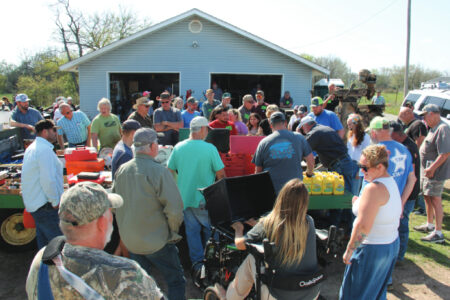
Then there’s day-of technology. Craig dates back to a time before the mobile public address (PA) system. Now, he wouldn’t dream of doing an auction without it. “When I first started, the transactions were handwritten on pieces of paper and tickets. You’d set up on a card table inside a garage or a chicken coop with your cashier,” he says. “Today, we have the office trailer, and that’s where all the computers and payment happens. Our clerk goes along with the auctioneer; the clerk transmits the selling data by radio to the cashier inside the office trailer. The second we say sold, they have that information in the office trailer. Technology is the biggest change in the 43 years I’ve been in the business.”
Auctioneering is a year-round job. Craig has done auctions as late as Dec. 20 and as early as New Year’s Day, and the first of the year is one of the best days to have an auction. Actually, the best three-month period for public sales in Craig’s estimation are January through March.
Home Sweet Home
When he’s not out on the auction trail, Craig maintains a farm with 160 or so head of cattle, harvests hay in season, and maybe does a little real-estate selling in the farm and ranch segment. His various business interests provide a true dichotomy: one day, feeding the cows; the next day, selling a government-seized jet that belonged to a drug lord. The paradox of financial and social issues colliding with pastoral country life isn’t lost on him.
“When I was growing up, I could tell you usually by the time of day or the sound of the vehicle coming down our dirt road or the amount of dust flying who it was, because the same guys went by our house every day to go to work or to town. Now, the road out here is paved, and we have thousands of cars per day on it,” says Craig. “Every small town was kind of a trade center, and Gravette was no exception. At one time, the town had three grocery stores, two lumberyards, and two livestock markets. You didn’t go anywhere other than the closest town to trade, to buy a car or groceries, or to see the doctor. The fact is, people don’t hesitate to drive an hour to do shopping or to do anything now. It’s a real struggle to keep the doors open on a small business when people drive right through your town to go somewhere else to shop.”
It’s been a memorable journey for Craig, seeing his world grow and change from behind a microphone, with a few hundred folks looking for a deal or an opportunity to get the equipment they need to keep a business or a farm operating. He lives in a small place (Gravette’s population is 3,600), but his impact is big. It’s capitalism and commerce, but it’s equal parts helping your neighbor and respecting the past. If it’s 65 degrees and clear, the crowds will be big. If it’s 110 degrees in the shade, the crowds will be thin, but he’ll still be there. Someone needs to sell that tractor.
Steve Wilcox is a writer based in Bella Vista, Arkansas. He focuses on topics relating to rural America, small-town life, and small business.