Choose the right tools and techniques for backyard orchard fruit tree pruning in order to guarantee healthier plant life and better harvests from your backyard orchard.
Pruning and weeding are often performed at the same time and both involve elements being removed from the orchard, so they are discussed together.
The Basics of Fruit Tree Pruning
Trees cannot heal their wounds, not the way we can. Trees wall off damaged parts with a combination of tissue and chemicals to keep decay from spreading further. Then, if they have the energy, they grow past it. Trees don’t heal, they close. Every wound is permanent, and pruning inflicts wounds. Learn to do the least damage to prolong and enhance the lives of your trees.
Trees mount their defense against decay at the branch bark ridge and the branch collar. A swelling circles all the way around the base of a branch where it joins the trunk or another branch, and a ridge of bark pushes up in the angle between the two. These structures house the highest concentrations of the chemicals released in response to wounding. Pruning cuts made just outside the branch bark ridge and the branch collar supply the tree its best opportunity to compartmentalize the wound. Trees don’t always succeed in preventing the spread of decay, even with properly made pruning cuts. The larger the diameter of the wound, the more time the tree needs to close it, and the tougher the battle to contain decay. Big cuts make hollow trees. Try to keep the diameter of pruning cut wounds to less than 2 inches (5.1 cm).
Tree and plant stems have buds along their lengths and at their ends. Either leaves or flowers emerge from the buds. Some of these buds are easily seen protruding from a twig; many more, called latent buds, are hidden under the bark. The visible buds on a stem are called nodes (typically located at the bases of leaves). The node at the end of a twig or stem is called the terminal bud. Lengths of stem between nodes are referred to as internodal. All pruning cuts occur either at a node, or between nodes, and a tree’s response is different to each.
Trees and plants begin all the food chains on the planet by making their own food. Green plant tissues, leaves for the most part, turn sunlight into sugar. Sugars are used for energy and are stored inside trees for later use. When we prune living, green leaves from a tree, its ability to make its own food is reduced. Do not remove more than 20 percent of a tree’s canopy in a single pruning. Wait a year between prunings for young and mature fruit trees, longer for overmature trees.
The most stable structure for an urban tree (trees that live near people, buildings, roads, and other infrastructure) has a strong upright central leader with branch attachment angles of at least 45 degrees. Trees pruned into an open-vase shape will be developed to have four or five leaders. Branch collars are overlapping layers of wood formed by the central leader and the branch; the alternating layers form a strong union. Healthy branches with strong attachments are able to bear the weight of fruit. Young tree training and proper pruning helps to achieve this strong structure.
The best pruning cuts are the ones we never make. The best pruning cuts are the ones we prevent. The phrase, “Right tree, right place,” cannot be repeated too often. Choose trees grafted to the most appropriate rootstock for the home orchard’s size to minimize future pruning. True dwarfing and semidwarf rootstocks go further toward keeping fruit trees at a manageable size than frequent encounters with loppers and saws. (Semidwarfs can still get pretty tall, though; keep in mind, 15 feet [4.6 m] is a long way up.)
After selecting fruit trees with the appropriate rootstock, decide what form and at what height to maintain the tree for its useful life. Young tree training and structural pruning begin the day the fruit trees are planted. Details on types of forms for temperate zone fruit and citrus trees are provided later in this chapter. For the first three or four years after planting a new tree, developing the mature form is the focus, fruit is not. Small pruning cuts made early in the lives of fruit trees can prevent the need to make large cuts later. Training young trees prevents pruning away a lot of green leafy growth during summer. Trees respond to excessive pruning of foliage by growing a lot more leaves to replace those removed. Proper pruning helps to limit this regrowth response, leaving more energy to put toward fruiting.
Backyard Orchard Pruning Tools
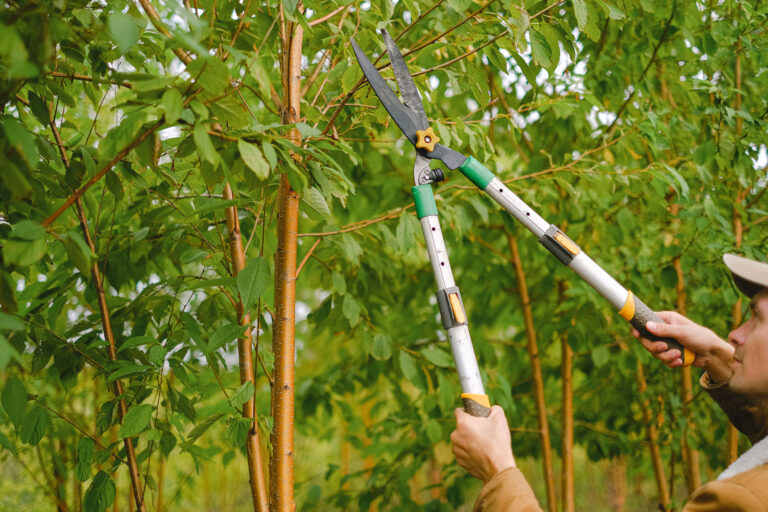
Have hand shears, loppers, a handsaw, pole pruner, and pole saw available to maintain the home orchard. Visually inspect all tools before, and clean tools after each use. Before and after the main seasonal pruning, thoroughly clean, sharpen, and lubricate all pruning tools. Learn to maintain tools properly to ensure their usefulness and your safety.
Hand shears, loppers, and pole pruners are basically the same tool with handles of different lengths — they are all shears. The way a pair of shears cuts a stem depends on the style of the shears: anvil or bypass. Anvil shears push the blade through the stem to a stop on a flat surface on the other handle, the anvil. Stems get crushed a little against the anvil, increasing injury. With bypass shears the blade “passes by” the stop, like a pair of scissors, and the stem is not crushed. Bypass shears are preferred; choose them when possible. Keeping blades properly sharpened is essential to minimizing pruning injury with either style of shears.
Root Pruning
The first pruning for a new tree is root pruning at planting time, when needed. Correcting the growth pattern of roots before the tree is planted prevents significant defects later: leaning trees, short-lived trees, stunted trees with poor vigor and few fruit, for example. Prune circling and severely kinked roots back to the point before the defect starts, or back to their point of origin — whichever comes first. The thicker the root and the closer to the trunk the circling begins, the more significant the defect. Make clean cuts with sharp blades; prune roots like they are shoots. Root pruning can slow growth of the above-ground parts of a tree, while new roots are growing to replace those removed. Only remove circling, girdling, or severely kinked roots — and do not prune excessively. Remove the cutoff portions from the root-ball before planting, if possible.
More from The Home Orchard Handbook
A Simple Guide to Fresh Fruit at Home
Reprinted with permission from The Home Orchard Handbook: A Complete Guide to Growing Your Own Fruit Trees Anywhere by Cem Akin and Leah Rottke, published by Quarry Books, a member of Quayside Publishing Group, 2011.
There’s no end to the benefits of planting fruit around your home: you have unlimited access to a fresh supply of produce; a bountiful landscape in your own yard and neighborhood; and an ecosystem ready for pollinating bees and delightful songbirds to visit. That’s not to say that a home orchard cannot come with a new set of challenges, however. A large part of planting fruit trees is maintaining them, a task made simpler when guided by the wisdom of Cem Akin and Leah Rottke in The Home Orchard Handbook (Quarry Books, 2011. While this book has plenty of advice on where and how to plant and harvest your fruits, these authors spend just as much time walking their readers through causes and solutions to possible diseases, conditions, and nonbeneficial insects that may plague the lovely backdrop they’re attempting to create. In simple and understandable terms, from selection to care to fresh recipes, Akin and Rottke will walk you through how to plant, tend, and harvest the apples, lemons, peaches, or whatever else you can gather without ever leaving your yard.