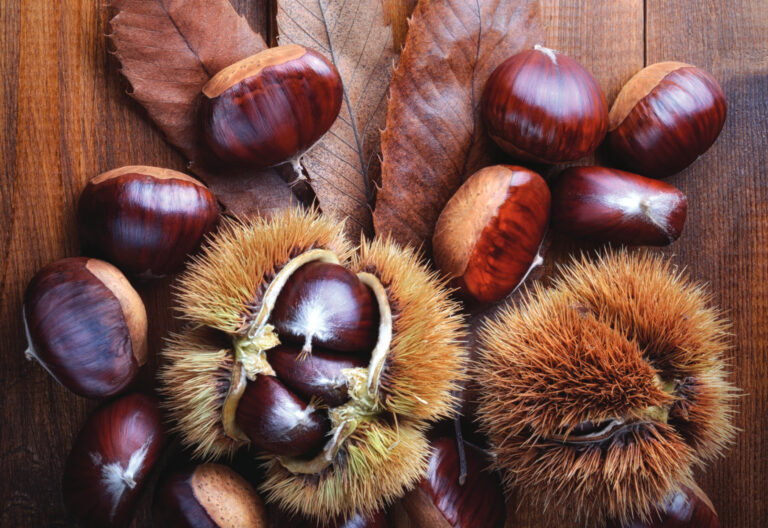
Where do chestnuts grow? Learn how to grow a chestnut tree, growing chestnuts from seed, chestnut tree spacing, and finally how to roast chestnuts in the oven.
In my journey with chestnuts, I started off growing American chestnuts, which I obtained from the American Chestnut Cooperators’ Foundation. I didn’t have much success growing these trees, though. Either the seedlings didn’t survive or they eventually caught the fungal blight and died. Luckily for me, American chestnuts aren’t the only kind. Hundreds of crosses and cultivars have been developed from four types of chestnuts: the American chestnut (Castanea dentata), the European chestnut (C. sativa), the Japanese chestnut (C. crenata), and the Chinese chestnut (C. mollissima).
So, after the failure of the American kind, I then switched to Chinese chestnuts. These chestnut trees have been cultivated for thousands of years, and some high-quality chestnut cultivars have been developed from them. I ordered Chinese chestnut seedlings from several mail-order nurseries.
I had to go through a learning process to successfully plant the seedlings, care for them, and create a productive orchard. At that time, there wasn’t much readily available information on chestnut growing and tree availability. The following is some of what I’ve learned.
How to Grow a Chestnut Tree
Choose the Right Spot
First, chestnut trees require full sunlight, so they’ll need to be planted in the open and away from the shade of larger canopy trees. Chestnut trees don’t do well in wet soils, and they like a soil with a pH between 4.5 and 6.5. My soil is approximately 5.4 pH. If the soil pH is too low, add lime to raise the pH level. If the soil pH is too high, lower it by mixing in sulfur. My soil is also sandy with low organic matter. So, to increase the survival rate of the seedlings, I plant them with approximately 1 cubic foot of good-quality topsoil. Water the seedlings once planted and then at least weekly through the first year if there isn’t adequate rainfall.
Chestnut Tree Spacing
I started a high-density orchard with seedlings planted 12 feet apart and rows spaced 12 feet apart. This original orchard comprised 40 trees, with four rows of 10 trees each. An electrical-fence enclosure protected them from deer. I then had to remove every other tree and every other row to give the remaining trees enough space and sunlight to do well. This was a difficult decision when two side-by-side trees were both good producers. I now plant my trees 24 feet apart in rows spaced 24 feet apart.

Keep the Area Weed-Free
Control vegetation at least 4 feet around the seedling to prevent it from competing for sun, water, and nutrients. I don’t use herbicides, so I mulch with manure 2 feet around the base of the seedlings. The manure also adds nutrients to my poor soil. I then mow around the seedlings for at least another 3 feet. Once the seedlings’ roots take hold, they’ll be very resilient, and even if the seedlings are damaged, the roots will push up new suckers that will grow into a new tree.
Protect the Seedlings From Wildlife
To protect seedlings planted outside of the fenced area, I wrap a 4-by-5-foot wire enclosure around the seedling and secure it with a 5-foot-long garden stake. To make the enclosure, I’ll buy a 4-by-50-foot galvanized welded wire with a 2-by-4-inch rectangle mesh. I’ll then cut the roll into 5-foot lengths to give me 10 cages per roll. Chestnut trees will grow about 1 foot or more per year in proper conditions. When the trees are approximately 5 to 6 feet high, I’ll remove the cages.
While I like to use wire cages, some growers use grow tubes, which may provide faster growth the first year or two as the tree tries to grow out of the tube. The grow tube also minimizes lower-level branches on a tree, making it easier to mow around. Regardless of how you protect your trees, label them with a permanent, weatherproof marker to keep a record of them.
Growing Out the Orchard
I grow chestnuts in southwest Michigan, in Zone 6a. Of all the trees I’ve ordered from mail-order nurseries, few have provided good-quality chestnuts. One tree, whose cultivar I don’t know, provides lots of medium-sized chestnuts. I’ve propagated another small orchard from these nuts.

My favorite tree is a ‘Qing’ cultivar, and it produces a fair number of large nuts. I use the nuts from this tree to propagate new seedlings to expand my orchard and to replace culled trees, which I turn into firewood. As of the time of writing, I haven’t had to use any insecticides or herbicides. Contact your local county or university extension office to see which cultivars they recommend for your specific area.
Chestnut trees are living things with different traits and personalities. Some will be damaged or die off for unknown reasons. Just be persistent and replace them to keep the orchard going. Chestnut trees can have marcescent leaves, which means they’ll retain their leaves during winter. Sometimes, this leads to branches breaking from a wet, heavy snowfall. Trim those broken branches and apply a pruning sealer to the wound.
Grafting Chestnut Trees
Chestnut trees can either be grafted or grown from a seed. To create a grafted tree, join a scion from the tree that you want to propagate to rootstock (the part of the grafted plant that will produce the root system). The grafted tree, excepting the rootstock, will then become a replica of the tree the scion was taken from. In contrast, a tree grown from seed will have characteristics of both the tree it came from and the pollinating tree. I use trees grown from seed and cull those that don’t produce well.
Growing Chestnuts From Seed

To propagate my trees, I collect the best nuts from the trees that I want to reproduce. I keep the nuts in a refrigerator to cold-stratify them during winter. In very early spring, I plant each seed in a 2-gallon container. During summer, I water the seedlings well and keep the pots weed-free. By fall, the seedlings will be about 12 to 18 inches high, and I plant some of them in the ground and hold the others over the winter to plant in spring. I store the overwintering seedlings in a garage to keep them from freezing hard and then plant them in spring when the weather permits. I’ve had success with both fall and spring plantings. If planting in spring, wait until all danger of frost and freezing temperatures is past before planting outside. I’ll fertilize the trees in spring and prune and cull in the winter months.
Chestnut Tree Cross-Pollination
In my area, trees typically bloom from late June through early July, depending on the weather and the cultivar. Catkins will shed pollen, and the female flowers will become receptive around the same time. In rare years, heavy rain can affect pollination. Chestnut trees will need two or more trees to cross-pollinate. They’re mostly pollinated by the wind, with the aid of some insects. Don’t plant them more than 60 feet apart to ensure adequate cross-pollination.

In my orchard, I plant one type of tree with good qualities in several rows and then another type with complementary qualities upwind of the prevailing wind to cross-pollinate. Hopefully, the nuts from the pollinated tree will be an improved hybrid.
Make the Most of Your Harvest
Chestnuts are a healthy food source that can be used for home use, wildlife food, and commercial enterprises. The trees start producing nuts in 5 to 7 years. Harvest time in my area is from mid-September to mid-October. I mostly harvest by hand, though I also have a Nut Wizard (a rolling metal cage) to collect nuts. Nut collecting is labor-intensive, and it all seems to come at once. The nuts are ready to harvest when the burr starts to split open, and the burr either drops to the ground or the nuts fall out. Harvest the nuts immediately.
Always store chestnuts in the refrigerator. They’ll keep for several months that way. Chestnuts can be baked in an oven, roasted over a fire, or microwaved. Cooked and dried nuts can also be ground into a flour and used in a multitude of recipes. Chestnuts are gluten-free, high in carbohydrates, and low in fat.
How to Roast Chestnuts in the Oven
I like to cook chestnuts in an oven. To prepare them, slice an X with a serrated knife on the flat bottom of the chestnut. Place them on parchment paper on a baking sheet. Sprinkle with virgin olive oil and season to taste. Bake at 400 degrees F for 12 to 15 minutes. Let them cool, peel off the shells, and enjoy. Chestnuts make good appetizers or snacks around the holidays.

I’m always learning new things about chestnuts and how to grow them. For me, it’s a rewarding experience where I can be outside and enjoy my orchard.
Tip: Chestnut wood is great for smoking and barbecue. It lends a heavily sweet, mildly smoky flavor profile to the food. To use it, chip and cure smaller tree trimmings as needed for the smoker or use larger logs for live fire cooking. Consider mixing it with a milder wood, such as apple or cherry. Avoid wood from toxic horse chestnuts (Aesculus hippocastanum), though.
Matt Moulds is a retired engineer with two grown daughters, and he lives on a small hobby farm with his wife and chickens, dogs, a horse, and a miniature donkey. He has been growing chestnuts for over 15 years.
Originally published in the September/October 2026 issue of Grit magazine and regularly vetted for accuracy.
Frequently Asked Questions
How fast does a chestnut tree grow?
Chestnut trees will grow about 1 foot or more per year in proper conditions.