Grow a multipurpose Japanese quince bush. These flowering quince varieties are an asset to your garden and kitchen, with many unique ways for how to eat quince.
Flowering quince bushes are old-fashioned harbingers of spring, producing abundant displays of bright, colorful flowers in late winter as the plant’s leaves begin to open.
The Chaenomeles genus is made up of three species of flowering shrubs, native to southeast Asia, that’ve found a home in American gardens for over a century. At one time, the Japanese quince bush was one of the most popular decorative garden and hedge plants in the United States, especially in the central and southern states, where old, unruly specimens can still be found.
Because of the wide range of flowering quince cultivars, gardeners can select a bush to fit almost any space. But few growers know that these shrubs can be grown for their fruit. We hope, in the future, plant breeders will create plants with larger fruit and smaller seeds. In the meantime, as for how to eat quince as they are now, we think the jelly produced from flowering quince fruit is incredibly delicious.
History and Origins of the Japanese Quince Bush
Plant taxonomists and nursery retailers have long been confused as to the precise history and identification of flowering quince. In 1784, Sir Joseph Banks, director of the Royal Botanic Gardens at Kew, introduced to England the first Japanese quince, mistakenly identified as a species of pear. Later, it was correctly identified as quince, but it was classified as a tree quince (Cydonia japonica). Then, in 1822, British botanist John Lindley created the genus Chaenomeles for flowering quince and named the plant Chaenomeles japonica.
The history of flowering quince varieties only gets more perplexing over time, as a few other species were introduced into cultivation and given accurate (or inaccurate) species names, and then hybridized to produce a bewildering array of new plants. By the 1960s, there were more than 500 known cultivars of the Japanese quince bush alone.
Today, we classify flowering quince species under the genus Chaenomeles. Three species are commonly available and make good fruiting garden specimens. C. japonica has a short stature, with spreading branches and a tendency to grow horizontally to 3 to 4 feet. C. x superba grows to 4 to 5 feet, while C. speciosa slowly reaches between 6 and 10 feet high. Sadly, modern plant breeders have created many double-flowered cultivars that are sterile, meaning they produce no fruit. For fruiting shrubs, see our list of recommendations of Quince Cultivars. Note that quince blossoms require the pollen from another quince bush to set fruit.
How to Grow Flowering Quince Varieties
The Chaenomeles genus is populated by multi-stemmed deciduous shrubs with thorny branches. Their rich-green leaves have finely serrated edges and are alternately arranged on the branches.
Some sources list these plants as cold-hardy to minus 20 degrees Fahrenheit (Zone 5), while others rate them to minus 30 degrees (Zone 4). They may be damaged or killed during severe winter conditions in the coldest parts of Zone 4.
Chaenomeles bushes are fairly adaptable and grow in a wide range of conditions, so long as the soil is well-drained. The shrubs can be grown in part shade to full sun, but they flower most abundantly in full sun. Flowering quince are considered to be fairly drought-tolerant after getting established. After a few seasons, the bushes are virtually indestructible.
Add compost to the soil around the roots to encourage the shrubs to produce more flowers and grow vigorously. Chlorosis (yellowing leaves) can occur if you plant quinces in overly acidic soil, such as that found beneath established groups of pine and oak trees.

Flowering quince bushes often have an unkempt look when left unpruned, referred to in garden literature as having a growing habit “like a garbage can,” since old leaves and garbage will collect in the twiggy mass of branches. We think this is a bit harsh, but the shrubs do need to be pruned occasionally to keep them looking tidy. Luckily, these shrubs are easily propagated from hardwood cuttings taken in late winter to early spring, before the first leaf buds burst open. Keep the cuttings potted in soil for three consecutive growing seasons, until they have a good root system to support being replanted in a new location.
We haven’t had any major problems with growing flowering quince, although cedar-quince rust (Gymnosporangium clavipes) does affect some fruit each season. To control this fungal disease, we burn the diseased fruits or dispose of them in the garbage. To lessen the impact, try pruning some of the older branches on established bushes to encourage better air circulation and sunlight penetration.
Scale insects can be a problem in certain parts of the United States, but they don’t usually cause significant damage to our shrubs. We also don’t experience much loss of fruit to animal predation, because flowering quince fruit is hard and sour.
How to Eat Quince
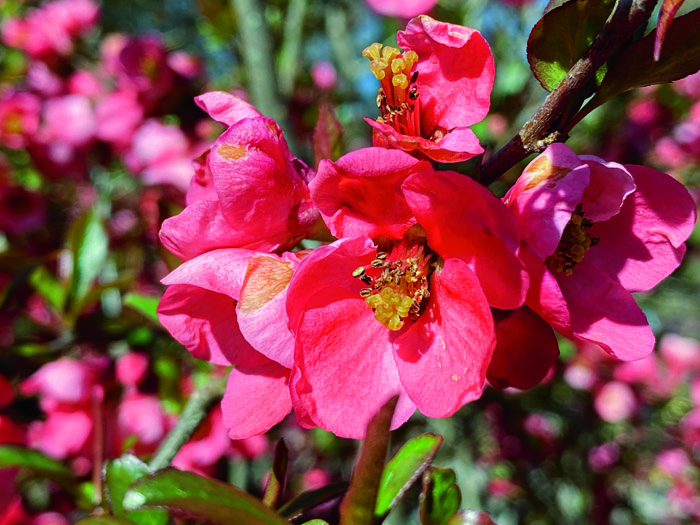
Chaenomeles‘ flowers open up just after their leaf buds burst open in early spring, and their blooms can produce a beautiful display of much-needed color when most landscapes are still waking from winter. The blossoms are generally pink, red, or orange, but cultivars also come in a range of other colors, such as white, yellow, and variations of pink with white. The flowers measure 1 to 2 inches across, depending on the species and cultivar. An occasional second flowering may occur during abnormally warm fall weather.
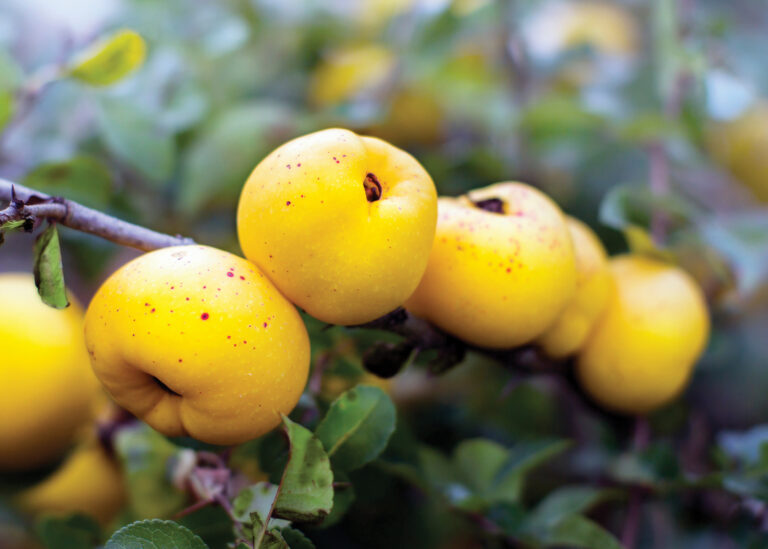
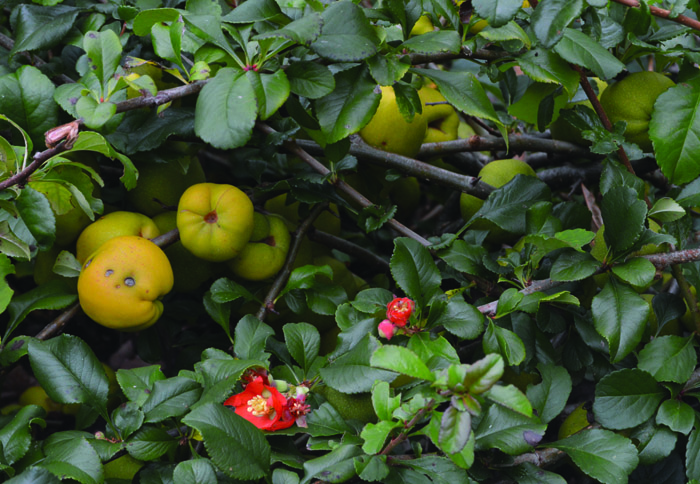
Flowering quince produces pomes – yellow to yellowish-green rounded fruits about 1-1/2 to 2 inches in size. The fruit must be cooked with sweetener to make it palatable, and it requires a substantial amount of time to peel, core, and remove the numerous seeds. Although some readers may wonder if the fruits are worth the effort, we assure you that quince jelly‘s flavor is an extraordinary combination of sweetened cranberry and lemon, and its color is a beautiful, deep red.
The best way to make jelly from the fruit of flowering quince is to cover the peeled and cored fruit with water, and then cook the mixture on the stove until the fruit can be pierced with a fork. If you separate the water from the cooked pulp, you can use both as food products. The water contains pectin, and it can be reduced to make a superb scarlet-colored jelly with a floral taste rich in lemony notes. Cook the strained fruit pulp into a gelatin-like paste traditionally known as membrillo. You can eat the quince paste (also known as “quince cheese”) as is, or add it to desserts. Membrillo added to cooked apples will produce a unique, floral-tasting applesauce.
While flowering quince has fallen out of favor since the mid-20th century, some select retail nurseries and specialty catalogs still carry a few cultivars. Note that the popular ‘Double Take’ series shrubs are sterile and won’t produce fruit. The cultivars listed below are productive fruiting plants with beautiful flowers.
Flowering Quince Varieties

- ‘Crimson and Gold’ (Chaenomeles x superba): Magnificent fire-engine-red flowers with golden anthers on a shrub that tends to sucker and grow horizontally, from 3 to 5 feet high.
- ‘Jet Trail’ (C. x superba): Compact shrub that grows 3 to 4 feet high and produces abundant displays of pure-white flowers.
- ‘Tanechka’ (C. japonica): Ukrainian cultivar with attractive scarlet-pink flowers, growing 5 to 6 feet high and producing large crops of fruit.
- ‘Toyo-Nishiki’ (C. japonica): Distinctive Japanese cultivar with pink, white, and scarlet flowers on the same shrub, growing 4 to 7 feet in height.

The following nurseries offer one or more of these flowering quince varieties.
Colorado Hardy Plants 970-765-0670 Colorado Hardy Plants
Green Acres Nursery & Supply I Dig Green Acres
Forestfarm at Pacifica 541-846-7269 Forest farm
Planting Justice 510-756-6965 Planting Justice
Wilson Bros Gardens 770-573-1778 Wilson Bros Gardens

Allyson Levy and Scott Serrano are co-founders and directors of Hortus Arboretum and Botanical Gardens in New York. This is an excerpt from their book Cold-Hardy Fruits and Nuts, reprinted with permission by Chelsea Green Publishing, and offered on the opposite page.