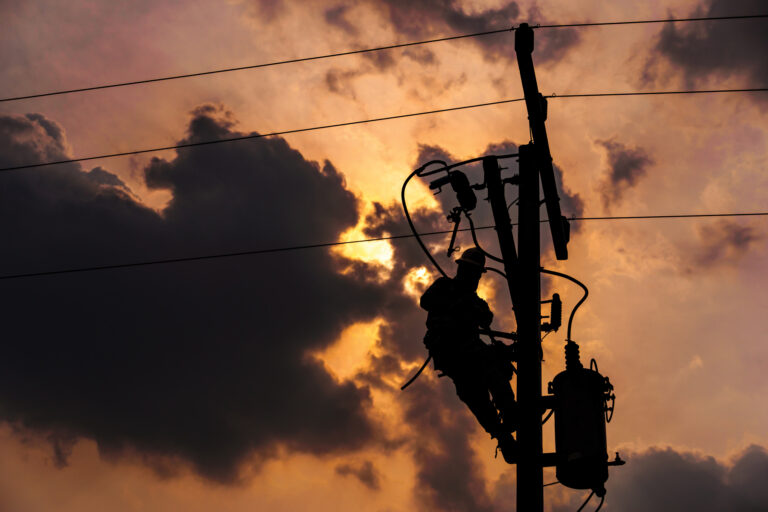
Severe weather can bring problems to the power grid. Learn about how weather causes power outages, what to do when the power goes out, and what to do during a power outage.

This article is also in audio form for your listening enjoyment. Scroll down just a bit to find the recording.
Power outages can be more than just inconveniences. If they last long enough, they can become real threats to our well-being and even health. Power outages can affect just a single home or can be widespread, affecting millions of people. The most common causes of power outages are weather events, which can occur at any time of day or year. It’s important to understand these events and how to prepare and stay safe when the weather takes a turn.
Let’s start with some basic definitions.
- Electrical grid or power grid: Consists of generation facilities; transmission and distribution equipment, such as transformers, substations, and power lines to deliver the energy; and consumers who use the power.
- Power outage: An unexpected, complete loss of electrical power for a period of time (sometimes minutes, sometimes days or weeks) that results from failures in the power infrastructure.
- Blackout: A power outage that affects many people.
- Brownout: A reduction in voltage of the electrical system, resulting in a dimming of lights and other malfunctions of electrical devices.
- Rolling brownouts and rolling blackouts: Brownouts and blackouts that are planned by electricity providers to reduce demand, affecting a sequence of areas at different times.
Many types of weather events can cause outages, so your preparation and response may vary depending on the weather that’s common where you live.
What to Do During a Power Outage: Types of Storms
Thunderstorms

Thunderstorms are a common cause of power outages, and they’re most frequent in warmer months, although southern states can have them even in winter. Lightning can strike utility poles, transformers, or other electrical equipment, causing a power disruption. Electrical power surges associated with these storms are also possible. Typically, power outages due to lightning strikes would only affect small areas. However, lightning strikes to a substation and power lines, followed by some equipment failures and human errors, led to the famed New York City blackout on July 13 and 14, 1977. Most of the city went dark that night. More commonly, during storms, trees either drop branches or just topple over onto power lines. This could be because of a lightning strike or because of strong winds often associated with thunderstorms. In the most extreme (and fortunately rare) cases, a thunderstorm-produced tornado will certainly cause power outages.
One thunderstorm can cause power problems locally, but complexes of thunderstorms can bring widespread power outages. One particularly damaging thunderstorm complex is called a “derecho.” It can last for hours and cover hundreds of miles. On Aug. 10, 2020, a powerful derecho with estimated peak winds of 120 mph plowed through the Midwest. Central Iowa and northern Illinois were especially hard-hit. At one point, around 1.4 million people were without power, and power outages continued for several days. Another derecho with peak wind speeds, again estimated at 120 mph, moved through parts of Ontario and Quebec, Canada, on May 21, 2022. At its peak, more than 1 million people were without power, some for over a week. Repair costs shot into the tens of millions of dollars.
Winter Storms

Winter storms are typically associated with strong winds and copious amounts of precipitation, and they’re especially damaging if they consist of heavy, wet snow or ice-producing freezing rain. Power lines can come down on their own or, more likely, again, when tree branches or whole trees fall on the lines. Power outages are often widespread, affecting many people. Such storms are associated with cold weather and are often followed by extremely cold weather with life-threatening temperatures.
In the middle of February 2021, a series of winter storms and an associated Arctic outbreak that brought temperatures of 40 degrees Fahrenheit below normal affected an area from Nebraska down to Texas. Damage from snow and freezing rain and a surge in power demand because of the cold resulted in a major power outage, with Texas being especially battered. At its peak, almost 10 million people were without power. In Texas alone, 246 people died, many from lack of power in bitterly cold conditions.
Hurricanes

Typically occurring in late summer and fall, hurricanes and even lesser tropical cyclones can bring an onslaught of damaging weather conditions. Powerful winds, coastal flooding with high storm surges, and inland flooding because of torrential rains can wreak havoc on power grids. These storms can stretch hundreds of miles across and take out power over large areas.
On Sept. 26, 2022, Hurricane Ian hit western Cuba as a Category 3 storm with 125 mph winds, causing the entire country’s power grid to collapse. Two days later, the storm hit Florida as a Category 4 storm with 150 mph winds, a record-breaking storm surge, and torrential rains. At its peak, more than 2.5 million people were without power. In Cape Coral, northwest of Fort Myers, officials said 98% of the city’s power structure was wiped out.
About a week before that, Hurricane Fiona hit Puerto Rico. At one point, all power on the island was cut off, leaving more than 3 million people without electricity. A week later, some people were still without power. Fiona was only a Category 1 hurricane, with winds under 100 mph, but massive rainfall (as much as 30 inches) produced major flooding, which did the damage. Five years prior, Category 4 Maria had hit the island and destroyed the island’s power grid with winds well above 100 mph. Full restoration was yet to be achieved even before Fiona hit.
In September 2017, powerful Hurricane Irma hit Florida before moving into Georgia and South Carolina. The strong winds over a large, heavily populated area resulted in a massive power outage. At one point, 6.7 million Floridians — 64% of all electric customers in the state — were without power. Some were without power for over a week. In addition, 1.3 million customers in Georgia and a half-million in neighboring states lost power. About 60,000 power workers from the United States and Canada were involved in power restoration there.
Floods, Slides, and Fires

Floods can impact electrical generation facilities, substations, and underground lines. On the local scale, flooded roads can keep crews from getting to downed lines. Flooding can occur because of the previously described storms or because of river flooding from excessive rainfall or snowmelt.
In mountainous terrain, even more power-threatening situations exist. Mudslides and rock slides, often because of heavy rains, can come thundering downslope, destroying power grid components (and everything else). In winter, extensive snowpacks resting on precariously tilted surfaces can release a downhill onslaught — an avalanche. Power outages after avalanches are fairly common in such locations.
In my article on wildfire behavior and mitigation, I described how weather conditions are a crucial factor in wildfire ignition and spread. Certainly, if a wildfire damages power transmission equipment or a power generation facility, it can cause outages. Many wildfires are driven by strong winds, which can directly bring down power lines or cause tree branches or whole trees to fall on the lines. Even worse, downed power lines are also a frequent cause of wildfires when winds are strong — so much so that in the western U.S., electricity providers may shut off power when strong winds are occurring to lessen the risk of wildfire ignition. These are called Public Safety Power Shutoffs. The public is warned, but these deliberate power outages can last for as long as dangerous weather conditions continue.
What to Do During a Power Outage Audio Article
Overwhelmed Grids
Extremes in temperature can also cause power issues. Uncomfortably high temperatures don’t directly cause power problems; however, people will typically use more air conditioning than normal. Even without a damaging winter storm, sometimes unusually cold weather can cause problems. This is especially possible where electric heaters are widely used. Electrical consumption can increase to near or beyond maximum capacity, leading to deliberate brownouts or blackouts or outright blackouts.
Power outages can also be caused by elements beyond our planet. If we include the category of space weather, then we must include geomagnetic storms. Coronal mass ejections (CMEs) from the sun can interact with our atmosphere to induce geomagnetic storms. These can and have resulted in power outages, primarily in the higher latitudes. According to the National Oceanic and Atmospheric Administration (NOAA), the strongest of these storms can cause widespread voltage control problems, protective system problems, and grid systems that experience complete collapse or blackouts, and these effects could extend as far equatorward as 40 degrees latitude.
The Quebec blackout on March 13, 1989, is considered to be a quintessential example of what can happen when a powerful geomagnetic storm occurs. Astronomers noted a massive CME on March 10. On March 12, a powerful geomagnetic storm developed in the Earth’s atmosphere. Electrical currents generated by the storm entered the Quebec power grid, shutting it down in the early morning of March 13. A 12-hour blackout followed that affected millions of Canadians. Although effects were felt below the border, U.S. grids managed to handle the situation, with no power outages occurring.
What to Do When the Power Goes Out
How should you prepare for a possible power outage? It’s important to know what to do when the power goes out. First, if you have a generator, know how to use it. For getting the latest information when the power goes out, have a portable radio or a NOAA Weather Radio. For light, have flashlights or lanterns and plenty of batteries. (Small solar-powered lanterns and emergency candles can help save on the cost and use of batteries.) Keep about a week’s worth of drinking water. Not only may municipal water be cut off, but wells with electric pumps won’t work. Have about a week’s worth of nonperishable food and a manual can opener as well. Extra blankets and a tent placed in the center of a room can also help keep you warm if the power does go out.
To keep track of the weather in the U.S., the National Weather Service is the official source of all severe weather information. For Canada, it’s Environment Canada. Additionally, local authorities will provide more specific information on current conditions.
If you know a storm is coming, fill up your vehicle with gas since gas pumps won’t be working, and store an extra can of gas outside. Get cash before the storm since ATMs won’t be functioning. Fully charge power banks, portable chargers, and all portable devices, especially cell phones.
For major storms, such as hurricanes, you may be asked or required to evacuate. Even if evacuations aren’t officially required, those with health or accessibility needs will need to decide if leaving is the safest choice. This is especially true if medical devices needing electricity are essential. If you’re leaving, disconnect all appliances and turn off your electricity.
If you stay and the power goes off, disconnect all appliances to prevent power-surge damage. Limit opening refrigerators and freezers to keep food as cold as possible. Even without electricity, food can stay good if the internal refrigerator and freezer temperatures stay below 40 degrees, but temperatures above 40 degrees will only keep food good for a couple of hours at most. If the electricity is still on and you have flooding, never go into your basement or any room where electrical outlets or cords are submerged. Go to a community shelter if things are untenable at home, especially if it’s extremely hot or cold.
If you’re outside during or after a storm, stay away from downed power lines. Never drive over them. Even if the lines are dead, your car can become entangled in them and pull down more lines or even a pole. If the line is live, you could be electrocuted if you leave your car. Stay in your vehicle until utility workers can depower the line.
Stay aware and equipped if the lights go out. Research the weather in your area, prepare some supplies, and develop a safety plan for your household so you can take proper action during a weather event.
Ed Brotak taught college students about weather for more than 30 years and led many of them to pursue careers in meteorology. He lives in Asheville, North Carolina, with his wife (who’s also a meteorologist).
Originally published as “When the Lights Go Out: Weather-Related Power Outages” in the March/April 2023 issue of Grit and regularly vetted for accuracy.