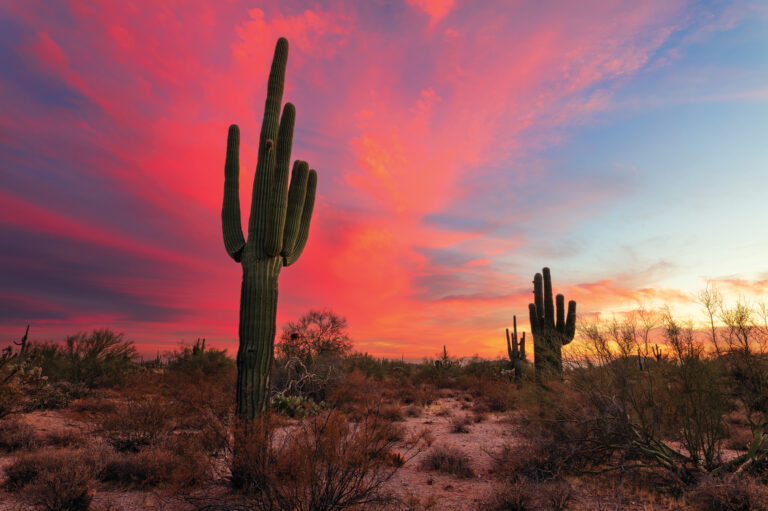
Why does the sky change colors? Learn why strange weather phenomena occurs and follow the weather phenomena list.
Weather systems, disturbances in the atmosphere above us, can be dangerous. But the atmosphere can also offer views of some of the most spectacular sights in nature.
To appreciate those sights, we can start with the sky itself. The daytime sky appears blue — a brilliant darkish-blue on clear days and a milky whitish-blue on others. Although sunlight appears white, it’s actually a combination of colors along the spectrum from violets and blues to oranges and reds. Air molecules are smaller than the wavelengths of the various colors of the spectrum. When sunlight hits the atmosphere, air molecules can scatter the light separately by wavelength, or color. Because blue light wavelengths are shorter and smaller, blue light is scattered more, and so this is what we see. Blueness of the sky is maximized during the middle of the day. At sunrise and sunset, the sun’s rays travel through more of the atmosphere. More of the blue light is scattered before it reaches your location, so the reddish part of the spectrum becomes more dominant. Therefore, sunrises and sunsets are famously red in color.
Clouds often add to the visual effect of colorful sunrises and sunsets. They reflect the reddish colors and thus often appear red themselves. Some of the most striking cloud coloration occurs when a deck of clouds almost covers the whole sky but leaves a narrow clear strip near the horizon. Stratospheric volcanic dust particles after a major eruption can also cause colorful sunrises and sunsets for many months.
Why Does the Sky Change Colors?
Natural haze and pollution aerosols come in all sizes and scatter the components of sunlight. This makes the sky grayish or whitish and diminishes the blue during the day and the red at sunrise and sunset. This is more prevalent in summer. It also means more remote locations, such as deserts and oceans, have more vivid sky colors.
What Are Photometeors?
Besides clouds, you can see many things in the sky above, and their scientific name is “photometeors“: “photo” for “light,” and a “meteor,” in this case, is technically anything in the sky. These are visual phenomena produced when the light from the sun or moon interacts with something in the Earth’s atmosphere, often some form of water.

The best-known and most spectacular of photometeors is the rainbow. A rainbow is a luminous arc across the sky featuring, well, all the colors of a rainbow, from violet on the inside to red on the outside. It’s produced when sunlight passes through water droplets, such as rain or fog. The raindrops act as little prisms that reflect and refract (bend) the white sunlight into its component colors and project it onto the water. Rainbows appear on the opposite side of the sky from the sun. Any spray of water droplets can produce a rainbow, including sprays from a garden hose or a sprinkler. “Moonbows” also exist, but they’re much weaker, and the colors may be absent. For the angle of the sun’s rays to form a visible rainbow, the sun must be fairly low in the sky, 42 degrees above the horizon or less. The bow itself has a radius of 42 degrees. Occasionally, some rays of light go through this process a second time and produce a second rainbow. This secondary bow is outside the primary bow (a radius of 50 degrees), is weaker, and has the order of the colors reversed.

Occasionally, you’ll see a halo around the sun or moon. Typically, it’s a white, luminous ring with the sun or moon at the center. Sometimes, you can see a red fringe on the inside and, rarely, violet on the outside, and the sky is noticeably darker inside the ring than outside. Haloes are produced when sunlight or moonlight is reflected or refracted by ice crystals high in the atmosphere. Solar haloes are more pronounced than lunar ones because of the differences in the intensity of light. Historically, such haloes were thought to foretell a coming storm. In fact, they’re produced by cirrostratus clouds, which often do precede especially winter precipitation, but not always. The most common halo is a 22-degree halo, meaning it has a 22-degree radius with the sun or moon at its center. Less common is the larger 46-degree halo.

Sun dogs, official name “parhelion,” are bright spots that appear on one or both sides of the sun at about 22 degrees. These are caused by refraction of sunlight by ice crystals, a type of cirrus cloud. They may appear as bright-white patches or show colors, red on the inside to blue on the outside.
A corona consists of a ring or set of small-diameter rings, either white or colorful, around the sun or moon. If colorful, the colors range from blue-violet inside to red outside, with green and yellow possible between them. Coronas are caused by diffraction of light by thin clouds or fog and are considered separate from haloes.
A glory is a small, rainbow-like ring surrounding the shadow of the observer. Like a rainbow, it’s always seen directly opposite from the sun and is produced by small water droplets found in a cloud, fog, or even dewdrops on the ground. First seen by mountain climbers, who spotted glories cast onto clouds below their vantage points, glories can also be seen surrounding the shadow of an airplane on a cloud below.
Sometimes, alternating bright beams and darker streaks can be seen emanating from the sun. These are called crepuscular rays. They’re formed when the sun shines through broken clouds. The sun itself is often hidden behind a cloud, typically a thick cumulus cloud. The darker streaks are actually shadows produced by the clouds, whereas the bright beams appear where the sunlight isn’t blocked.

A sun pillar is a type of light pillar that’s actually a halo phenomenon. This bright shaft of light extends upward or downward from the sun, typically when the sun is low in the sky. It’s produced when sunlight is reflected by ice crystals falling from cirrus clouds. Other light pillars can occur with the moon, bright planets like Venus, or even streetlights.
The green flash is a seldom-seen optical phenomena. It’s a quick (1-to-2-second) green flash just above the nearly risen or set sun. To see it, you need clear air and an unobstructed horizon, such as over the water. It’s caused by the dispersion of light by the atmosphere.
Sometimes, high cirrus clouds will show iridescence (or “irisation”), bright colors either in patches, streaks, or on the edges. Colors are typically green or pink-red. This is caused by diffraction of sunlight by the ice crystals in the cloud.
A mirage is an optical illusion, a visible image of something that’s not really there or something that’s there but highly distorted. It’s caused by the refraction of normally straight-moving lightwaves. Lightwaves tend to bend when they move through layers of air that have different densities, because of extreme differences in temperature. One of the most commonly seen mirages is the apparent occurrence of shimmering water over a hot asphalt road on a sunny day. This “water” is actually lightwaves from the sky being distorted in the superheated air above the road’s surface. Mirages can also famously occur in deserts. A Fata Morgana is a complex mirage that can significantly distort distant objects. It tends to occur in polar regions or over cold water, places with strong inversions of warmer air overlying very cold air near the surface. Famous examples include the “floating city” seen across the Strait of Messina, and the Flying Dutchman, a ghost ship seen floating above the ocean.
There are also electrometeors, made visible when atmospheric electricity interacts with the air. Gas molecules become temporarily energized, but then give off this energy as light when they go back to their normal state. This is similar to how a neon bulb works.

Years ago, I wrote an article on lightning for this magazine (“Nature’s Electricity,” September/October 2015), but I never got into the visual workings of a lightning bolt. In fact, the electrical discharge in the atmosphere heats the air in the lightning channel to a tremendous degree, energizing the atmospheric gases so much that they become incandescent, giving off a vivid white light. A blue-white color is the specific result of nitrogen (the atmosphere’s most abundant gas) being heated to luminescence.
One of the most mysterious of the atmospheric apparitions is ball lightning. Ball lightning is a luminous globe that can range in size from less than an inch to several feet across and can last up to 10 seconds. Reported colors have ranged from blue to orange to yellow. It can float in midair or even roll along the ground for some distance. These luminous balls have been known to roll through houses and down the aisles of airplanes. It’s not true lightning (although it’s typically associated with thunderstorms), but instead a continuous, although brief, electrical discharge in the atmosphere that appears as a glowing ball. Since ball lightning is rarely observed and thus impossible to study, scientists still don’t have a good explanation for its occurrence.
St. Elmo’s fire, an almost magical display of plumes of light, has been noted by sailors at sea for centuries, visible on shipmasts. The name comes from St. Elmo, one of the patron saints of sailors. This is a continuous electrical discharge that occurs when a rod-like object is electrically charged and induces the surrounding air to become ionized, thus giving off light. St. Elmo’s fire is not lightning, and the electrical charges involved may produce a minor shock but aren’t dangerous. St. Elmo’s fire is not restricted to boats. Planes in flight encounter it, as do land-based lightning rods and wind vanes.
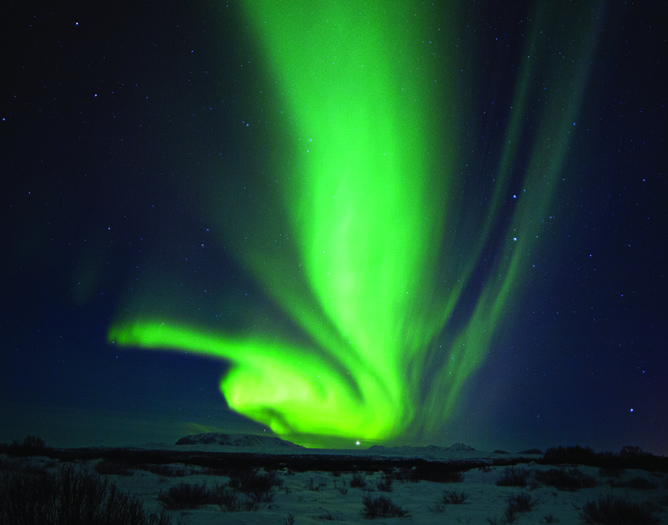
Of all the electrometeors and all the visible displays in the atmosphere, perhaps none is more spectacular than the auroras: the northern lights, or “aurora borealis,” in the Northern Hemisphere, and the southern lights, or “aurora australis,” in the Southern Hemisphere. Auroras occur when electrically charged particles from the sun (the solar wind) interact with atmospheric gases miles above the Earth’s surface. The auroral display can take different forms. Moving curtains of light formed by tall rays are common. Sometimes, an arc of light can extend across the sky. Or, auroras can look like patches of clouds that glow in an otherwise dark sky. The auroras display different colors. Oxygen atoms energized high in the atmosphere will produce a red glow. This same gas at lower levels will produce a green-yellow color. Nitrogen atoms can produce reddish and bluish light. The electrically charged solar particles are guided by the Earth’s magnetic field, primarily to the magnetic poles. The Earth’s magnetic poles aren’t collocated with the actual poles, but are hundreds of miles equatorward. This is why the auroras are much more common and prominent in higher latitudes, in places such as Alaska, northern Canada, and Iceland.
Auroras are typically caused by disturbances on the sun’s surface. Sunspots, large storms on the sun’s surface, are a primary source. During a peak of the sunspot cycle, these disturbances are most common. Even when sunspots aren’t active, coronal holes or solar flares can occur at any time and produce auroras. The more intense the solar event, the more likely the aurora will be observed farther equatorward, even occasionally down into the U.S. and, rarely, into Mexico. To get the latest information on auroras and other space weather, visit the NWS Space Weather Prediction Center.
Ed Brotak taught college students about weather for more than 30 years and led many of them to pursue careers in meteorology. He lives in Asheville, North Carolina, with his wife (who’s also a meteorologist).