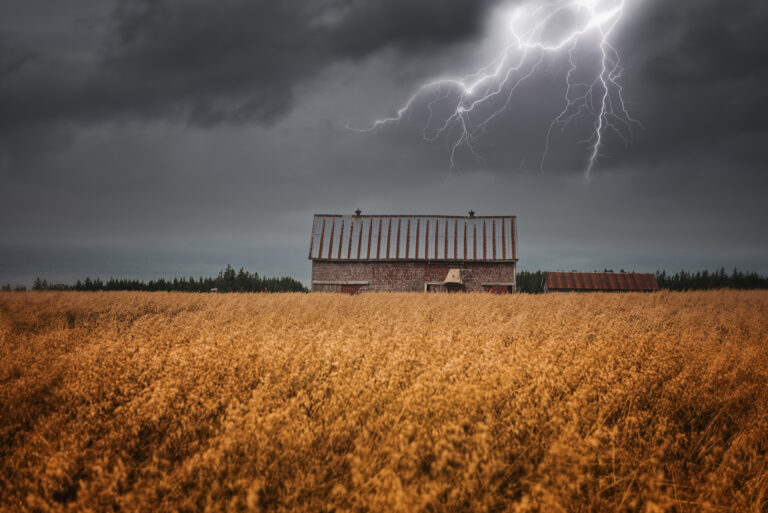
If you hear thunder, you’re at risk of being struck by lightning. That’s just one of the lightning safety principles key to avoiding serious injury or death caused by a lightning strike.
According to the National Weather Service, lightning is a “giant spark of electricity in the atmosphere or between the atmosphere and the ground,” and they report an average of 43 deaths per year due to lightning strikes.
How Lightning Strikes Affect People
When a person is struck directly by lightning, that person becomes a channel for the lightning’s electrical discharge. Direct strikes aren’t common, but they are the most deadly. In most direct strikes, a portion of the electric current in the lightning moves along the skin surface and a portion moves through the body — usually the cardiovascular and/or nervous systems.
Lightning produces heat, which results in burns. However, the current contained in the lightning is the biggest concern. A person may survive a lightning strike if they receive immediate medical attention. However, a strike can be fatal.
When lightning strikes an object near a person, a portion of the current may jump from that object to the victim. In short, the person acts as a “short circuit” for part of the energy in the lightning discharge. When a victim is within a foot or two of the object struck by lightning, side flashes generally occur. Anyone who’s standing next to an object when lightning strikes it is at risk for injuries such as burns to the skin or flash burns to the eyes.
‘Ground Currents’ Cause the Most Risk
Lightning may also travel outward from a strike and run along the ground. This is referred to as ground current. Anyone outside near a lightning strike is potentially a victim of ground current. Because the ground current affects a much larger area around the strike, ground current is the cause of most lightning deaths and injuries. Ground current also kills many farm animals.
Metal surfaces and wires don’t attract lightning, but if it strikes nearby, these types of surfaces conduct the energy found in lightning. Whether inside or outside, anyone in contact with anything connected to metal wires, plumbing or metal surfaces that extend outside is at risk. This includes anything that plugs into an electrical outlet, water faucets and showers, corded phones, windows and doors.
Center pivots are lightning conductors, and anyone standing near them when lightning strikes are at risk for severe injury. Because the ground around a pivot system is often wet, ground current will rapidly spread out from the pivot.
How to Avoid Lightning Strikes on Farms
Monitoring weather conditions is the most effective way to protect yourself from a lightning strike. Once a storm is within 10 miles of your location, lightning strikes may occur. Use a phone lightning app to remain aware of the danger.
Once a storm is approaching, there’s no safe area out of doors. In the even that you’re not able to seek shelter inside a building during a storm, stay away from an open field, the top of a hill, and tall objects such as trees. Keep your distance from water, wet items, and metal objects such as fences or poles.
Lightning strikes are rare, but when it happens it happens quickly. Don’t become complacent. Know the safety practices and consistently implement them during inclement weather.
Loretta Sorensen writes from her home in southeast South Dakota, where she regularly develops agricultural safety and health articles for the Central States Center for Agricultural Safety and Health (CS-CASH) at the University of Nebraska Medical Center. Connect with Loretta on Facebook and Twitter.
All GRIT community bloggers have agreed to follow our blogging guidelines, and they are responsible for the accuracy of their posts.