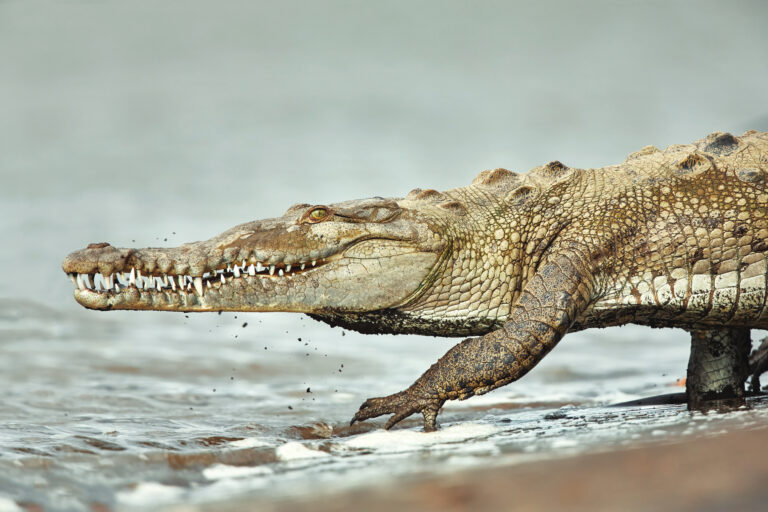
Discover the American crocodile vs. American alligator, how to tell the difference, the American crocodile range, what do alligators eat, where they build nests and lay eggs, and how aggressive these apex predators can be.
After the dinosaurs died out, the largest reptiles left on Earth were two species of crocodilians: crocodiles and alligators. In the Americas, we have a few of our own species of crocodilians, distinct from those found elsewhere. Two species live in the United States: the American alligator and the American crocodile.
American Crocodile vs American Alligator
The American alligator (Alligator mississippiensis) has adapted well to the U.S. climate, with a population in the millions, extending from coastal North Carolina down through Florida and westward into Texas and Oklahoma. The northeastern part of Mexico is the farthest south they’re found. In the 1960s, alligators were considered endangered. Now, however, they’re considered one of the largest conservation successes, given their numbers are estimated to be over 4 million in the wild across the U.S.
Are There Crocodiles in Florida?
The American crocodile (Crocodylus acutus) prefers warmer climates and can be found along the southern coasts of Mexico and some Caribbean islands, through Central America, and into coastal areas of northern South America. Actually, the northernmost range of the American crocodile extends into southern Florida. Thus, this is one place in the U.S. where you can find both American alligators and American crocodiles coexisting. It’s estimated that up to 2,000 American crocodiles live there – a small population compared with the estimated 1.3 million alligators that are believed to inhabit Florida alone.
Are Crocodiles Endangered?
Like many native species, the American crocodile population decreased drastically because of overhunting and habitat destruction. By the 1970s, the population was estimated at several hundred, with extinction a real possibility. It was then listed as an endangered species. Subsequent conservation measures have been greatly successful, leading to today’s population. This has resulted in a change of classification from endangered to threatened, but they’re still protected.
Both species like warmer climates, and crocodiles strongly prefer brackish water or even salt water, so they’re typically found near the coast, although they can live in fresh water. This is because American crocodiles have salt-secreting glands that remove excess salt from their bodies. Lacking these glands, alligators thrive in fresh water but can survive in brackish water and tolerate salt water for brief periods of time. Both species of American crocodilians inhabit the Everglades and seem to tolerate each other fairly well, although occasional fights have been noted.
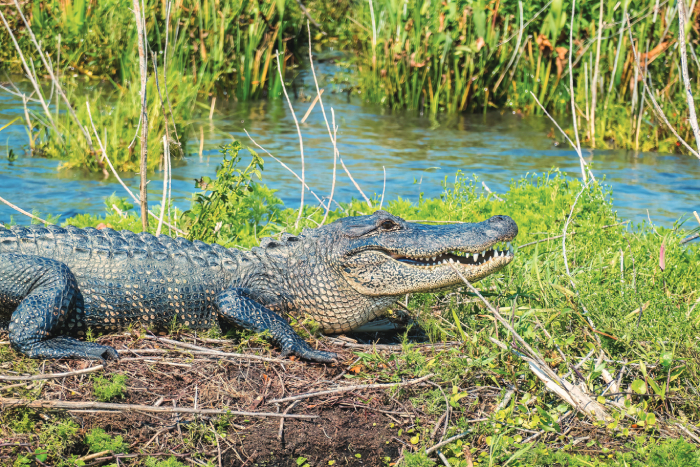
What Time of Day are Alligators Most Active?
You can often see crocodiles or alligators lying on the beach or ground near the water during the cooler parts of the day. Both crocodilians are ectothermic, meaning they don’t generate their own body heat. They rely on external sources of heat, such as sunlight, to raise their body temperatures.
Alligators vs Crocodiles: How to Tell the Difference
Although alligators and crocodiles look similar, they do have visible differences. Most prominently, the crocodile snout is pointed, unlike the alligator’s broader, rounded snout. Crocodiles also have a lower tooth exposed, even when their mouth is closed. In terms of coloration, alligators tend to be dark green, almost black. Crocodiles are grayish-green, with young ones even lighter.
How Long Do Crocodiles Live?
American crocodiles and American alligators are roughly the same size in the U.S. Large male crocodiles typically reach 12 feet in length, with 15 feet the U.S. record. In areas farther toward the equator, American crocodiles have been reported to be over 20 feet long. These larger crocs can weigh over 1,000 pounds. Females are smaller, as all crocodilians exhibit sexual dimorphism, so they usually range 8 to 12 feet. The average lifespan of an American crocodile is 50 to 70 years.
Male alligators average about 10 to 15 feet in length, weighing between 500 and 600 pounds, though on the larger end, up to 1,000 pounds. Females are significantly smaller, only averaging 8 feet in length and about 200 pounds. Their average lifespan in the wild is 30 to 50 years, though many live much longer in captivity. How fast and how large a crocodilian grows depends on food availability and environmental temperature.
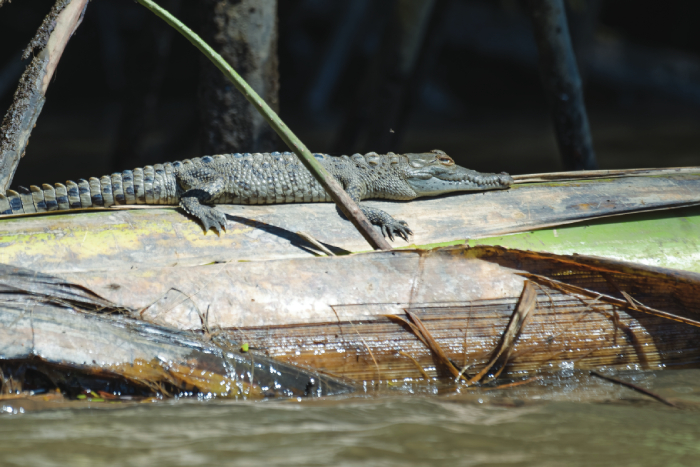
What Do Alligators Eat?
Both American alligators and American crocodiles are opportunistic predators. They’ll go after smaller mammals, such as opossums and raccoons, and birds and other reptiles near or in the water. But much of their diet consists of aquatic species, such as frogs, turtles, snakes, and large fish. Both are considered ambush predators, meaning they’ll sit and wait for their meal to come to them rather than chase it down. This means that if your pet (or your calf or cow that recently gave birth, if you’re raising cattle on the bayou) wanders down to the waterside in an area known to harbor crocodilians, the gator or croc hanging out just out of sight may decide it’s time for a nice snack.
Alligators vs Crocodiles Reproduction
Courtship in American crocodiles usually starts late in winter, at the end of January and in early February. Females start looking for nesting sites in late April or early May as temperatures warm. In American alligators, courtship generally begins in April, and females begin nesting around May and June.
Do Alligators Lay Eggs?
American crocodile nests are built on land near the water but above the tidal high waterline. Nests are holes or mounds of sand or dirt. Nests may contain from 20 to 60 eggs that can take more than two months to hatch. Alligators, however, tend to build their nests into riverbanks, swamp edges, and lakeshores. Their nests are fairly large, sometimes reaching 6 feet across, and the mounds of dirt and detritus can reach about 2 feet high. Nests may contain 20 to 50 eggs and take about 65 days to hatch.
Interestingly, the sex of developing embryos isn’t determined at fertilization but rather as they develop, and it’s determined by nest temperature. For crocodiles, warmer temperatures, near 90 degrees F, produce mostly males. Cooler temperatures produce mainly females. For alligators, male temperatures are 90 to 93 degrees; female temperatures are 80 to 86 degrees; and temperatures for a mix are 86 to 90 degrees. Overall, temperatures must remain above 80 degrees for the eggs to survive and hatch in either species.
Egg predators – such as raccoons, birds, and crabs for crocodiles; and turtles, snakes, large fish, birds, and small mammals for alligators – must be scared away by the nearby mother if nesting is to be successful.
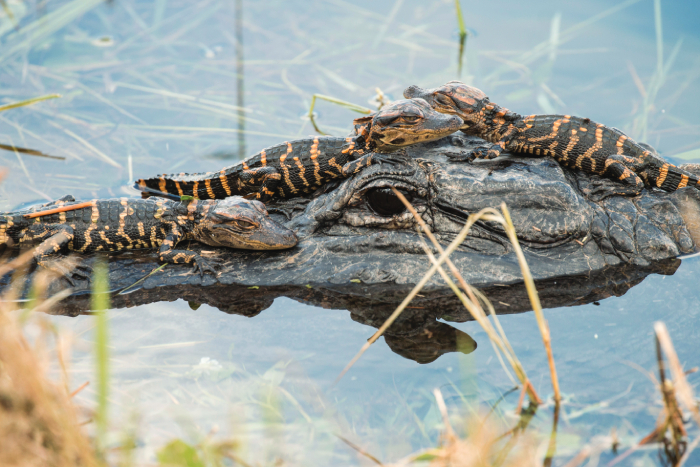
When hatching begins, females of both species dig out the nest and help the hatchlings reach the water. But soon afterward, the baby crocodiles are on their own. Hatchlings are preyed upon by many of the same predators that attack nests, and few of the crocodile hatchlings make it to adulthood. For alligators, the hatchlings tend to stay with their mothers for protection for months, and many have been documented staying with their mother for up to two years. On average, only 25 percent of crocodile hatchlings and up to 80 percent of alligator hatchlings will make it to the end of their first year. Adult crocodiles and alligators have no natural predators (other than humans).
Crocodile Attacks Human Stories
You’ve probably heard the horror stories of crocodiles attacking people, especially in Africa, Australia, and Southeast Asia. It’s estimated that as many as 1,000 people are killed each year by crocodiles. Fortunately, the American crocodile is much less aggressive than these other crocodilians. They’re reclusive and typically avoid people. This, along with their small population, has made crocodile attacks on people in the U.S. very rare.
In August 2014, two young men swimming in a South Miami canal were bitten by a 9-foot crocodile. They survived the attack, which was considered by local wildlife officials to be the first known American crocodile attack on a human. Ten years later, a rare crocodile attack was recorded in the Florida Everglades in March, when a man fell off a sailboat in Flamingo Bay in Everglades National Park. A crocodile bit his leg, and he needed medical attention.
Are Alligators Aggressive?
Unprovoked alligator attacks are also rare, but not quite as rare. On average, there are 5 to 10 a year, but provoked attacks are more common, at about 218 a year, with about one attack per year being fatal. Feeding alligators is the leading cause of attacks, so please don’t feed the gators. Leave the hunting and handling to the professionals.
All in all, American crocodilians are fascinating creatures – ancient, powerful, and undeniably majestic. Their remarkable habits and habitats reveal the extraordinary resilience of these apex predators. By understanding and respecting these remarkable animals, we can contribute to their preservation and ensure their continued presence in our ecosystems.
Dr. Ed Brotak has a Ph.D. in biometeorology from the Yale School of the Environment. As a college professor for 30-plus years, he taught students about the weather, animals, and plants. He lives in Asheville, North Carolina, with his wife, who is also a meteorologist.
Originally published in the July/August 2026 issue of Grit magazine and regularly vetted for accuracy.