
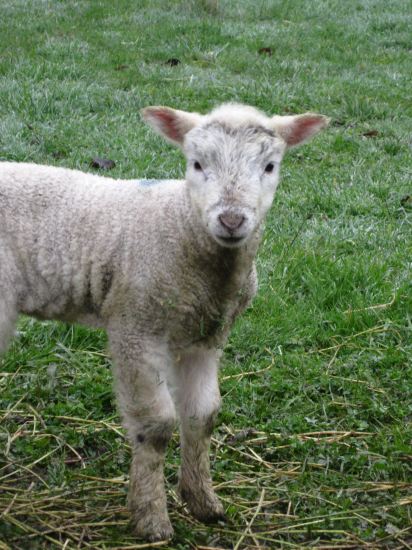


We have gypsy sheep (no it’s not a special breed). It’s what my brother started calling them because they don’t have a real home. My husband and I don’t own any farm ground but we know people that do. So we take our sheep where there are weeds, grass and blackberries to eat.
In our experience people with blackberries do not have fences that will contain the sheep, so we bring our own. We use three strands of electric poly wire and step-in plastic posts. For the most part this is successful.
The benefit of temporary electric fence is that it is temporary. The challenge of temporary electric fence is that it is temporary.
We’ve been at the temporary fence thing for almost exactly a year now. In that time, we have found some short cuts and simplifications for the process. For example, when we first started out, we did wood panel gates between each of the pastures. While in theory this is a good idea, we’ve learned that it’s easier just to lay the fence down; the sheep will walk/jump over and we can drive over it, too. This eliminates the need for connector wires buried in the ground at each gate and reduces potential connection issues with the electricity.
Our No. 1 challenge, though, was that of actually putting the fence up. Most of our pastures are in the neighborhood of three to five acres. We mounted three geared reals vertically on a piece of angle iron with each reel holding around 1,640 feet of line. Initially we would stab the angle iron into the ground at one corner of pasture, tie the ends of all three lines to the back of the ATV and pull the three lines at once. Since we use metal t-posts with insulators at the corners, we would slip segments of scrap PVC pipe or electrical conduit over the t-posts so that poly wire wasn’t frayed as it pulled around the corners. The problem with this whole system is that the wire gets rolled/twisted together during the pulling processes and sometimes it takes a while to untwist. The key is to be able to tie the ends of the wire at the first corner and pack the reels with you.
The other component of the fencing – the step in posts – were also challenging to deal with. We kept the cardboard boxes that the posts came in for storage. Although they come 50 to a box from the factory, we’ve always been hard pressed to get that many back into them. We were using the box bungee-corded to the rack of the ATV to haul them out to the fence line and install. The problem becomes that if you’re riding across a slope one way it’s great. If the slope changes direction all of your posts slide out of the box into a crazy version of pick-up-sticks on the ground, in the brush, in the mud, etc.
We talked about making a quiver for the posts. The problem always being if it hung down too far off the back of the ATV, we risked dragging in on the ground and getting hung up through ditches or low spots. Also it didn’t remedy the problem of trying to pull one stake out and getting five. And we couldn’t figure out how to hold enough stakes without the quiver weighing as much as the ATV itself.
Being from a lumber community and a forestry family, one day I told my husband, “What I really want is a set of bunks for the step-in posts.” For those of you not familiar with logging, bunks are the uprights on the log truck that the logs sit in. The logs aren’t tied down to the truck, but wrappers (chain, cable or rope) hold the logs in a bundle inside the bunk.
With that in mind, my husband went to the shop and within a day had a whole new set-up for me. He built a set of bunks that he attached to the back rack of the ATV with self-tapping screws. They are easily removed and perform their function marvelously. He also fashioned a holster for the back of the rack, which a single reel or our triple reel set-up will slide into quite easily. Now we can build fence more efficiently as one person drives the ATV and the other installs posts as the line is played out. It eliminates the multiple trips around the field as well as the tangle issues.