Learn the ins and outs of disbudding goats and despurring roosters so that you can make the best decisions for what to do with goat horns and rooster spurs on your farm or backyard homestead.
Delve into the literature concerning the care and keeping of livestock, and you’ll soon start reading through chapters on removing parts of them deemed problematic, such as spurs on roosters and horns on goats. When I was new to my back-to-the-land life, preparing for my first animals, I took these admonitions seriously as the “official” path to follow.
But now that I’ve spent years with my own flocks and small herds, I understand there are far more choices than the single course recommended in the conventional literature. Every farm, homestead, and backyard has a different set of beliefs, animals, and infrastructure. The best course of action for the people and animals involved may not be the same from one place to the next.
Now, I confess I’m biased toward leaving my animals intact: I don’t disbud or despur. I do understand, however, that sometimes it’s in the best interest of the humans or animals involved to remove potential threats. My goal with this article, therefore, isn’t to convince you one choice is better than the other, but to present a variety of information in the hopes you’ll find the practices that fit your personal philosophy and animal management.
Disbudding Goats
Disbudding is the process of removing a young goat’s horns before they have fully formed. (This is different from dehorning, which is the rather traumatic removal of an adult goat’s horns.) Disbudding is usually performed when kids are between 1 and 2 weeks of age.
On a typical farm, a disbudding iron is most commonly employed. Though the specifics are beyond this article, it involves placing the young kid in a restraining box, placing a red-hot disbudding iron around the forming horn buds, and cauterizing the growth cells. When done successfully, the growth cells should die off and the kid’s head will heal, covered by a smooth layer of hair, sans horns.

The advantages of disbudding are many. Hornless goats are deemed less of a threat to their keepers, their environment, and other goats. Though goats will always butt, without their weapons, the butts are a lot less harmful. Hornless goats are also less likely to get their heads stuck in their fencing. (I’d say unlikely, but anyone who has goats knows that the silly things often get themselves in inexplicable situations.)
The downsides of disbudding, however, though not often discussed, are also many. Disbudding isn’t always a successful process. Sometimes, a handful of growth cells survive, resulting in strange, malformed horn-like projections called scurs. While scurs can be loose enough simply to fall off on their own, sometimes they cause problems. They can grow in erratic shapes, often curling down toward the goat’s skull or eye. If left unchecked, they can cause serious damage to the animal. Because of this, they require routine maintenance.

Disbudding also removes an essential part of a goat’s head. Some folks argue that goats are meant to have their horns just as much as their eyes, hooves, and tails. The horns are used to establish social ranking, defend against predators, scratch hard-to-reach places, and provide an important element of a goat’s thermoregulation. Lined with blood vessels, the horns allow goats to cool their blood more effectively on the worst of summer days.
Finally, disbudding takes away a handle that may help you maneuver the animal more safely. Though you shouldn’t pick up any animal by its horns, I must admit, when transporting an ornery buck or scared doe, having an extra “thing” to grab has its benefits in keeping animals in place.
Deciding What to Do with Your Goats’ Horns
First, decide if they’re problematic. If you have established fencing that horned goats are constantly getting caught in but lack the resources to make the fencing more goat-appropriate, perhaps disbudding new arrivals to your herd will prevent an unnecessary death. Or, if you have a lot of visiting children who come to your property — perhaps school groups or other children who don’t have experience with farm animals — it may be less of a liability to have hornless goats.
However, if you’re just trying to raise a handful of goats for milk or meat and you have good, tight fences, you may find disbudding the goats just doesn’t offer many benefits. This may be especially true if you reside in a hotter climate: Horned goats are less susceptible to heat stroke.

All that said, intact males are very aware they have a hammer for a head, and they will employ it to express their virility, frustration, desire to be with females, or impatience that you’ve brought feed 10 minutes later than usual.
Control horned males by building them a buck-strong enclosure that can put up with their constant “testing,” and by keeping a bucket of water with you whenever you move through their area. Any buck that tries to test you will be sent running when you throw water in his face.
Despurring Roosters
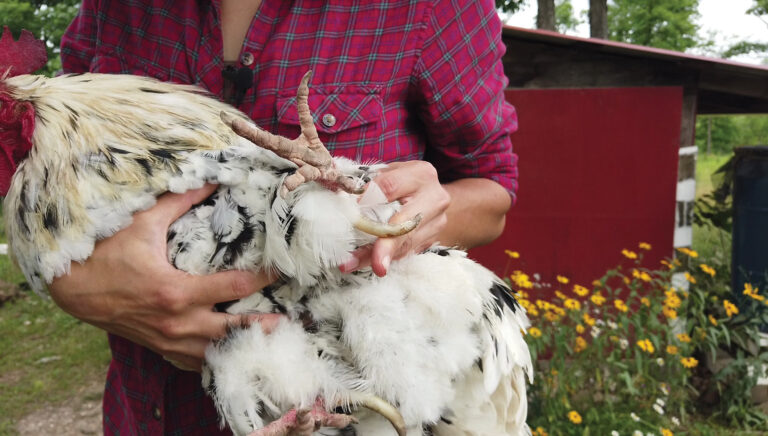
Roosters have been endowed with a specific tool for defending their flock and fighting off rivals: the spur. This hardened spike of keratin — much like a giant toenail — is reminiscent of the killing claw on a velociraptor. It’s perfectly angled on a rooster’s leg to impart a spiked attack on whoever or whatever a rooster kicks.
Though it will regrow like a fingernail, trimming a spur is a common way to control a rooster’s stabby potential. All despurring methods are best employed at night when the rooster is less active and alert. Some folks take a Dremel to it, rasping the spike down to a harmless blunt nubbin. The same can be achieved with a file and a bit more patience. Others will soften the spur with a hot potato, then take a set of pliers and twist the tip off. In all cases, care must be taken to protect the sensitive, blood-rich quick at the heart of the spur — nicking it or leaving it exposed will cause pain, bleeding, and the opportunity for infection.
Permanent spur removal is beyond most laypeople. It can be done by a veterinarian, but it’s expensive and traumatic.

Despurring can offer peace of mind to folks with aggressive roosters. While it may seem funny to watch YouTube videos of folks being harassed by roos on the offense, there’s nothing funny about being stabbed in the calf by a mean chicken. People with pets and young children often believe despurring is the best option to keep unsteady toddlers, unwary children, and playful dogs safe from an unexpected rooster rampage.
Sometimes, spurs need to be trimmed for the flock’s health, even if the rooster in question isn’t aggressive. The spur never stops growing. Older roosters may end up with long spurs that curl back toward their shanks and start to poke and burrow into their skin, causing pain and damage. In such a case, a seasonal spur-icure of the leading points will certainly alleviate the issue for the old fellow.
Another instance where a trim might be in order is in the spring when the roosters are crowing and mating with all their testosterone-flooded might. If you have a young, inexperienced male, or if you have too few hens for your rooster, the hens’ backs may be scratched by the rooster’s spurs. Remediate the situation by trimming spurs or outfitting any bare-backed hens with a special mating saddle for protection.
Despurring isn’t a cure-all. If you free-range your fowl, spur-less roosters have lost one of their biggest and best weapons against marauding foxes, raptors, and dogs. A spurred rooster offers all-day surveillance to protect your flock, and letting him keep his assets may help keep your hens safe.
Finally, despurring may keep some roosters around and creating offspring far longer than they should. Aggressive behavior can be passed down, and a rooster with a nasty streak will likely produce chicks with the same belligerent personality. For backyard flock-keepers merely looking to produce eggs and meat for their family, mean roosters should end up in the stew pot rather than the despurring table.
Deciding What to Do with Rooster Spurs
If you have a calm, younger rooster with enough hens to keep him busy (usually a 1-to-7 ratio is optimal), his spurs may not be an issue. In this situation, it’s perfectly fine to leave him alone to crow and strut in point-protruding peace.
In that case, treat your intact rooster with respect. Always remember that spurs emerge when a rooster feels threatened, so create an environment where your rooster doesn’t have to go on the defense. This includes making sure visitors to your coop — especially children or friends’ dogs — don’t tease the big guy.
It pays to understand rooster body language. A calm roo will pretty much ignore you and focus on his ladies. If he warily inspects you, bumps into you, or, worst of all, fluffs up his hackle feathers, you’ve done something he finds suspicious. Maybe your squeaky boots or your flappy raincoat are to blame. Don’t underestimate a simple-minded bird’s ability to turn something seemingly innocuous into a scary, bring-out-the-spurs threat.
Make the Choice That’s Best for You and Your Animals

When it comes to managing your flocks and herds, the list of decisions that need to be made is huge and often divisive. I hope this article gives you plenty of material to help you make an informed decision that’s the best fit for your land philosophies. If you find removing problematic pointy parts is what serves the animals and people on your land best, then make your decision with confidence and use the ample materials available in conventional literature. But on the flip side, if you’ve always been uncomfortable with the constant admonitions to cut bits off your birds and goats, know you can also leave your animals intact with confidence. It may require you to amend and adjust your habits to accommodate for your animals’ inherent roosterness and goatness, but learning the habits and quirks of your creatures is one of the quiet joys of keeping animals in the first place.
Wren and her husband left the city and its dependency and went back to the land in the Ozarks. Every year, they’re getting closer to their goal of getting entirely off-grid, being as self-sufficient as possible, and living happily as modern peasants.