Follow Nathan Putnam hunting with pack goats through the backcountry trails, up mountains, and across tough terrain, while encountering bull elk, cows, and bears.
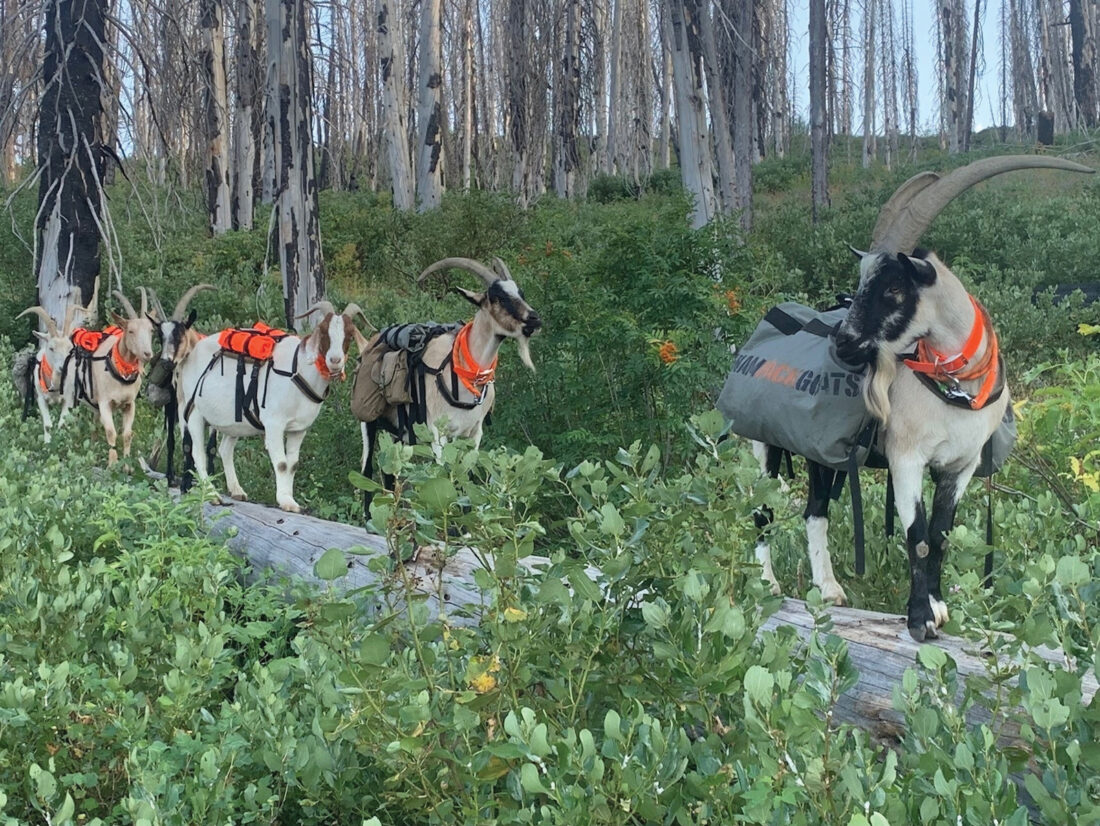
The mountain road winds and climbs as we make our way along a narrow jeep track that barely fits my full-sized pickup. Brush scrapes the sides, and I’ve had to tuck my mirrors in for clearance as I cautiously navigate the more treacherous areas, slowly creeping along in four-wheel drive and having to hammer the pedal every now and then to get through loose sections. Protected by a contractor camper shell, 10 pack goats bounce around in the truck bed, with some hog panel covering the open slider windows for ventilation. On top of the truck is a roof rack with a pair of coolers and several large storage boxes laden with camp gear and pack saddles meticulously organized for our adventure.
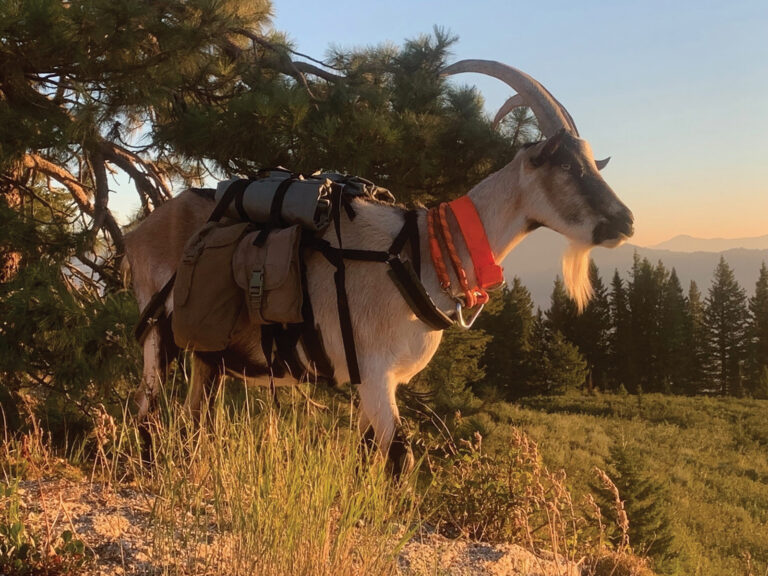
I pull into our high mountain campsite, a remote pull-off surrounded by densely wooded peaks, and hastily start unloading gear and goats. I’d driven in late in the afternoon in hopes of giving the goats a small respite from the heat of the day, but now I have daylight working against me as we set up camp. I inspect the site and begin to consider the best place to tie out the goats for the evening and position my tent with the door facing them, a habit I’ve developed so I can sit up and check on them in the middle of the night with a headlamp without getting out of the tent. It’s September, and there’s no adverse weather in the forecast, so this exposed hillside with a low line should work well, and the surrounding grass and bushes make for a lush graze as the goats mill around camp.
It’s rare for us to set up these “truck camps,” as I call them. Usually, I prefer to put several miles between us and the roads for our backcountry hunts, living off the supplies in the goat packs for several days at a time while avoiding other hunters. However, in this spot, most of our elevation can be gained by driving, and it allows us to drive around the mountain in several directions, chasing game. This is my second time in this location, and aside from the single camp pullout, there’s nothing for miles in either direction, a happy compromise in my book.
I make the final preparations for our camp, throwing out a pair of heavy-duty low lines I’ve built out of coated 1/4-inch steel cable. This is a special truck-camping system I made with 10-foot tie-out points for grazing, allowing each goat to nibble a 6-foot radius around itself when stretched out at the end of its lead. For this spot, I’ve chosen to run it as a double low line using one of the spokes on my truck wheel as an anchor and a strong sapling for the opposite end, some 100 feet away. As I begin to collect goats and fill my low line, I’m mindful to put brothers and buddies next to each other to avoid bullying; often, bonded pairs like to cuddle up at night for warmth and comfort. Soon, I have all 10 goats stretched in single file outside my tent door. As I make my final preparations in my tent before turning in for the night, I do one final check on them. A few are still standing, but most have scratched spots for themselves to lie down and are lazily chewing their cud.
The night doesn’t offer much rest, since we’re intermittently being woken up by a bull elk bugling above our camp, longingly announcing his eligibility. The alarm I’ve set comes too soon, and, bleary-eyed, I sit slightly out of my tent and tie my boots while sipping coffee and munching on Pop-Tarts. Robotically, I go through the motions of saddling goats with a headlamp, being careful to make my final adjustments to their tack as I wait for the first rays of morning light before departing camp. When we know where we’re headed, we can start before daybreak, occasionally stopping to check my back trail to make sure the goats have kept up. Still, I prefer to get my packing done in the daylight, and I’ve found we’re just as likely to bump into game 10 minutes from camp as we are rushing up the mountain in the dark to be up top at first light.
We move slowly, weaving our way through brush and over deadfall as I follow a faint elk trail, stopping here and there to listen for bugles or to trim a few branches out of the way with a pair of loppers I keep in my pack. Eventually, the terrain opens up to an exposed ridge with rocky outcroppings and fresh sign from the bull that had kept us up the night before. The surrounding area is littered with elk sign, both new and old, and I stop and inspect several rubs on a large set of saplings where a bull has been angrily raking his horns, a display they use to attract cows and intimidate competing bulls.
Ahead of us is a massive boulder with a precarious set of handholds to climb to the top. I drop my pack and remove my binoculars, being careful to place my muzzleloader out of the way where the goats won’t knock it over. A quick scramble, and I’m up on top for a good glassing position, the goats milling around me in the brush below. Off in the distance, a few large, tan shapes sharply stand out on the thickly overgrown hillside as a group of elk cows enjoy the warmth of the sun during their morning meal, the light reflecting off their coats and producing a vibrant golden color against an otherwise dull landscape. Below them, tucked deeper into the brush, I can make out a set of massive antlers, a sight that’s shortly confirmed by the deep bellow of a mature herd bull. I hear the response of a challenger in the distance before being cut off by the high-pitched shrieking of the mature bull, which abruptly settles their argument.
I scramble back down from my glassing position, half sliding down the boulder in my excitement as I quickly gather my things. A low whistle to the goats, and we’re moving again, cautiously weaving through the brush and sticking to the exposures whenever possible, while picking a route toward the group of elk on the opposite side of the ridge so as not to be seen. The goats will make noise as we move, which is unavoidable, but if you move cautiously, the sound is nothing more than one would expect to hear from a group of cows slowly working their way toward a potential suitor.
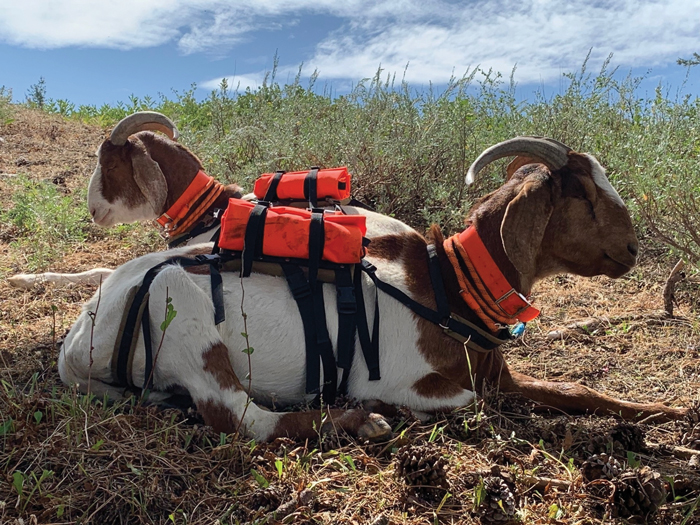
I reach a small clearing on the ridge and abruptly sit down. There’s the faintest movement in the brush ahead of us, and an elk calf suddenly appears, unaware of us as it continues its morning graze. From below, I can hear the rustle of several other larger bodies hidden in the bushes as we wait for the calf to saunter off without blowing our stalk. The goats have gathered around me, their ears perked and pointing sharply into the brush where the calf disappeared. Often, when we’re sitting and glassing, I’ll use the direction of my goats’ ears just as much as (if not more than) my own eyes when working a hillside, and it’s incredible what small sounds and movement they can pick up, often spotting game animals long before I do.
We sit in this small clearing for several more minutes before cautiously creeping forward, continuing toward the thicker brush where we’d last seen the massive bull elk. Moments like these are tense, since any moment a cow can blow out, and often I’ve found eyes and ears staring back out at me from the shadows. The bushes make a haphazard patchwork across the hillside, with tight lanes between open areas. We inch our way forward, the goats feeding off my cautious movements and, in turn, moving cautiously themselves, sensing the excitement of the hunt building. By now, I have my muzzleloader out, a custom Remington 700 ML 50-caliber with a Williams peep sight loaded with a paper-patched 460-grain boolit, a load I developed for close-range elk hunting.
Suddenly, there’s an uproar of branches breaking as the bull comes boiling out of the brush and goes barreling down the mountain in thick cover, clearing 100 and then 200 yards in a matter of seconds before cresting the hillside and disappearing into the next drainage with a trail of cows in pursuit. I stop for a moment to reflect on our approach and whether things could’ve gone differently, but I’m mostly grateful for the opportunities to have close encounters with bulls like these, especially when other hunters may go their whole lives without feeling that sort of thrill. I pack my rifle away and remove my trekking poles once again, mentally preparing myself for the climb as we begin to feel the heat of the morning sun.
Climbing is tougher now as we scramble to the top of the mountain, with no protection from the sun as it glares down on us. Early September temperatures can still linger above 90 degrees F during the day and drop to freezing at night, and today is one of those brutal, windless climbs. I stop and grab the water bottle in my pack, find it empty, and fish a full canteen off a goat’s saddle while we take a long pause before continuing, the goats all breathing heavily around me. I know that in heat like this, we’ll need to stop soon and rest in the shade for the bulk of the afternoon, but if I’m careful and watch for early signs of heat exhaustion, I can get a few more miles out of them. Fortunately for them, today won’t be one of those days, and we soon reach the tree line and the cooling shade it offers.
We spend the afternoon lounging in the shade, chasing it as the sun moves. I’ve broken out my Helinox chair, a small, portable camp chair that collapses down to almost nothing. The goats take breaks from milling around and grazing to come and lounge next to me. I often find them hovering over my shoulder, with no concept of personal space, patiently waiting for me to give them my full attention.
The bulls have gone quiet by now as they spend the warmest hours dozing in the shade, but occasionally the silence of the afternoon is broken by a halfhearted bugle. A spike bull (a young male elk) wanders past, completely unaware of our presence until he stops and looks up at us as one of my goats shifts to get a better look. He pauses for a few minutes to inspect the “ugly elk,” as I call my crew of packers, before wandering off.
Finally, the sun begins to lower in the late afternoon and a slight breeze picks up as we pack our things and start moving again, sticking to the shade and going at a snail’s pace. I have a small backpacking tent with some gear on one of the goats and enough water to get through the night if needed, so we wander aimlessly as I take in the landscape and plan out future adventures.
As we descend again, the trees transition from looming ponderosa pines to a thickly woven mat of aspens. I duck and dodge branches while finding the best route, gently moving branches out of my face with the barrel of my muzzleloader and carefully paying attention to the goats as they navigate behind me. Gear hangups are common in thick growth, and occasionally I have to drop my pack and backtrack to help a goat untangle itself. We reach a small clearing and sharply cut back up to the ridge.
As I duck and weave through an opening, there’s a sudden dark brown flash of movement, and a large black bear clambers up a tree, resting across a branch and taking in the new intruders. Being slightly downhill from us, the bear is eye to eye at no more than 5 yards, which adds an extra element of excitement. Without pause, I raise my rifle to my shoulder and fire at point-blank range. The thick, sulfurous smell of black powder permeates the air as the smoke clears, and for a moment, I think I missed, but slowly the bear sways from its perch before tumbling to the ground.
I pause again to soak in the moment and glance back at my goats, who have startled from the gunshot but are only a few paces behind me in the thick brush. I calm them and give them small reassurances before backtracking a few steps to the small clearing and tying them out before I get to work.
From one of their packs, I remove a small bag that contains a set of lightweight game bags, a tin of black pepper, and a small diamond knife sharpener. On the other side, I remove a small ultralight tarp that I use as a poncho but that, in these situations, also doubles as a clean mat for laying out quarters. As I work, I sprinkle black pepper to ward off flies and meat bees, pausing occasionally to touch up the edge of my pocketknife with the sharpener.
Once the quarters are removed, I focus on freeing up the loose neck meat and back strap, gently placing each piece on my shaded tarp and generously sprinkling one final coat of black pepper. Lastly, I turn my attention to the hide and head, which I’ll pack out myself.
I remove a small digital luggage scale from my pack and weigh the quarters when I’m finished before shuttling the now-balanced loads back and placing them on two of my goats in a small set of meat panniers I’ve made just for these occasions. At first, the goats stagger under the weight, but once they’ve adjusted to their loads, they anxiously wait to be let off again to continue their snacking.
With our heavy cargo, we slowly pick our way back along the ridge to camp. The goats are on edge from the musty smell of bear emanating from my pack, and occasionally one will snort and startle the rest of the group when it gets a strong whiff.
Once clear of the brushy areas, it’s a smoother descent, and I stop to admire one goat with his meat load as he articulates over a shale section, precariously testing each step and sending the occasional rock crashing down below. It’s tough terrain like this where pack goats prove their worth the most, as we transition from scree to deadfall and back to scree again, diving off the mountain to meet up with the road we drove in on the day before. Exhausted, we finally arrive at camp. With the last waning light of the sunset, I gently reward each goat with a scratch as I remove their packs and begin the work of packing up camp and loading the truck for our drive home.
Nathan Putnam is a board member of the North American Packgoat Association. He and his wife, Jackie, own Putnam Pack Goats in Mountain Home, Idaho, where they breed SaberPine crosses and build pack goat equipment. They enjoy hiking and hunting in the Idaho backcountry with their goats. You can learn more about them at www.PutnamPackgoats.com or on Instagram @putnampackgoats.
Originally published in the May/June 2026 issue of Grit magazine and regularly vetted for accuracy.