Use the calf-sharing milking technique to balance the task of providing fresh milk for your dam-raising dairy calves and your family.
Most conventional dairy farms separate newborn calves from their dams shortly after birth. A few of the reasons for this arrangement include disease control within the herd, ease of calf management for the farmer, and greater profit margins for the dairy. Smaller operations, however, may find that dam-raising dairy calves offers the farmer more flexibility, while the calves reap the benefits of being raised in their natural environment. Sometimes, this process is called “share-milking,” because the farmer and the calf share the responsibility of keeping the cow milked. For close to 20 years, I’ve used this share-milking model to balance the task of dam-raising dairy calves with that of supplying fresh milk for our family.
Benefits for the Cow
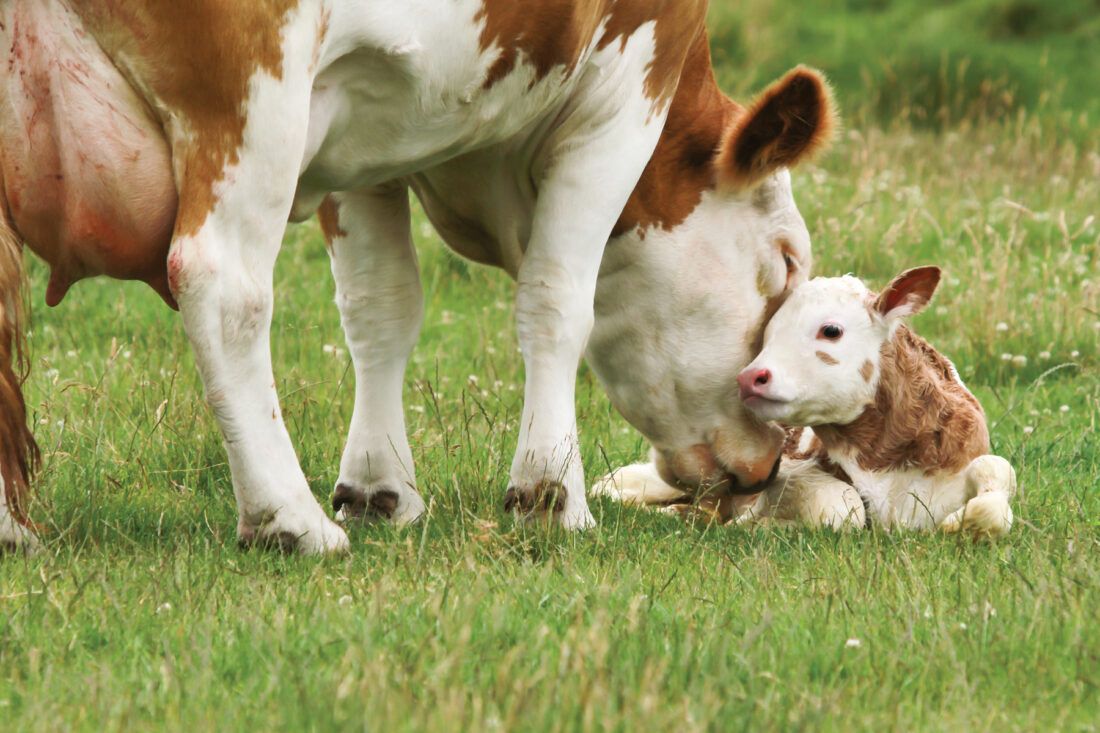
A cow’s hormonal response to the birthing process isn’t unlike that of other mammals. It’s normal for a cow to want to nurture and bond with her offspring by nursing, licking, grooming, and otherwise stimulating her baby. Beyond this physiological reward, share-milking may have other benefits for the cow. Some studies have indicated that a nursing calf helps discourage mastitis that otherwise might be caused by residual milk left in the cow’s udder; it may help increase the cow’s milk production as well. According to “Is rearing calves with the dam a feasible option for dairy farms?” published in Applied Animal Behaviour Science in 2016, “The udder health of nursing and non-nursing cows is reported to be similar or better in nursing cows in a number of studies. This may result from the residual milk being consumed by the calf soon after milking, which would also reduce the risk of lower milk production due to high residual milk.”
Benefits for the Calf
The benefits of share-milking are both physical as well as social for the calf. Calves housed with their dams can choose when and how often they wish to eat, as dictated by their physical needs. This means dam-raised calves eat smaller meals more frequently in contrast with bottle-fed calves, which are often fed only twice a day on small farms. The direct result of this arrangement is that the pre-weaning weight of dam-raised calves will typically be greater than that of bottle-raised calves. In addition, calves who are left to satisfy their suckling reflex in a natural setting are less likely to express this behavior in unnatural ways, such as by cross-sucking on other calves.
Dam-raised calves also seem to pick up on important social cues and learn the herd dynamics more readily than calves that aren’t raised in a group setting. Preliminary studies show that calves left with their mothers learn to forage quicker and more effectively, choosing grass that’s beneficial to their diet and ignoring unhealthy or less-nutritious plants.
Additionally, studies show long-term benefits for dam-raised dairy heifers. Applied Animal Behaviour Science shares, “There is a growing body of evidence that early high milk intake leads to higher milk production in the heifer’s first lactation. All these results support the view that leaving cow and calf together before weaning can improve calf welfare and also give some production benefits.”
Adopt the Calf-Sharing Milking Model
Leave the newborn calf with the dam to nurse on demand for the first 12 to 24 hours after birth. Giving the mother cow and her calf a 12-to-24-hour window to spend together before you start the milking routine will allow the pair to bond uninterrupted and will give the calf a chance to consume the antibody-enriched colostrum provided by the dam. It’ll also allow time for the mother cow’s hormones to settle a bit after the birthing so she’s calmer when the milking routine begins. (The only time I intervene during this 12-to-24-hour period immediately following birth is for a medical emergency or if I think the calf might not be nursing.)
After this initial bonding period, milk the cow twice daily. While settling into this initial routine of milking twice a day may seem demanding, it’ll help prevent mastitis when the calf is too small to consume all the milk produced by the cow. In addition, it’ll help maximize the cow’s production. This will be important once the calf is older and the homesteader wishes to have enough milk available for both their family and the calf. (Keep in mind that other factors also affect a cow’s production, such as genetics and the quantity and quality of feed.)
This initial twice-a-day milking routine won’t last forever. As the calf grows and consumes more milk, you can then begin milking once a day. I gauge the timing of this change by paying attention to the cow’s udder and her production rate. Unless you have a cow that produces more than 4 gallons of milk a day, it’ll typically be safe to milk the cow once a day by the time a calf is around 4 weeks old. Ask yourself these questions to help you decide if the time is right to begin milking once a day:
- Is the calf now nursing out of all four teats, or is it still ignoring one or two of them? (Newborn calves will often pick one or two teats and only nurse from them until they’re older and can consume more milk.)
- Am I consistently getting less milk, making it feel like a twice-a-day milking routine is becoming a waste of time?
- Is the supply of milk I take to the house approximately half (or less) of what I was getting when the calf was only a week or two of age?
Another shift in the milking routine typically happens when the calf is around 6 to 8 weeks old and large enough that it begins to consume most or all of the milk the cow is producing. When this happens, you’ll have at least two options.
The first possibility, and the one I use, is to separate the calf into an area next to its dam where it can’t reach through the fence and nurse. Being in proximity to one another will usually keep the cow and calf content, especially after they grow accustomed to the routine and realize they’ll be reunited daily. I separate them most nights, which allows me to put the calves out to pasture with their dams during the day instead of pasturing them separately. However, if it’s better for you to milk in the afternoon or evening, you can separate the calves during the day instead, ensuring they have access to grass or hay and water. This may also be a good time to slowly begin introducing them to grain. An ideal situation would be 12 hours with the dam and 12 hours of separation, but the split doesn’t need to be exact to be workable. After the calf has been separated for the allotted time, the farmer can then harvest the milk for their own needs before reuniting cow and calf.
Another management option is to allow the calf to remain with the dam full-time and only separate the calf when the homesteader needs milk. For instance, if you know you’ll need several gallons of milk a week to supply your family’s needs, you can separate the calf from the cow once or twice a week for 12 hours. Milk the cow, return the calf to its mother, and separate again the next time you need to replenish your milk supply. This method of management can allow the farmer to leave home overnight, or possibly even for several days, without worrying about finding someone to milk the cow.
Potential Challenges When Share-Milking
While share-milking may seem like an ideal solution for many small homesteads, there are potential difficulties. A commercial dairy cow used to having her calf removed shortly after birth will usually more readily fall into the milking routine. However, a cow that has the sole responsibility of raising her calf may be nervous when the calf is a newborn, and possibly for a few weeks afterward. At times, you can alleviate the dam’s resistance to coming in for milking by allowing the calf to remain with the mother when she’s being milked. (The calf can stand beside the dam or be placed in a pen where the cow can see the calf and know it’s safe.) Be patient and understanding as the cow adjusts. Once the calf is past the critical newborn stage, around 2 weeks of age, the mother will be happy to leave the calf unattended and enter the stanchion to be milked.
Another potential hurdle to share-milking is milk ejection, otherwise known as the “let-down reflex.” The presence of the calf and the calf’s need for milk creates a physiological response in the mother. As her body produces oxytocin, she’ll begin to release milk for her baby. This response is sometimes withheld when humans try to extract milk from a cow. To stimulate the cow, you could allow the calf nurse one teat while you milk the other three teats. Or, you can let the calf to nurse for a couple of minutes, and then remove the calf and proceed to milk out all four quarters. Many homesteaders find this latter arrangement works well for them, even long-term.
Take a few moments to watch a nursing calf, and note how the calf stimulates the ejection response in the dam. It’ll press its head into the cow’s udder and use its head to bump the udder. Humans can mimic these actions to help stimulate an ejection response in the cow.
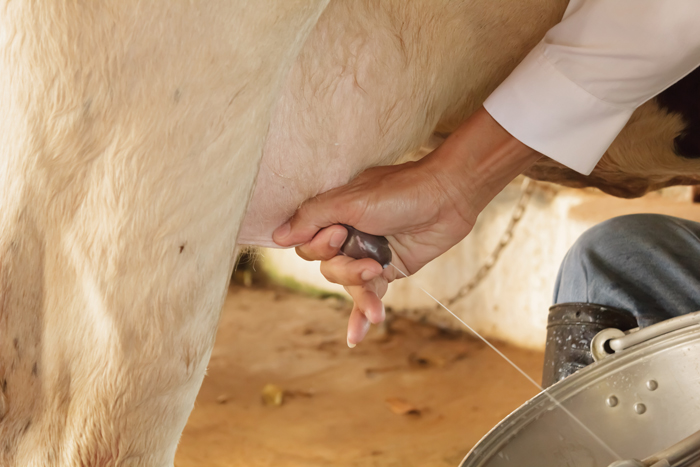
Always strive to keep a calm and relaxed atmosphere when milking your cow. She’ll sense if you’re nervous or agitated and will be less likely to relax. Begin your milking routine by washing the cow’s udder with warm water, and then lean into the cow as you milk her, using your head to apply pressure to the hollow in front of the cow’s rear leg and above the udder. Occasionally bump the cow’s udder with your hand while milking. You can also run your hand along the large vein (commonly referred to as the “milk vein”) on the underside of the cow’s belly; this will encourage the cow to relax and let down her milk. Many times, a combination of these actions will evoke a let-down reflex from a cow that’s stubbornly holding back her milk for her calf.
Additionally, a cow’s teats will often become cracked and sore from a calf’s frequent nursing. Older calves may even leave teeth marks on the tender teats. Pay attention to udder health, and keep udder cream on the cow’s teats, both as a preventive and as a treatment. If an older calf is rough and damages the dam’s teats, you may need to limit their time with the dam at that point.
One final consideration is that when a calf is nursing, it receives the best of the cream, and the quality and quantity of the cream left for the farmer is compromised. However, when the calf is finally weaned, all the quality and quantity of the cream will then be available to the farmer.
Happy Milking
Many people hesitate to keep a milk cow because of the time and commitment it involves, but the share-milking routine offers options and methods for keeping a family cow on many busy farms and homesteads. Whether you choose a share-milking routine for your farm as a matter of conscience or because of its flexible schedule, the routine has the potential to be beneficial to bovines and humans alike with the proper management.
Tammy Cupp and her husband, Mike, raise and train dairy cattle on 50 acres in the Blue Ridge Mountains. Follow them on Instagram @MapleLawn_Farm and on Facebook @MapleLawnFarmInSWVirginia.
Originally published as “Share-Milking a Cow” in the July/August 2024 issue of Grit magazine and regularly vetted for accuracy.