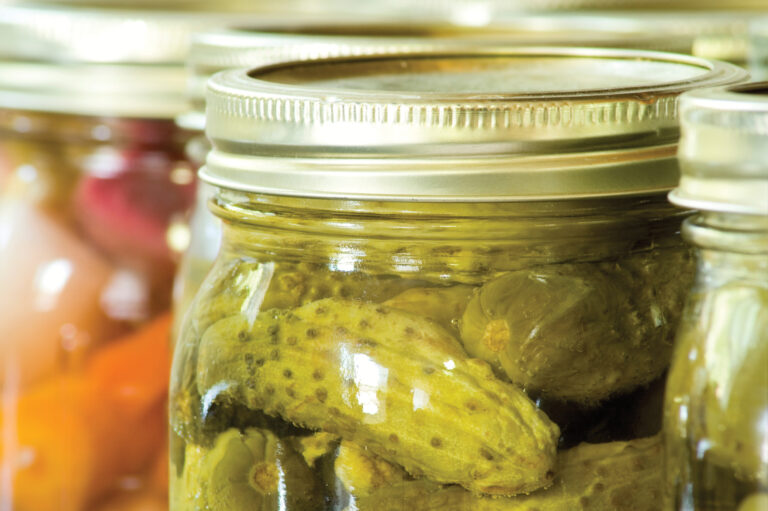
I vividly remember the first time my grandmother took me to “the cave” to retrieve a couple of jars of pickles. We lived on a hundred-year homestead, and who knows which generation had dug the root cellar and created the little hill in Grandma’s front yard. The door didn’t angle up that far, and after you opened it, you went down a few crude stairs and still had to dip your head low to get in. To my young eyes, it seemed to be a door into the past. The rock-lined chamber was cool and smelled like dirt and age. Shelves lined both sides, and, though we never ate their contents, some of the jars had to be left from generations past. By the time I was around, Grandma only used the shelves closest to the door. We grabbed up a couple of jars of dill pickles (I also remember how we hoarded the last jar of Grandma Pickles). As I carried them back to the house, I wondered how it was that we could put food in a cave that wasn’t nearly as cold as our refrigerator and not have it spoil.
Now I know more about the process and the science that makes canning a safe way to preserve food. The canning process mitigates several factors that can make food inedible. It removes oxygen that reacts with food; destroys enzymes that cause food to break down; prevents the growth of bacteria, molds and yeasts; and forms a vacuum in the jars that keeps liquid in and air and microorganisms out.
But how does it work? Well, the heat processing is the most important part. The filled jars are closed with metal lids and screw bands, and placed in the canner. Then you heat them up, and the stuff in the jar starts to expand and push some steam and air out of the headspace (even with tops on the jars and tightly screwed rings, the pressure is enough to let gasses escape). After the elapsed heating time, when the jars begin to cool, the food contracts again, increasing the pressure inside the jar and pulling the lid down (pop!) to form a “vacuum seal.” This seal keeps the bad stuff out and the good stuff in.
The heat is also the mechanism for destroying enzymes and killing bacteria, mold and yeasts. Canning is done with either a boiling-water canner or a pressure canner. Which one you use has to do with the acid content of the food. High-acid foods, such as most jams, jellies, fruit, pickles and relish, can be processed at lower temperatures because their acid content already retards microbial growth. Low-acid foods, such as many vegetables, meat, soups and poultry, require the higher-than-boiling temperatures attainable in a pressure canner.
A primary concern is botulism. The bacterium that causes that dreaded poisoning hangs around as dormant spores in soil and on fruit, just waiting for an oxygen-free environment in which to grow and make toxins. Low-acid foods (those with a pH above 4.6) support the growth and toxin production of Clostridium botulinum, and it is easier to destroy at the higher temperatures of pressure canners.
According to “The Complete Guide to Home Canning” from the USDA, you can also process low-acid foods in a boiling-
water canner, but it must be held at temperature for 7 to 11 hours. I don’t know about you all, but in the heat of summer, processing times between 20 and 30 minutes are plenty long enough for me to be in a steamy kitchen with boiling water.
Web Editor Jenn Nemec may also remember the cave because of the spiders that creeped and crawled inside.