
Nearly everyone remembers their mother’s and grandmother’s cooking with a smile. Aside from being generally good cooks and bakers, they had an edge. Fried potatoes, pie crusts, cookies, and most all the other favorite dishes were made with good old-fashioned lard. If they really wanted to add flavor, they would go for bacon grease, too. My arteries are cringing at the mere mention of these words.
As we add years, we start to think more often of making healthy choices. Of course, when it comes to fats, the star is olive oil. However, this isn’t as simple of a choice as it sounds. Olive oil isn’t just olive oil. If you look at the grocer’s shelves, the choices are endless; virgin, extra virgin, lite, semi-virgin, fine virgin … the list goes on. Seriously, how is a person to choose?
The price tags are as varied as the grades. So, before laying out a few nickels, I decided to do a little research. What I found is that olive oil has a story all its own.
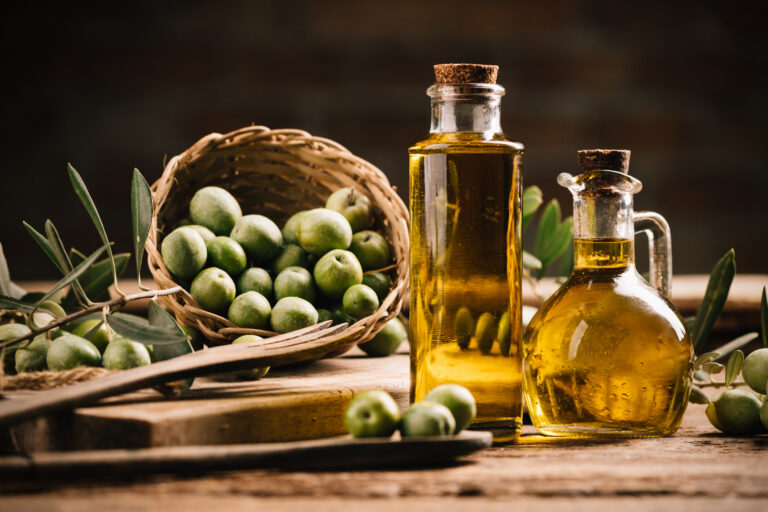
Many variables go into the production of this oil. These variables yield dramatic differences in color, aroma, and flavor. Unsurprisingly, a large percentage of olive oil comes from the Mediterranean area. It takes several years for the trees to mature before they produce oil. As with any crop, olive farmers go for higher yields without sacrificing quality. This is especially important since it takes 10 pounds of olives to produce one liter of oil. Careful pruning helps the trees to produce more.
There’s much work involved just to coax the oil out of the olives. Traditionally, trees were shaken or beaten with sticks to make the olives drop to the ground. This causes bruising and, once bruised, the oil starts to degrade. For this very reason, some olive oil labels specify “hand-picked,” or further distinguish by labeling the olives used for the oil as “tree olives” or “ground olives.” In modern day production, some large-scale producers use tree-shaking devices and large nets to catch the fruit. Care must also be taken during transport. Any bruising can trigger oxidation and fermentation, which results in an “off” flavor.

Another key to producing a quality oil is how soon the fruit is pressed after harvest. Leaves, twigs, and stems are removed after picking. Then the olives are washed before pressing. In the old days, stones or granite wheels were used to press the oil, whereas today, stainless steel rolls crush the olives and pits then grind the pulp into paste. This paste then undergoes malaxation, which is a process where water is slowly stirred into the paste, allowing the tiny oil molecules to clump together and concentrate.
This mixture is then stirred for 20 to 40 minutes. A longer mixing time increases oil production and gives the oil a chance to pick up additional flavors from the olive paste. The downside is that mixing also exposes the oil to air, which produces free radicals, which in turn affect the final quality.
Modern systems use closed mixing chambers filled with a harmless gas to prevent oxidation. This method can increase yield, flavor, and quality without allowing oxidation to occur. Oils can be heated to 82 degrees F; this temperature is still low enough for the oil to be considered cold-pressed.

The paste can be further processed by putting it on mats and pressing more or sent through a centrifuge and rotated at extreme speeds to further separate materials. The olive paste is pushed to the sides of the compartment while water and oil are extracted and later separated. The solid material after the extraction of oil is called pomace and contains residual oil. Some manufacturers will use steam or solvents like Lexane to squeeze out more oil. This must be labeled as pomace, a low-quality oil.
From this point on, the oil can be further refined, bleached, or deodorized. Refining reduces acidity and any bitter taste; bleaching removes chlorophyll and carotenoids (the natural pigment which gives it color) and possibly reduces residual pesticides. All of this results in a lighter-colored oil with fewer nutrients. The olive oil is then stored in stainless steel containers at about 65 F to prevent further breakdown before bottling.
All of this processing is what produces the various grades of oil. Olive oils are graded by the production method, acidity, content, and flavor.
- In a nutshell, the term “olive oil,” when used alone, refers to a blend of refined and virgin olive oil.
- Virgin oil is obtained from the olive using solely mechanical or other physical means, which don’t alter the oil in any way.
- Refined olive oil is obtained by treating low quality or defective virgin olive oil with charcoal, other chemicals and physical filters.
There are many grades within each of these categories, with extra virgin being the highest grade of oil. Choosing an oil is a matter of taste and personal preference, although there are some general guidelines depending for what purpose the oil is intended.
- Premium extra virgin is nature’s finest. It has extreme low acidity and is best used in uncooked dishes where the distinct taste and aroma can be appreciated.
- Extra virgin has a fruity taste and is also best used in uncooked foods.
- The lower grades, like virgin, are best used in cooked recipes.
I was surprised that oils labeled “lite” or “mild” doesn’t refer to the calorie content, but rather to the lighter flavor and color.
Olive oil has been likened to a fine wine. Both are good for you when consumed in moderation. Being a monounsaturated fat, olive oil is heart-healthy, helping to lower LDL cholesterol and heart disease in general. Studies have shown that by consuming more olive oil, blood pressure meds can be reduced by a whopping 48%. Likewise, olive oil is loaded with antioxidants and anti-inflammatory properties. However, unlike wine, olive oil does not improve with age; its quality is best when used within a year of pressing.
Now I can head back to my grocer’s shelves. By choosing the right olive oil, I can enjoy healthier versions of some of my favorite recipes without sacrificing flavor. Who says you can’t have your cake and eat it too!