Would you be prepared to survive in the event of a complete breakdown of modern civilization? In Long-Term Survival in the Coming Dark Age (Paladin Press, 2007), author Jim Ballou introduces you to the essential skills and mind-set you will need to survive a complete, long-term shift in the way the world operates. Learn how to build a fire, recycle and salvage everything, develop survival bartering skills,
prepare and store caches and much more. The excerpt below comes from chapter 5, “Making Fire.”
You can purchase this book from the GRIT store: Long-Term Survival in the Coming Dark Age.
Let us now shift our attention to the subject of fire, as I believe this will always be of great importance to our lives in one way or another. In primitive times, fire was used for keeping warm, cooking food, signaling, providing light, hardening clay and wooden tools, and for smoking meat and hides to help preserve them, among other things. In a future Dark Age, I expect that fire might be useful for keeping warm, cooking food, boiling water to purify it, sterilizing surgical instruments, firing clay, heating, tempering, and melting metals, and for providing light wherever electricity might be unreliable or in short supply. I am convinced that the ability to create and control fire will give knowledgeable survivors a significant advantage in the future, just as it has in the past.
As important as fire obviously is to the quality of human existence, it is also potentially very dangerous to the environment and a real threat to the survival of those who find themselves in the path of a raging wildfire.
Various systems for creating fire include the friction bow-drill, several different sparking devices, and a cigarette lighter.
Attentive supervision and proper safety measures therefore will be every bit as important as the ability to create and effectively use fire. The most common hazards associated with fire are the blaze spreading beyond the hearth or fire pit due to popping embers or wind-blown ashes; soot and smoke filling the lungs; and carbon monoxide poisoning and asphyxiation in confined spaces where the fire consumes all the oxygen.
The majority of problems can be prevented by ensuring that shelters have adequate ventilation; fireplace chimneys are clean and in good condition; campfires or candles are not positioned too close to low-hanging tree branches, dry leaves or grass on the ground, curtains, or other unintended flammable matter; breaks or walls are used to shield wind around the fire pit; proper equipment such as tongs, pokers, shovels, buckets, and thick leather gloves are on hand for safely handling the fire; a supply of water or loose dirt is available to put the fire out; and no fire is ever left unattended.
There are a number of methods by which ignition might be initiated. The chemical reaction we know as fire is really a rather complex process, but we can create and effectively use it for our purposes if we only understand a few basic essentials.
Three things are required in order to build a fire: oxygen, fuel, and heat. These requirements comprise what is sometimes referred to as the “fire triangle.” Without all three, a fire will not burn. Also, there are two different types of combustion: flaming combustion and glowing combustion.
Flaming combustion burns fuel gases, while glowing combustion burns fuel solids.
Typically, a burning piece of wood will undergo the flaming combustion process first, until the gases contained in the wood have been completely consumed by the flames, and then the wood will usually undergo the glowing combustion process for an extended period. The glowing combustion is seen as the glowing coals or remaining embers after the flames have died down.
Primitive Methods for Making Fire
Early methods for making fire, such as the bow drill, the hand drill, or the fire plow, relied on friction to generate the necessary heat.
Fire Piston
One primitive method used in some parts of the world is the fire piston, which utilizes rapidly compressed air to produce enough heat to ignite the tinder. These fire sets consist of a cylinder of hardwood plugged at one end and bored inside to about a half-inch diameter, with a perfectly fitted wooden shaft or piston having a cupped tip to hold a small pinch of tinder, and a push knob on the opposite end.
With the piston started in the cylinder, a sharp blow on the knob with the palm of the hand forces the piston swiftly in, creating the compression that ignites the tinder. The piston is then quickly removed and the tinder is transferred to a larger tinder bundle where it can be fanned to flame. The principle is the same used in diesel engines. While seemingly simple in concept, everything has to be just right for the fire piston to work. In the demonstration I watched, a gasket of thread was wrapped around the end of the piston to create an airtight seal. (To be honest, my own limited experimentation with the fire piston has yet to yield a glowing coal as of this writing.)
The Bow Drill Method
The more common bow drill method for obtaining fire is one that demands a bit of practice to master, but a determined individual with some fundamental knowledge can create fire using very basic natural or makeshift equipment. The fire set consists of a fireboard, spindle, top socket, and a short, loosely strung hand bow. The cord used with the bow must be fairly durable to sustain the friction generated while spinning the spindle.
I personally applied a great deal of effort over a period of time attempting to create fire using the bow drill, quite unsuccessfully at first but nevertheless producing my share of smoke, until I watched the technique demonstrated in a video and finally learned how to do it correctly.
Different instructional sources recommend different types of wood for the component parts. Some prefer softwoods, while others recommend using hardwoods.
My guess is that most types of wood will produce a coal when the proper techniques are applied. I’ve made it work with pine and cottonwood, though some say that pine is too resinous for best results.
The spindle should be a straight shaft between about 5/8- to 1-inch in diameter, somewhere between about 8-14 inches long, and tapered at both ends like a pencil. The wooden fireboard, or hearth, should be fairly flat on the bottom for stability, and long enough to accommodate multiple drill holes.
The drill holes can be started with the tip of a knife blade. Shallow funnel-shaped depressions fairly close to one edge are sufficient to start with. Wedge-shaped notches should then be cut from the closest edge of the fireboard to the centers of these holes, which will allow the charred powder produced by the friction of the spinning spindle to escape and accumulate.
The top socket can be made from a piece of hardwood, bone, antler, or rock that will fit the palm of the hand. The socket has a depression into which the top of the tapered spindle will fit to stabilize it during the spinning.
The depression in the socket should be as smooth as possible to minimize the friction at that point.
The hand bow can be a simple bent stick, to which the cord that serves as the bowstring is secured at both ends. The bow can be a rigid L-shaped stick, about a foot and a half long. The cord should not be strung taut, but with some slack, so that it can be wrapped one time around the spindle with just enough tension to rotate the spindle. The cord will have to sustain a fair amount of friction.
Synthetic cord of at least 1/8-inch diameter, such as a bootlace, clothesline, or parachute cord usually works well. Leather, rawhide, and plant fiber cords have all been used in the past. The disadvantage of rawhide is that it stretches. The disadvantage of plant fiber cords is that they tend not to wear as well.
Survivors might have to make do with whatever they can find or make.
The key to the bow drill is the coal that must ultimately appear in the generated charred powder. The process will never create fire until the coal is produced. With adequate materials and good technique, a coal should develop within a minute or two of rapid spindle spinning.
The coal won’t be visible at first, but its existence will be apparent when the smoke issuing from the charred powder is thick and continues rising from the powder on its own without further friction. By then the powder will be a very dark brown or black, and it will contain a tiny coal that won’t be visible until air is gently blown on it.
Very often when people are first learning the bow-drill technique, they will encounter little trouble generating a substantial amount of smoke, but they might lack the acquired intuition for accurately reading the smoke, or fail to understand exactly how to proceed once they have the hidden coal in the charred powder. If the powder keeps smoking steadily after the action stops, it’s time to set the spindle aside and nurture that coal buried within. This is the most delicate part of the whole process.
Before starting the spindle to spin, an adequate tinder bundle should be prepared into which the coal can be transferred after it develops. A mass of fine dry fibers, like a bird’s nest, makes the ideal tinder bundle.
Mosses, crumpled dry leaves, certain fuzzy tree barks, and cattail fluff are all popular for tinder. A flat, rigid leaf or flat piece of bark might be useful under the fire hole in the fireboard to catch the charred powder. A thin, pointed twig is also useful for prying the accumulated powder out of the wedge-shaped notch in the fireboard and onto the flat plate of bark, where it can be gently blown on before being transferred to the tinder bundle, or directly into the tinder bundle. These things should be made ready before the drilling starts. It is also important to have the fire pit ready with dry twigs stacked up to take advantage of the flames that will hopefully soon arise from the bird’s nest and have a supply of firewood to sustain the fire once it gets going. Survivors are usually people who learn to think ahead.
Basic Bow Drill Technique:
- Place the fireboard on level ground with one of the fire holes over a flat piece of bark to catch the powder or bridge the fireboard over a shallow depression in the ground filled with some tinder for catching the powder.
- Kneel down next to the fireboard on one knee and step on one end of the fireboard with the other foot to stabilize it.
- Wrap the bowstring once around the spindle’s middle section and, holding the components with one hand, fit the bottom point of the spindle into one of the holes in the fireboard.
- With the top socket in the palm of the hand, fit it over the top of the spindle while steadying the spindle upright. Moderate downward pressure should be applied to the socket and gradually increased when the spinning starts.
- With the opposite hand holding the bow close to its end nearest the body, a sawing motion back and forth should get the spindle spinning smoothly. The speed can be increased gradually to build up the friction in the fire hole, until heavy smoke indicates that a coal is in the powder.
- Once it becomes apparent that a coal is in the powder, the spindle can then be set aside and the powder carefully transferred to the bird’s nest tinder bundle using the pointed twig, and gently fanned or blown on. The coal will first appear in the charred powder as a tiny glowing red dot the size of a pinhead when the air hits it.
As it is fanned or blown on, it will grow. The powder containing the coal should be placed into the center of the tinder bundle where it can spread and flame up. The tinder should be gradually closed around it while a steady stream of air is supplied to it. The smoke will continue to increase until the flames erupt.
If the spindle starts binding or squeaking during the spinning, something isn’t right.
The components should be closely inspected and any needed corrections made before continuing. Also, if the bowstring stretches and gets too loose to effectively spin the spindle, it should be tightened up sufficiently.
A small amount of slack in the cord can often be taken up simply by cupping several fingers of the bow hand over it at that end and drawing it into the curve of the bow to tighten it up, holding it taut during the spinning.
The Hand Drill Method
A simpler friction fire method, but one that some consider more difficult for the beginner to master, is the hand drill. The principle of using a wooden shaft to create fiction by rotation in a depression in the fireboard is exactly the same. But with the hand drill, the smaller diameter shaft (normally 3/8-inch to 1/2-inch diameter) is rolled back and forth between the open palms of both hands to produce rotation. The hands spin the shaft one direction and then the other, while simultaneously applying downward pressure. The motion simulates rubbing the palms of the hands together, and they work their way down to the base of the shaft very quickly, forcing the frequent changing of hand position back to the top of the shaft, temporarily disrupting the rotation.
Some books show a variation to this technique that includes the use of cord thumb loops tied to the top of the shaft, whereby the hands can continue rotating the shaft with suspended thumbs, allowing enhanced downward pressure and sustained motion without the problem of the hands working their way down to the base. This simple adaptation makes the hand drill perhaps even more practical overall than the bow drill, once all of the particulars have been worked out.
Flint and Steel
While the friction fire methods produce a smoking coal, the more modern flint and steel fire methods produce sparks, which are actually very small hot shavings of carbon steel. I have never been able to ignite organic tinder directly with a spark from flint and steel, but when the sparks fall on black charred cloth, the sparks will create glowing coals that can then be fanned and introduced to the tinder bundle to obtain flames.
Charred cotton cloth or canvas can be produced easily using virtually the same process as described to make charcoal, but instead of wood chunks, a metal container is filled with pieces of cloth. The lid is locked securely on a container that has only a small ventilation hole to allow gases to escape and, exactly as we do while making charcoal, the container is placed in a fire and cooked until flames emit from the ventilation hole. The limited oxygen within the container permits the charring process, but prevents the conversion of the cloth into ashes.
Flint, agate, chert, and quartz are the most common rocks for creating sparks with steel. I believe the best steel for sparking is hardened, plain high-carbon steel. Most files make fine flint strikers when a long scraping surface is ground smooth on a flat side or edge.
My preferred method for striking flint and steel together entails covering the fingers of my left hand with a leather pad to protect them from the sharp edges of the flint and, holding the steel in my left hand and the flint with my right, striking the sharp flint against the smooth surface of the steel with downward glancing blows over a piece of black charred cloth, directing the sparks onto it until one continues glowing after it hits the cloth. Some people prefer striking the steel against the flint. My method is simply an attempt to simulate the action of a flintlock gun, which I know from experience works very well. In any case, a good tinder bundle must be kept ready to take advantage of a hot coal.
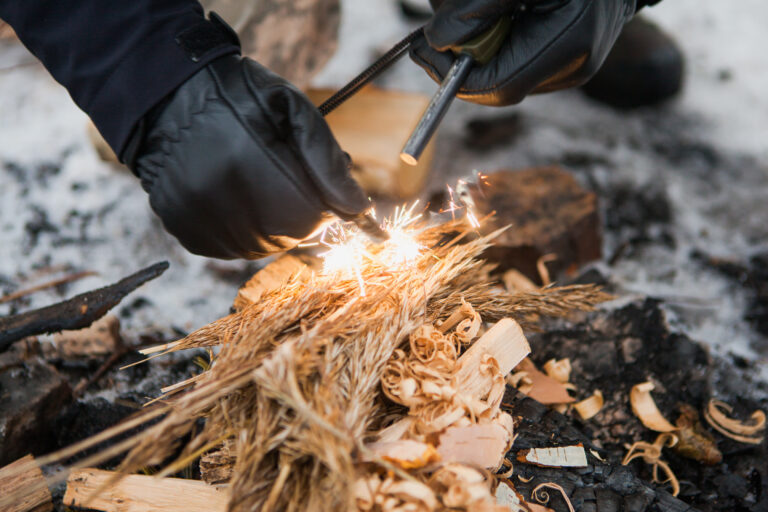
There are more modern variations of the flint and steel system sold in outdoor outfitter stores. They use the same type of flint substitute material (primarily a composition of iron and cerium) used in some cigarette lighters and, when scraped by an edge of steel, this produces extremely hot sparks. The popular flint strikers embedded into magnesium blocks are wonderful products for the backpacker’s kit. They throw showers of super hot sparks, and small amounts of the magnesium can be scraped off of the block and into a pile of shavings using a knife blade, quickly providing effective tinder that will possibly ignite even damp leaves or pine needles.
Fire Making Tips
Wet Weather
Getting a fire started in wet weather can be a monumental challenge, even with a healthy supply of matches. A few simple tricks may improve the odds. If survivors are fortunate enough to have road flares, getting an emergency campfire started should obviously be no problem at all, but we can’t always count on having these when a fire is needed.
Standing deadwood is always preferred over damp, rotting trees and branches collected off the ground, or green live wood, as these can be difficult to ignite. Thick branches can be feathered with a series of knife cuts to expose layers of dry material and create finer fuel with better air exposure to aid combustion. Pitch or resin (tree sap) can be the fire maker’s savior. It does not absorb moisture like porous wood does, and it is very flammable, even in the dampest of conditions. It burns hot, and will sustain flames usually long enough to dry out other moist tinder materials in adverse weather.
Tinder
Quite often, the difference between success and failure in attempting to create fire will be determined by the tinder. Materials that don’t easily ignite can really waste your efforts. Most of the fine, fibrous organic materials make suitable tinder as long as they are dry. Prepackaged tinder or other fuels can be very important to a survival kit. Cotton balls can be rubbed in petroleum jelly to make them more flammable and then sealed in plastic containers to keep moisture out during storage. When they are needed, their fibers can be pulled apart slightly to enhance the air circulation. Fine 0000-steel wool is another good tinder to pack in the survival kit. The wool will burn when showered by the hot sparks from the striker in the magnesium block.
A lot of survival books describe the technique of starting a fire with a magnifying lens. When we were kids we would burn holes in leaves and newspapers with a magnifying glass for fun. This method requires certain elements for it to be successful: sunshine, a magnifying lens with sufficient magnification power, the skill needed to concentrate the sun’s rays into a small focal point and then hold it steady until combustion is obtained, and proper tinder or flammable material to take advantage of the generated heat. Burning holes in newspapers on a hot summer day is one thing — creating and sustaining a campfire in adverse weather conditions is something else altogether.
Hiding a Fire
There may be situations when a fire is needed, but building one is risky because the light or smoke may reveal your position to others who are hunting you or who might be considered hostile. The famous “Dakota Hole” is one way to have the warmth of a small fire while keeping the thermal signature to a minimum. It is simply a pit in the ground about the same depth and diameter as a 5-gallon pail that will contain a very small fire. A ventilation tunnel is bored into the base of this main fire hole, angled down from a surface opening several feet away and ideally about the diameter of a pop can, to carry the needed air to the fire in the bottom of the pit.
By keeping the flames below ground level in the Dakota Hole, and using the driest available wood to minimize smoke, a degree of warmth can be enjoyed and limited cooking can be accomplished, possibly without drawing unwanted attention to the campsite.
Such a hole is also easy to fill in when it’s time to pack up and move, burying the ashes and erasing the signs of a campfire. If the position of the fire pit is near the base of a tall tree, the branches might serve to help screen any dissipating smoke, minimizing a detectable smoke signature. However, extra caution should accompany the increased fire hazard of a fire close to a live tree, or under any low-hanging branches.

Read more: Learn how to use and tie knots in Surviving in Tough Times: How to Tie Knots.
This excerpt has been reprinted with permission from Long-Term Survival in the Coming Dark Age: Preparing to Live after Society Crumbles, published by Paladin Press, 2007. Buy this book from our store: Long-Term Survival in the Coming Dark Age.