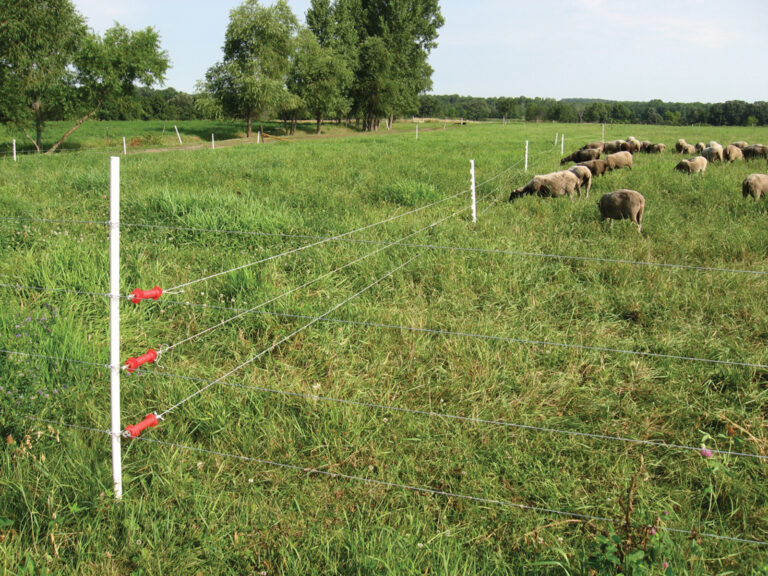
Good fences make good neighbors, especially when those fences keep your prized Hereford bull from paying a visit to your neighbor’s registered Jersey cows. But farm fencing isn’t only about controlling the perimeter. Here on our rural homestead, I see a landscape of diverse animals and terrain. I sometimes feel overwhelmed with the thought of having to keep it all organized, safe and healthy. There are hardly any tasks as daunting or as essential to the vitality of a farm, be it just a few horses or an intense multi-animal operation, as having a trustworthy fencing system.
One might argue that it is possible to physically contain animals within a fence, but the fact of the matter is that physical barriers are difficult and expensive to create. And even the best wire fences only provide physical containment for a while … usually long enough to become a psychological barrier. An animal thwarted by a wire fence will eventually quit testing the fence … until the grass looks so green on the other side that the pressure builds to the point of fence failure. Without a memorable psychological reminder that messing with the fence is unpleasant, virtually any farm animal will test, push, root, rub and eventually break or find a way through, under or over the barrier.
One the most effective and humane forms of fencing uses an unpleasant electrical shock to remind animals that they want to stay away from that fence. Electric fencing is effective as a stand-alone barrier or as part of virtually any other kind of fence. Most folks will use a combination of electric and some physical barrier, as both methods have pros and cons. I prefer electric fencing for larger areas because it affords flexibility as well as being easy to install at a reasonable price.
Installing an electric fence can be intimidating for those new to the process. In reality, an electric fence is one of the most reliable, safe, least expensive methods of animal containment available.

There are many ways in which to design an electric containment system, but the core principles are relatively universal. First you need something that produces the electricity, somewhere for it to go (conductor) and finally, a way for it to return (ground).
Energizers
To produce the charge needed to power an electric fence you will need an energizer (also known as a fencer or charger). Energizers exist that can be powered with either AC (plugs into an outlet) or DC (uses a battery, solar panel, or both) electrical current. Most farm-fence energizers use that electricity to deliver a short pulse of very high voltage and low amperage current to the fence. Most of these so-called short-shock chargers deliver a powerful burst of electricity in a concentrated voltage for a fraction of a second every two seconds. Many emit a steady “tick tick tick” along with the pulse to let you know that it is doing its job. This burst quickly dissuades the curious animal from further exploring its escape route and ensures that they do not receive too much of a shock.

Energizers are categorized by how many acres or miles of fence they will charge. For instance, a common fencer might charge 20 to 30 acres of land and cost between $80 and $90. Smaller energizers are available that can charge up to 8 or 10 acres, so you have the flexibility to find a solution that meets your specific needs. One thing to keep in mind is that the number of acres or miles the charger will power is for a single line only, and many animals require a multiline fence. I find the mileage rating to be far more effective when researching fencers.
Since electricity likes to travel in circles, sending a pulse down the fence wire is only part of the story. With a properly working electric fence and nothing connecting the hot wire to earth, the electrical circuit is open … it’s like a switch that’s turned off. That electrical pulse then travels the full length of the fence and dissipates. When an animal (or non-attentive rancher) touches the hot wire, the pulse travels through them and into the ground where it is conducted back to the energizer’s ground pole through ground rods driven into the earth. The guttural burst emitted from the unsuspecting beast is evidence of the switch being turned on … the electrical circuit is complete, but usually for only a split second.
Grounding systems
One of the most important things to understand about electric fences is grounding. Your animals will only feel the 8,000-volt shock if the pulse passes through them and returns to the charger. You can facilitate routing the electrical pulse back to the ground terminal on the charger in a couple of ways.
The first, an Earth Return System, uses steel “ground rods” that are pounded into the earth near the fencer and act like a homing beacon once the electricity exits the fence through its unwilling host. The number of ground rods that are required depends on the strength of the energizer and the type and moisture of your soil. Plan on about 3 feet of 5/8-inch or 3/4-inch steel pipe per joule of output (copper ground rods work well also but are more expensive). The benefit of an Earth Return System is that an animal need only touch a single line to receive a jolt. The downside is that the environment plays a large role in your fencer’s ability to deliver adequate shocks on a consistent basis.

Since the Earth Return System depends directly on how grounded your animals and fencer are, you will need to monitor your system routinely. Dry or frozen ground has an insulating effect, which prevents the full power of the electrical pulse from making its way back to the charger. Conversely, if you are standing in a puddle and decide to kneel down while working on the electric fence, take care not to let your head come in contact with the hot wire. When you come to, you’ll realize that you experienced an abnormally powerful shock (yes, I speak from experience) because both you and the charger had a good connection to a highly conductive soil.
The second grounding method takes a bit more understanding and requires multiple wires, but it will leave you with a safer and more reliable system. This Wire Return System employs one or two lines to deliver the pulse, and a third that connects directly to the energizer’s ground terminal and a series of grounding rods. In order to receive a full shock, the animal must touch one hot line and the ground line. This method is more reliable because the earth alone is not required to conduct the current back to the charger. The down side is that you need more ground rods, and this fence will be somewhat more vulnerable to short circuiting.

Short circuits occur when a hot wire inadvertently comes in contact, or partial contact, with a good ground. For example, an old steel post and barbed wire fence can easily be reinforced with a single electric wire. But when the deer jump the fence, there’s a chance they will inadvertently wrap the hot line around a stretch of barbed. When that happens, the pulse will have a direct route to the earth … so if an animal touches the hot wire it will feel a tickle at best. Likewise, if your steel gate shocks you, it is receiving a pulse through some short in the system. Shorts are readily detected with a volt meter designed for testing fences. We have 4,000 volts, which is a good minimum voltage, but we’ve seen sheep actually laugh at that amount before they leapt through the fence. We try to keep it around 6,000 to 8,000 volts. If your charger shows 8,000 volts when not connected to the fence and 6,000 volts when connected, there is likely a short. It might be as simple as wet vegetation in contact with the hot wire … or the hot wire coming into contact with a wooden fencepost.
Fencing materials
Now that we have a basic understanding of how the electricity moves through conductors we can detail how to build the fence and some of its star players. Electric fencing conductors include high-tensile and low-tensile solid metal wires and conductive composite materials such as poly wire (a twine-like material made with fine metallic wires and polypropylene). High-tensile wires resist breaking much better than any of the other conductors and are best used for permanent paddocks and perimeter fences. High-tensile wires, when used properly, can deliver a consistent charge and withstand significant physical shock load. If your cattle get spooked and hit the high-tensile fence, it will continue to stretch long after low-tensile wire will break and boards will shatter. In addition to the physical barrier, the animal receives a couple brief reminders that the fence is not to be tested under any circumstance. The result is that both fence and herd remain intact.

Poly wire and low-tensile metallic wire are best used for temporary subdivisions and in other places where you will need to create and then tear down the fence in short order. These fences can be charged by clipping their conductors to those of the more permanent perimeter electric fence, or they may be charged with a portable energizer.
Putting it all together
How you suspend the wire depends on your application. Always use a sturdy post (wooden or composite) when working with long stretches of line or multiple lines. As far as styles of corner post setups go, many different websites and publications are available to help find a solution that meets your needs. If you are putting together a smaller paddock, spaded steel posts will work just fine. I caution the use of any steel post, however, as it is very easy to have a stray wire touch the metal and cause a short. If you do decide to go this route, you must be diligent in finding the short if you lose fence power. Also, I would argue against using barbed wire. First, if it is an existing wire, it well may be corroded and rusty, which will significantly reduce the ability of the electricity to travel through it, and second, if an animal (especially a thick haired/wool variety) gets tangled in the fence and is unable to free itself, it would surely receive lethal doses of shock.

Connecting the wire to the post depends on the type of post you are using. Insulators are connectors that separate the post and the wire, thereby allowing the electricity to flow freely through the wire and not into the post, which creates a short. A wooden insulator is nailed on, and the wire threaded through. A second option is to cover the wire in a weather-resistant coating (rubber, nylon, etc.) and affix it to the post with a heavy gauge staple. For metal posts, there are a few different options, but they all follow the same clip-on style. Also, it would be wise to purchase an Electric Fence Tester that allows you to see how much power you are getting out in the field. These are relatively inexpensive and well worth the purchase, as an oft-tested fence creates peace of mind. All of these supplies are available online or at your local farm supply store.
Many advanced configurations, including gates and paddock switches are available and can make your system highly tailored to meet your specific and ever-changing needs. Always remember that your fence demands respect and, with a basic operational understanding, it is not an overwhelming task to install one yourself this season. Give it a try. I think you will be pleased with the results.
Just don’t kneel when you are working with a live fence.
Andrew and Rebekah live on a fourth-generation farm in Omro, Wisconsin, where they are transitioning to an organic, grass-fed meat and produce CSA along with educating friends and family on the wonders of raw foods.
Rebekah Sell lives on a small plot of land with her husband, Andy, on which they are hoping to build a sustainable homestead. With a small business and four kids, life is always interesting as Becky and Andy live fully the idea that the journey is the reward.
Originally published in the May/June 2009 issue of Grit magazine and regularly vetted for accuracy.