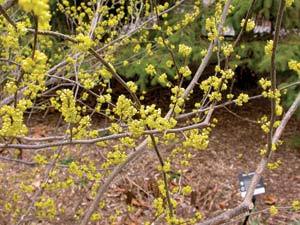
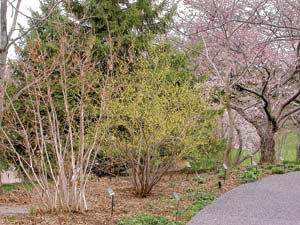

Winter’s end on the banks of the Black River near South Haven, Michigan, is punctuated with cheerful dots of limey-lemon color. Although most folks today don’t know it, that early spring eruption occurs compliments of the American spicebush – a medium-sized shrub that once lived in the spotlight.
The American spicebush (Lindera benzoin) is a native shrub that displays clusters of tiny, greenish-yellow flowers in March and April before its leaves appear. The hardy plant is found in the north from Maine to Michigan and through the South down to Florida and Texas. As an 8-to-12-foot-tall, under-story species, spicebush thrives in the dappled shade of damp woods with rich soils, in ravines, alongside streams and in partially shaded, swampy areas.
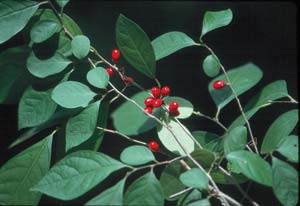
This unassuming native often goes unnoticed, but it makes a lovely addition to the home landscape that delivers visual appeal all year. Shortly after the blossoms fade, tiny oblong drupes (berries) develop on the female plants. In fall, when the spicebush’s light green leaves change to a creamy butter yellow, its berries ripen to a brilliant red. The berries are lovely to look at and have the added value of providing food for birds and other wildlife.
But there is much more to the American spicebush’s story than landscape appeal.
Old aromatic
The American spicebush has a long history of medicinal and culinary uses, as its many names would indicate. Lindera benzoin is also known as “spicewood,” “wild allspice,” “fever bush,” “Benjamin Bush” and “snap-wood,” in addition to spicebush. Be sure to request it by its botanical name at the nursery, or you may end up with Calycanthus floridus, Carolina Allspice, or Calycanthus occidentalis, California Spice Bush.
A member of the Laurel family, American spicebush is named for the Swedish botanist, Johann Lindler, and “benzoin” comes from an Oriental gum of the same name because the shrub has a similar spicy aroma and flavor.
American spicebush’s bark, fruit and leaves are aromatic, and all have been used for everything from flavorings to scent making. Spicewood oil is used to add a spicy fragrance in perfumes, especially those with a lavender bouquet. The berries, dried and powdered, were used during the American Revolution as a substitute for allspice, and early American settlers used dried spicebush bark in place of cinnamon. In the American wilderness, when both the population and stores were sparse, pioneers used spicebush as a general spice.
During the Civil War, spicebush tea often substituted for coffee when rations ran short. Dried leaves were often used for this purpose, but young branches were also steeped to make a tonic. This spicy beverage had medicinal qualities as well. It was used to reduce fever, to relieve colds and dysentery, and to destroy intestinal parasites. Lindera benzoin is considered a warming herb that improves circulation and increases perspiration rate.
Good for wildlife
Although human uses of spicebush have largely been left behind, that’s not the case with other animals. For example, squirrels and birds, such as the robin, Northern bobwhite quail, gray catbird, Eastern kingbird and the great crested flycatcher, savor the ripe berries in autumn. Spicebush swallowtail butterflies lay their eggs on the plant’s leaves, which the caterpillars then feed upon once hatched. These caterpillars have a scent gland that releases a strong, concentrated spicebush odor when danger is near.
Interestingly, this shrub is not a favored food of deer, which makes spicebush a good garden choice where deer are problematic.
Easy to like
American spicebush is an easy shrub to grow and is well-suited to those shady, wet areas where other, more traditional landscape shrubs often fail. It’s perfect for a natural setting or for use in a riparian buffer zone, which is a planted margin between the lawn and waterways that helps keep fertilizers and pesticides out of streams, rivers and lakes. Spicebush will also perform well in full sun if the soil is constantly moist. Heavy mulching under those conditions is a must.
Lindera benzoin has all the properties that make it a great home landscape addition: it’s a native, it is easy to grow, and it takes little care to flourish given the right conditions. American spicebush has early spring flowers, which are most welcome after the long winter, and it puts on a beautiful autumn display with its yellow leaves and red berries. It attracts wildlife. All this, and it comes with a spicy slice of American history.
Next time you are looking for something new for the landscape, why not consider spicing up your garden with American spicebush and your morning with a cup of spicebush tea?
Residing along the beautiful shores of Lake Michigan, Cindy Murphy is an Advanced Master Gardener and Michigan Certified Nurseryman at a large garden center. After a busy day at the nursery, she doesn’t mind bringing home work … as it always finds a home in her gardens.
Spicebush Tea
This recipe is a version of the “spring tonic” used by early American settlers. Considered medicinal, it’s also quite delicious. The twigs should be gathered in spring when the sap is at its highest concentration.
Ingredients:
Enough spicebush twigs, striped of leaves and broken into lengths of approximately 5 inches, to fill a 3-quart pan
2½ quarts water
2 tablespoons honey
Fill pan with twigs and water, and bring to a boil, uncovered. After about 25-30 minutes, water should be slightly yellow. Strain tea through colander into gallon container. Stir in honey. Tea will keep in refrigerator for a week. It should be served hot – microwaving is fine. Enjoy!