Raising goats can be fun, rewarding and frustrating – all at the same time. My first goat, Zygota, was a hellion. Milking was a battle where she performed a flamenco dance, often stomping her foot (triumphantly, it seemed) in the milk pail. If she was bothered by something, such as seeing a chicken or a cat, she would use her teeth to throw her feed bucket across the milking parlor. If I was late for milking, she would “self-suck.” Weaning involved constant screaming. To top it off, she went under, over and through fences.
Not all goats are like Zygota. If they were, no one would raise them. Zygota’s daughter, for example, was a saintly creature – docile, obedient and an excellent mother. But here’s a hot tip: If you’re about to buy an adult goat, you’re more likely to get a hellion than a dream goat. Goat owners rarely sell their great animals; the difficult goats are sent to market.
Getting your goat
At livestock auctions, you might be buying health problems, even if the animals were healthy when they went to market. Goats can suffer from “shipping fever” triggered by the stress of shipping and confinement, and they may have contracted diseases. If you buy a goat from a farm, you can avoid some of these problems.
It’s best to buy goats from an environment similar to yours. This will make the transition easier (e.g., less of a shock than going from a flock of 200 to a flock of two, or vice versa). For example, a friend of mine once bought a Saanen, a docile, pure-white breed. He couldn’t understand why the mild-mannered goat became increasingly agitated, recoiling at his touch and jumping when flies landed on her. The former owner came over and was shocked to see the goat outside. It turns out the goat had been kept in a barn all her life and was now sunburnt. She was kept inside for a week, then introduced gradually to sunlight.
If you want to raise a goat organically, try to find one that has been raised using natural health care. A goat that has been given commercial dewormers and antibiotics regularly will be less likely to thrive in an organic setting.
Ideally, buy two or more goats from the same farm so they are familiar with one aspect of their new setting. It’s critical to have a companion for your goat, such as another goat or a sheep. That said, my terrible goat flirted shamelessly with my ram until she conceived (but didn’t carry to term) a “shoat” or “geep.” After that, she took every opportunity to beat up ewes. Lesson learned: ensure the companion animal can’t mate with your goat.

Breeds
If you want a dairy goat, consider whether you’re looking for quality or quantity of milk. For a high volume, consider Saanens. These calm white goats are the Holsteins of the goat world, each day producing a gallon of milk that is relatively low in milk protein. If your main objective is to make cheese, the Nubian is your goat of choice. These floppy-eared high-strung goats produce up to 3 quarts of rich milk per day. Alpines and LaManchas both produce fairly rich milk, Toggenburgs produce thinner milk, and Nigerian Pygmy goats produce small quantities of creamy milk.
Angora goats can be raised for their mohair, Cashmere goats for their luxurious fiber, and Pygmy and dwarf goats are often kept as pets. Boer, Spanish and Kiko goats are meat breeds. For details on choosing a goat breed, see “Get Your Goat” in the November/December 2008 issue.
Making milk
A goat doesn’t produce milk until after she has given birth (kidded). Goats are sometimes bred at under 1 year of age, but they are usually bred as yearlings. After five months of gestation, a goat will have kids, usually two or three. Although a goat often won’t need assistance during kidding, try to be there in case a problem arises. After kidding, you need to milk the goat twice a day at the same time each day. If there is a single kid, you might let her nurse in the morning and collect the milk in the afternoon, but if milk production is your goal, the kids need to be bottle fed.
Most goat owners breed the does each year. If the goat is already milking, you can breed her and dry her off (stop milking) at least two months before she is due to kid. Goats have about six to eight milking years.
You probably don’t want a buck unless absolutely necessary. Bucks are smelly creatures and, worse than that, having a buck around a doe will make her milk taste awful. Also, once a doe goes into heat (every 21 days in season), it will take sturdy defenses to keep them apart. Try to borrow/rent a buck or bring your doe to him when she’s in heat. A doe in heat will wag her tail and be more vocal than usual, especially after sniffing a “buck rag” (a cloth that has been rubbed over a buck).

Housing
Goats need protection from the elements. They need shade in the summer, shelter from winter’s wind and snow, and protection from driving rain. Angora goats are particularly sensitive to wet and cold conditions. Of the dairy breeds, Nubians are the least cold-hardy compared with many of the Swiss breeds (i.e. Toggenburg).
Adult goats can survive in uninsulated barns in much of Canada and the United States provided they are protected from drafts. A thick layer of bedding on the barn floor can release heat during the coldest months. Keep adding fresh bedding to the manure pack and wait until spring to muck out the barn.
Newborn kids are susceptible to cold conditions, especially when they are wet. In cold regions, try to avoid midwinter kidding. If you can’t, dry the kids off right after birth and, if need be, bring them into the house or another heated area for the first day or two. Keep in mind that even a day-old kid can leap over baby gates and jump onto your couch.
If coyotes are in your area, protect the goats by bringing them into the barn at night, using coyote fencing and/or keeping guard animals.
Fencing … beyond the tether
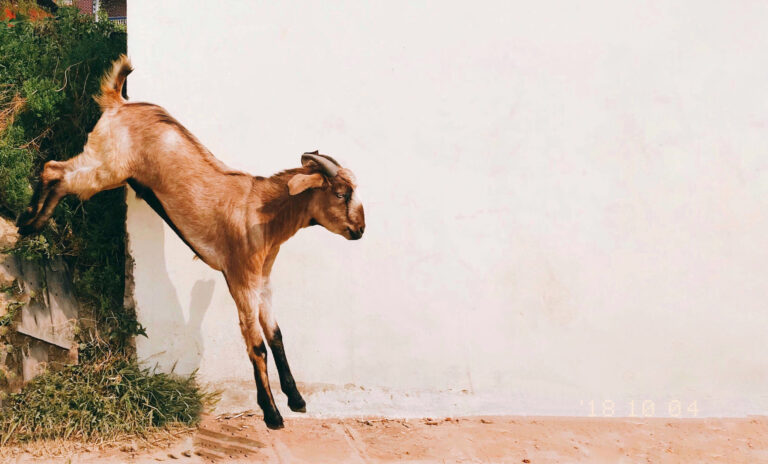
Fencing is a challenge, especially during breeding season, weaning, or when apples or other tasty treats ripen on the other side of the fence. Goats often begin each day by walking the fence line looking for weak spots, even if the pasture has better food than the areas outside.
Most goats can jump a 4-foot fence; Alpines can jump even higher. When I used page wire (sheep fencing), my stubborn goat would jump over it, paw at it until the fence was bent or the staples ripped out of the post, or squirm under it. A friend of mine had a goat who would listen to the ticking sound of the electric fencer. If the ticking stopped, she would bolt through the electric fence, followed by a hundred other goats.
I had the most success with a 4-foot-high page wire fence with two lines of electric fence above the wire and one strand of electric six inches from the ground (held away from the wire with wooden spacers). Other options include high-tensile electric fence with five to seven strands spaced closely together at the bottom.
Tethering is cheaper and easier than fencing, but it can lead to a frustrated, miserable or dead goat. If a goat can find something to climb, it will, and the result might be a strangled goat hanging from a tree. Also, tethered goats can’t escape from dogs.
Goats are social animals. If you tether two close together, you’ll get a mess of tangled goats. If you tether one alone, it will pine for its companion. If you do tether, use a pivoting tether, move it twice daily, ensure the goat has access to shade and water, and check the goat often.
As with other livestock, if you rotate your pastures, you will reduce the problems with internal parasites and increase the productivity of the land.

Goat walking
Goats make excellent walking companions. By taking your goats for walks, you’ll cut down on feed bills, require less fenced land and maintain a healthier flock. The goats can browse along the way, picking and choosing the vegetation they prefer.
Before you start walking your goats, teach them to come when called by providing treats, such as grain or apples. Note that they can kill small trees, even 10-foot-tall trees, within minutes. One goat can lean on it, bringing the top to the ground. After devouring the leaves and small branches, the goats will strip the bark. On my property, the favorite trees were (unfortunately) sugar maples and apples. I found that if I ran (not walked) past these, the goats would run with me and not notice the tasty trees.
Goat walking is only a viable option if you have lots of woodland; it’s not advisable if you are surrounded by neighbors with unfenced gardens.
Tin cans and treats
Goats have a reputation for eating anything when they are, in fact, picky eaters. I think the reputation comes from the goat’s habit of nibbling people’s clothes, and their preference for foods that other animals don’t like (e.g., bark on a fencepost). Goats love many weeds. They will clear a pasture of wild roses and blackberry vines before touching the clover. When pastured together, goats and sheep complement each other. The goats will browse the woodier material while the sheep graze the tender grass and legumes.
For hay, goats prefer weedy hay, as long as it is leafy rather than stemmy. Second-cut leafy hay with some clover, vetch and dandelions is a perfect combination. As with other ruminants, you need to provide a mix of grass and legumes. If you feed a pure legume hay (or put the goats on a pasture rich in clover or alfalfa), the goats will bloat. The better the hay, the less grain you will need.
Goats often waste a lot of hay; another advantage of keeping sheep with goats is that the sheep eat the hay the goats reject. I’ve watched with frustration as a goat tunneled its way through a manger, pushing out flakes of hay to get a dandelion leaf. To avoid wasting hay, provide tasty hay in a well-designed manger.
Many health problems are created by feeding too much grain. This can lead to difficult kidding, mastitis and other health problems. The healthiest animals are ones that aren’t pushed with too hot a ration (too much grain). Aim for moderately high, but not maximum, milk yields and provide most of the protein from forage, not grain. When not on pasture, an adult goat needs about 5 pounds of hay a day with at least a pound of grain to produce milk.
Provide loose minerals and a salt block (the blue goat/sheep block). For micronutrients, give dried kelp.

Feeding kids
Kids need colostrum (first milk) for the first few days after birth. After that, start giving them free access to hay and kid or lamb starter, along with milk or milk replacer. If you are raising goats for meat, you can just leave the kids on the doe and wean them after 12 weeks or so.
If you leave the kids on the doe, be warned that weaning can be stressful for the doe, the kids, the farmer and the neighbors. Once the kids are taken away, the doe will call for them. If she can hear her kids, she and the kids will call, then scream, back and forth for several days. Weaning around 16 weeks works well for some producers and minimizes separation anxiety. In any case, the easiest way to wean is to keep the kids where they can’t see or hear their mother – a neighboring farm is ideal.
You can take the kids away at birth and bottle feed them with either the mother’s milk or milk replacer. This involves a lot of work, and the kids will see you as their mother (while cute at first, it’s a hassle later on).
Marketing
You might be able to sell dairy products, goat meat (chevon), breeding stock, goat hides and/or fleece. Depending on local regulations, the infrastructure required to sell dairy products through channels is often prohibitively expensive for a small flock. Many goat owners choose instead to sell dairy products under the table.
There’s a market for goat dairy products among people who are lactose-intolerant and people who appreciate good food. I sold unripened goat cheese rather than milk. By making cheese, which doesn’t take much time, I could increase the value of a gallon of milk from $5 (fluid price) to $30 (price of cheese).
Goat meat can be sold to health-conscious consumers as lean meat, or sold at African, Jamaican or Middle Eastern markets. The skins can be sold to drum-makers. Mohair and cashmere can be sold to hand spinners. To get mohair, shear the Angora goats twice a year. Cashmere is combed from Cashmere or Spanish goats.

Thinking like a goat
The key to goat management is to think about what a goat wants and needs. Sometimes all a goat wants is to play. Reverse psychology is useful.
Zygota used to strain to get out of her stall, then not leave once I opened it. I learned a trick. Once I was ready to milk her, I would unlatch the pen surreptitiously. She would “escape” on her own and happily jump up on the milking stand. Afterward, if she didn’t want to go out with the other goats, I would leave her alone for a moment. The horror of being alone for a minute would leave her tractable. That said, my other goats didn’t require such mind games.
As well as being livestock, goats can be wonderful pets – like cats, they are affectionate and independent. Keep in mind at all times that goats are social, and they like to play.
Once, when I was repairing a barn door, a farm apprentice let the kids out by accident. They raced over and started to nibble on my tools. A kid walked on a sheet of plywood. After a couple steps, she stopped, stepped and listened. She was soon joined by the other kids in a raucous bout of tap-dancing.
While keeping goats can be a struggle, it can also be a source of great food and fun.
Janet Wallace is an organic gardener, freelance writer and editor of The Canadian Organic Grower. She now lives (without livestock) near the Bay of Fundy in New Brunswick. Although she sometimes misses the company of goats and the amazing cheeses, she is relieved to no longer be tied to a rigid twice-a-day milking schedule.