Learn to fly fish for and how to cook steelhead trout recipe; grilled style. Find steelhead in the Idaho Salmon or Clearwater rivers from July to December for the fall spawn and overwintering before they return to the ocean.
Steelhead trout – stocky, meaty, and flavorful – bring both a fishing story and a feast to the table. Wild steelhead hatch in streams and rivers, migrate to the Pacific Ocean, then return to fresh water to spawn. That journey sets them apart from freshwater-only rainbow trout, which are taxonomically the same species but live very different lives and develop a different flavor.
Female trout wiggle their strong bodies into river substrates to build nests, called “redds,” and lay their eggs. Males fertilize the eggs, and females bury them under gravel, where strong freshwater currents keep them oxygenated. Hatchlings hide near logs, boulders, and slower-moving eddies until they’re large enough to migrate downstream. Young steelhead eat zooplankton and both aquatic and terrestrial insects, then move on to fish, small animals that drop into the water, and, later, squid and crustaceans in the ocean. Those migrations and deeper feeding grounds allow steelhead to grow substantially larger than rainbow trout.
In the late 1800s, people introduced steelhead to the Great Lakes, where the fish remain landlocked, spawning in tributary rivers and using the freshwater lakes as their “oceans.” In the West, dams and other human interference nearly drove native steelhead to extinction by the 1940s. Today, because the Endangered Species Act lists one distinct population segment as endangered and 10 as threatened, local laws generally allow anglers to keep only hatchery steelhead marked with clipped adipose fins. Native steelhead, identified by intact adipose fins, must be released after they’re caught. Hatcheries funded by fishing license fees help repopulate waterways and provide fish, such as steelhead, rainbow trout, and cutthroat trout, for anglers. Corporations, such as the Idaho Power Company, also contribute funding as mitigation for hydroelectric dams.

How to Fish for Steelhead
The Salmon River in Idaho is prime steelhead fishing. A-run steelhead spend a year in the ocean before returning to the Snake and Salmon Rivers from June through August, weighing 4 to 6 pounds. Larger B-run steelhead spend two years in the ocean, then return to the Clearwater and Salmon Rivers after late August, weighing 10 to 13 pounds. Steelhead that spend a third year in the ocean can top 20 pounds, and Idaho’s record steelhead – 30 pounds 2 ounces – came from the Clearwater River in 1973.
Steelhead usually don’t eat when waiting to spawn. They’re more likely to strike at lures and bait out of territorial aggression. Anglers often use fly fishing techniques to incite this aggression. Because the fish aren’t looking for specific food, anglers can use a wide variety of lures and bait, from fishing flies to plugs and lures to bait such as salmon roe.
Steelhead season in Idaho stretches from July to December to catch the fall run and overwintering period, then into May for the spring return to the ocean. However, midwinter finds few anglers in the water, as even neoprene waders fail to hold back frigid temperatures that can drop well below 0 degrees F, plus an added windchill. Sportspeople from out of state may journey in to hunt mule deer and bull elk in October, taking a few breaks to relax with a fly rod while the sun warms their shoulders in a river canyon. Locals claim that October and November are the best times to fish.
If fishing isn’t your sport, or you don’t want to make the long drive and brave cold waters, you can purchase farm-raised steelhead. I recently found it on sale for less than $5.50 per pound, sold whole (headless, bone-in, fins on), 4 to 5 pounds apiece. Store-bought steelhead doesn’t carry any dramatic stories about dodging hypothermia or spotting moose and grizzly bears, but it still deserves the same careful cooking: low heat to warm the flesh through, then hotter fire to crisp the skin.
How to Cook Steelhead Trout Recipe: Grilled
Prep comes first. When preparing trout for the grill, be sure it’s scaled. Drag a knife back to front, against the scale grain, to remove this shimmery layer. Then, rinse the fish so the skin can crisp and crackle instead of carrying loose scales to the plate.

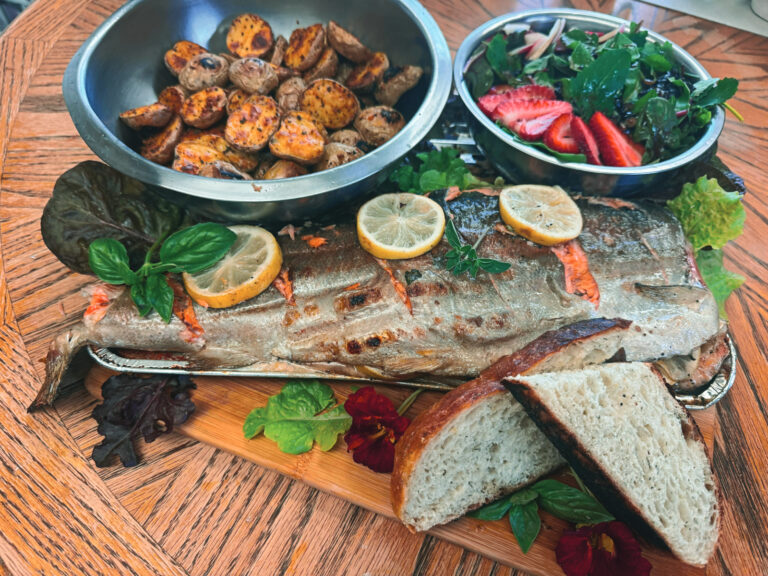
Choose a surface that protects the skin. Though my husband, Russ, usually prefers to wrap trout in foil and toss it into campfire coals, he cooked these steelhead using the Santa Maria attachment to his live-fire charcoal grill. We purchased cedar planks, but these fish were way too big, so we chose a grill liner instead. Cedar planks help prevent sticking; without them, Russ heavily oiled both the fish and the grill liner. If placing fish directly on a grill, always oil the grill and the fish first.
Season from the inside out. After scoring the skin to allow steam to escape and smoke to penetrate the meat, he rubbed the insides of the steelhead with olive oil. He then stuffed them with fresh garden basil, lemon slices, fresh onion, and peeled garlic cloves. You can also use butter or another oil, and you can trade the basil for other fresh herbs, such as mint, rosemary, oregano, or cilantro. Other aromatic options include orange slices, peppercorns, and fresh chile peppers.
Start low. When cooking a whole, thick-bodied fish, begin at a low temperature, around 250 to 275 degrees F. This will allow the flesh to warm through before you sear and crackle the skin. Throwing fish directly into high heat is fine for small or filleted fish, but with a thicker fish, you’ll burn the skin long before the inside is done.

Tent the fish if needed. If grilling in cold weather, or if the fish doesn’t appear to be cooking evenly, create a tent with aluminum foil to capture the heat and smoke. Place this mini “convection oven” over the fish until it reaches the desired doneness. If using a plank, you’ll definitely want to tent your fish to regulate heat. Cook at this low heat until the fish is about 20% cooked through. For our steelhead, this was about 2 centimeters in from the skin.
Finish hot. Now turn up the heat. If using a gas grill, simply adjust the knobs. Over live fire, move the fish closer. Russ lowered the rack on his Santa Maria attachment so the fish sat lower to the coals. Cook the fish at around 400 degrees F until the skin releases from the grill or liner, then carefully flip it over. Follow suit on the other side, allowing the skin to separate from the metal on its own. If you flip too soon, the skin will stick, and you’ll lose that tasty layer!
Check before serving. Before removing the fish from the grill, insert a knife inside to check doneness. If it hasn’t cooked all the way through, tent it again with foil, move it farther from the heat, and let it bake until perfect.

Now comes my least favorite part. But all great fish have bones. It’s a fact of life. Anyone who regularly eats wild-caught fish knows this, and any newbie learns it real fast. Eventually, anglers master the enviable skill of separating flesh from bone, then peeling back the spine with each rib intact. If you miss any bones, it’s much easier to find them with bigger fish. But even if you lean over your plate, a fork in one hand and a knife in the other, peering intently in search of each needle-like bone before your mouth finds it, the fish still tastes just as good.
I compare steelhead to a cross between salmon and a lighter fish like pollock. This makes sense, as steelhead is a salmonid species. But rainbow trout, smaller and landlocked as they are, don’t develop this flavor nearly as much. Light and deep at the same time, steelhead stands up to umami flavors, such as foraged mushrooms and ramps, while still welcoming brighter notes, such as citrus and ginger. Whether it came from a cold river or the seafood counter, it’s a fish worth cooking slowly, finishing over fire, and eating carefully down to the last rich bite.
Marissa Ames grew up in Salmon, Idaho, building fences, hunting, and herding cattle with her dad and gardening with her mom. She currently lives in eastern Idaho, where she grows a garden and teaches 4-H. As editor-in-chief of Grit, she enjoys representing the myriad lifestyles and experiences that define rural America.
Originally published in the September/October 2026 issue of Grit magazine and regularly vetted for accuracy.