Was it a wasp? A hornet? A yellow jacket? A mud dauber? Actually the questions are rather moot since there are about 100,000 related species using these various names. Additionally, almost all stinging insects give me adverse reactions. I am not a person to be rushed to the emergency room but I have more swelling and itching and it lasts longer than for most folks. Also, unless there were one or more of those species that I was acutely allergic to, I am not really interested in catching and identifying the culprit.
Now that fall is here, and many of these stingers are dying off or suffering from the cooler temperatures, being stung is not really a problem and I have more time to learn what might be out there stinging me. I confess that I have generally viewed all of the above as species that are on earth to cause me pain. I avoid them unless they really give me a problem and then out with the spray!
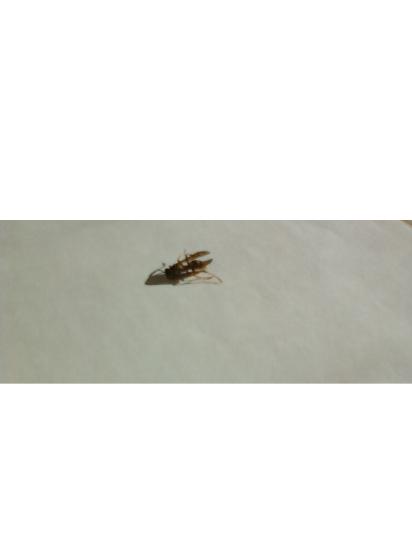
I found one, see pictures, crawling on my floor. It was not healthy and the picture was taken after its demise when I felt that I could safely look it over.
Doing some online research, I found that “mud dauber” and “yellow jacket” are common names and may refer to various related wasp species. Hornets are described as a type of wasp. Probably the name that most people agree upon for all of these species is simply “wasp”.
One way of describing wasp species is by they manner of living, solitary or social. Social wasps tend to be more conspicuous because we see their nests of mud or paper and we see many insects at one time.
Many social wasps can release an attack pheromone, which signals the danger to the entire nest. For this reason, killing a wasp near its nest by physical means, swatting it or stepping on it for example, is not a good idea. It is better to use a spray to kill the entire nest with one shot and avoid the possibility of multiple stings.
One of the most interesting facts that I learned is that wasps tend to focus on one or a few types of insects or spiders for food. Many of these insects or spiders are considered pests either to people or in agriculture. One example of food that I found is the black widow spider. This certainly refutes my idea that wasps are here to sting humans! Wasps may also feed upon flower nectar, overripe fruit and carrion.
I have often found dead wasps under shingles that I removed for replacement or in crevices of siding and other tight spots. I learned that only the queen wasp survives winter temperatures in this area so I can not explain why wasps take refuge in these spots. Perhaps they are looking for shelter from cooler weather but with or without shelter, they all appear to perish over the winter. The queen emerges from hibernation and starts a new generation.
In spite of the adverse reaction that I have to their stings, I generally will leave wasps and their relatives alone unless they build nest were it is inevitable that someone will be stung. A nest under a tractor seat can stay! Any insect that preys upon pests is not all bad!