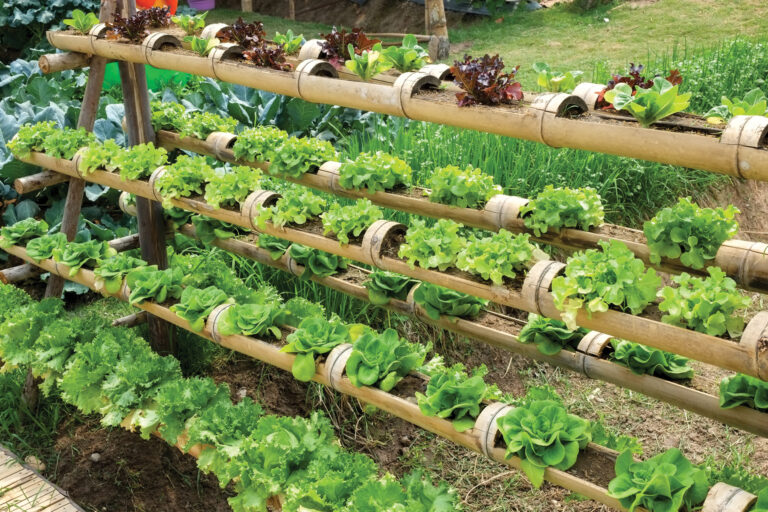
The concept of growing plants in vertical tiers has been around since the famously hanging gardens of Babylon. In the modern world, indoor urban farms have expanded on this concept to capitalize on limited space using a system of racks, towers, or shelves to stack plants in configurations that maximize the yield-to-space ratio. Any home gardener confined by cramped quarters can capitalize on the same system — growing up rather than out.
Because temperature, humidity, light, and water can be controlled in an indoor environment, closets, basements, and kitchen corners are fertile “ground” for growing nutritious produce.
If you adopt a soilless system, such as hydroponic or aquaponic, you can use up to 95 percent less water compared with field agriculture. The same space-saving, hydroponic techniques can work just as well outside as in (albeit with more dependency on weather than technology). As with any new venture, start with an understanding for which methods will work best for you, what kinds of plants you want to grow, and which materials you can access.
Types of Hydroponics
Hydroponic growing is based on the simple concept of submerging plant roots in nutrient-dense fresh water. Systems can be either completely liquid or using a medium, which will give support to the roots and hold plants upright while allowing excess water to drain through. In both cases, plants are usually placed in pots with small, pre-punched slits that promote drainage and air circulation. The water solution contains all the essential minerals, and the pH level is usually maintained between 6.0 and 6.5. Many garden centers carry the nutrient- and pH-adjustment solutions for these systems.
I’ve used six types of hydroponic systems, and each has its disadvantages and advantages.
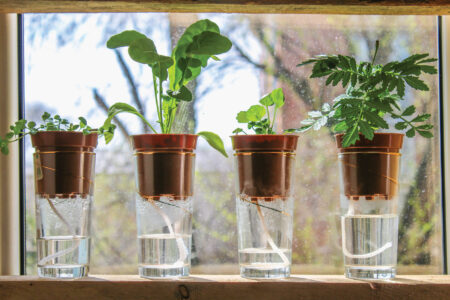
Wicking. A wick, such as a rope or piece of felt, transports nutrients and water to plants’ roots. Plants are suspended in a growing medium above a reservoir that holds the water and nutrients. You insert one end of the wick in the solution and place the other end in the growing medium. The wick transports water and nutrients at the rate the plant roots require them. Replace water and nutrients as water levels drop.
Containers you have on hand – Mason jars, coffee cans, 5-gallon buckets – work fine, and you don’t need a water pump. You simply need to place a net pot in a hole in the top and run a wick from it down to the reservoir holding the water solution.
Deep-water culture. This simple method can produce some great results, especially with larger plants, such as tomatoes. Suspend plants over a nutrient-filled reservoir using net pots and a growing medium. Roots are always immersed in the water solution, so this system needs an air pump and an air stone to pump bubbles, which oxygenate the water. The air stone, also known as an “air bubbler,” circulates water to produce oxygen.
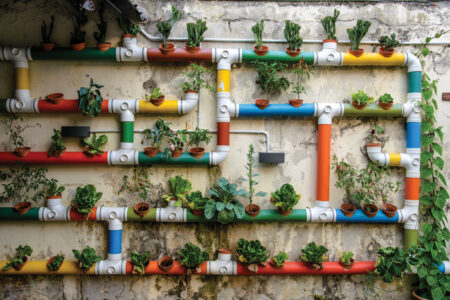
This system is a little more expensive to operate, because it requires electricity for the air pump. However, it uses less water than other methods, because the same water is recirculated. A large tote with 2-inch holes spaced 6 inches apart for net pots works well.
Nutrient film technique. This system also uses an air pump and air stone in a reservoir, but, unlike the deep-water culture system, plants grow in a watertight gulley or channel, and a shallow stream of water recirculates past the bare roots of the plants — meaning no growing medium is needed. The pump is on a timer that pushes the water through the channel at specific intervals. At the end of the channel, water drips back to the reservoir to be reused.
This low-waste recycling system ensures plants’ roots are never suffocated, because they’re never submerged in water.
Ebb and flow. Also known as “flood and drain,” this system uses a tray filled with a growing medium. A timed pump floods the tray with a nutrient solution on a cycle determined by the type of plants you’re growing, their growth cycle, air temperature, and other factors. After flooding, the tray drains the solution back to the reservoir to be recycled. It uses an air pump and air stone for oxygenation.
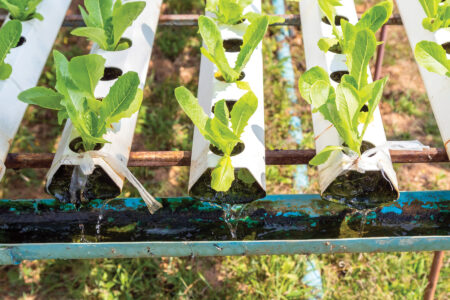
Although some growers prefer this method, because plants’ roots aren’t continuously exposed to the nutrient solution, ebb-and-flow systems needs to be continually monitored for environmental factors, such as pH levels and over- or under-stimulation that can dry plants’ roots.
Aeroponics. Although this method is the most high-tech and effective, it’s also the most expensive. Plants are suspended in air over a reservoir equipped with an oxygenating mister and pumps. Some growers continuously mist, while others use a cycle method. The misting cycle is shorter than the one used in the flood-and-drain system, so roots continuously reach nutrients without oversaturation or submersion and have a greater exposure to oxygen.
Drip system. This system is better implemented on a large scale in commercial settings, rather than in home gardening, because it requires lots of moving parts. Plants in net pots are suspended in a channel over a layer of water and nutrient solution. A pump uses small emitters to continuously drip the solution directly onto the plants. The solution isn’t fully recirculated, resulting in a high level of waste.
Most home gardeners starting out with hydroponics choose the wick or deep-water culture methods because of their ease of setup and cost-effectiveness. For any system, the containers you use must be opaque to keep algae from growing. You can paint containers to block out light. What plants you intend to grow should ultimately decide which growing method you choose.
Picky Plants?
So, you’re ready to pick a hydroponic system – but first, what will you grow? Many varieties of lettuce and different herbs work well with any of the methods. Growers generally agree that the five best plants to grow hydroponically are lettuce, spinach, strawberries, bell peppers, and herbs. They’re durable, fast-growing, and don’t require a lot of work to get started.
However, larger plants, such as tomatoes, can also be grown hydroponically. They just require more space, more water, and more nutrients. Plants that vine, such as squash, and those that grow tall, such as corn, can be difficult to manage in soilless systems.
Taste Test
Plants make their own vitamins, so vitamin levels tend to be similar whether plants are grown in soil or hydroponically. However, the mineral content can vary in hydroponic crops, depending on what fertilizer is used. The good news is you can control this factor.
Because you control nutrient inputs through fertilizer, you can easily grow hydroponic plants organically. In a controlled (indoor) environment, you’ll have few weeds or insects to contend with, eliminating the need for non-organic chemical inputs.
As for taste, hydroponic growers often say that vegetables, herbs, and other food grown hydroponically can taste better than their soil-raised counterparts because of their ideal growing conditions: All of the nutrients required by the plants are available when the plants need them.
Light It Up
Plants need light; they don’t really care whether it’s natural sunlight or artificial. If you have a large south-facing window, by all means, take advantage of the natural light. You may need to rotate your plants so they all get their fair share of it.
If your growing space is in a basement or other dark location, you’ll need grow lights. The two main types are LED and fluorescent, with LED being the most cost- and energy-efficient. Place lights a couple of feet directly above a plant for optimum growth. Avoid placing a light to the side, as plants will grow toward the light source, causing them to grow sideways.
Use a timer for grow lights to simulate the natural circadian cycle. Many newbies to vertical gardening leave the lights on 24/7, and their plants eventually die, because the plants needed periods of darkness as much as they needed light.
Use Whatcha Got
The sky is the limit here. Just as you can use anything you have around the house to hold your plants and water solution, anything will work to hold the containers. Metal racks, shelving units, sawhorses with boards, or anything else you can think of to stack your containers vertically will let you pack a lot of plants in a small space. You can even stack them on basement floors or in a corner of a room.
If your chosen system uses grow lights or water pumps, you’ll need to have access to electrical outlets. I’ve seen extension cords create several safety hazards.
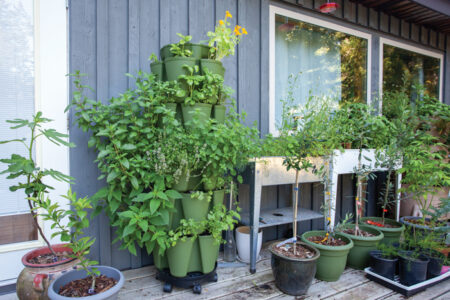
As with any garden project, growing a vertical, soilless garden can be as simple or as complex as you want. Many kits are available that provide growing containers, net pots, pumps, and everything else you need. However, for a fraction of the cost, you can usually use things you already have. All you’ll need is to have a growing tray suspended above a water reservoir. For instance, make net pots from disposable cups with slits cut in the sides to let the solution drain through.
Is It Time to Grow Up?
Every gardener has to decide whether vertical farming is right for them; it doesn’t need to be all or nothing. You can incorporate some vertical gardening along with traditional gardens. Maybe you live in a northern climate and want to have fresh greens during winter months but still maintain your soil garden in summer. Or maybe you never thought you could have a garden because of limited or no space. Turn a small corner into a “trial” vertical garden and see what happens. Start small until you learn the basics. From there, you can decide whether “growing up” is a good addition to your food-growing activities.
Lois Hoffman has covered rural living as a writer and photographer for more than 20 years. She lives on a 37-acre hobby farm in Michigan.