When we go about building the soil in our gardens, it’s easy to think that we can just add amendments, till really well and fertilize as needed; that’s been much of the standard thinking for many many years. It will grow plants, and it does work. The problem is that in our changing world, and by changing world I mean increasing fuel and food costs not to mention the increasing price of those very fertilizers and amendments we’ve depended on as demand for them increases, that same way of gardening will, and is, beginning to yield diminishing returns on the bottom line.
The way I like to combat this is to spend a good deal of my early season time in my garden working on “Growing my Soil” before I work on growing my plants and my main weapon is to add lots and lots of organic material throughout the year, and primarily in the fall. The complimentary component to adding to the beds in the fall, is turning those beds over in the spring.
![]()
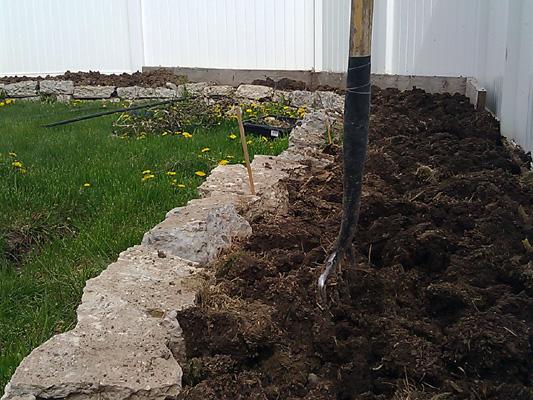
This gives a pretty good idea of what I’m talking about. In the foreground you can see the remains of the broken down grass, leaves and compost that was added last fall and some earlier this spring (About a month and a half ago.) and the rich soil laying underneath it after it’s been turned with my trusty pitchfork. You might think immediately, “How does laying a bunch of layers of organic material over the top of your bed help the soil underneath it?” and for that I have another secret weapon that helps me to drag all that organic goodness down into the soil…
![]()
Worms… and lots of them! Where there is lots of orgnanic material, there will be lots of worms, it’s just a matter of fact. And keep in mind, I added this garden bed as a “lasagna garden” only two seasons ago, prior to that there was nothing here but some unhealthy grass. As earthworms feed, many species move to the surface to have access to the rich matter found there. As they burrow back down into the soil they bring some of that material with them. They also excrete their castings (manure) into the soil, something often called black gold for it’s nutrient rich qualities.
A study by the New Mexico Extension Service found that earthworm castings “..often contain 5-11 times more nitrogen, phosphorus and potassium as the surrounding soils”
In addition to helping to incorporate nutrients into the soil, worms also serve a valuable purpose in helping to aerate the soil. If you look at the picture above, you can see one of the larger worm tunnels bored right through the soil. This helps to connect the sub-surface parts of the garden bed to the air above and bring needed air to the roots of the developing plants. It also makes for great little waterways for moisture to make its way deeper into the soil. Nurturing this web-of-life in your garden beds is a fundmental idea behind organic gardenening and is one of the most effective ways of moving beyond chemical additives and fertilizers. Besides, it’s cheap!
OK, so you get that I love my gardens earthworms right, but surely there must be more to turning the garden over that just turning in organic material and finding lots of worms? Definitely.
![]()
By taking the time to physically turn my soil over I have a one on one opportunity, so to speak, to take a look at the garden in general. One of the things I am able to take care of at that time is to find weed stock below the surface and remove them before they become a problem. The photo above looks like just a single stray root under the soil.
After breaking up the soil though, I found it to be a network of rhyzomous roots from our most noxious local weed, Field Bind Weed. These roots, as you can tell if you look closely at their tips, will throw off tens of side shoots and more rootstock that I’ll have to deal with later. Now’s the best time to take care of it.
The finished garden bed after being turned over with a fork. Much like discing a field, the soil has been turned and incorporated with itself and is ready for any tillage that it might need.
![]()
And finally, the tilled garden bed, ready for planting. It might look like I didn’t till it well enough but I left it a bit chunky on purpose. When you till a garden, or a field for that matter, you don’t want to till it to the point that it looks like soft fluffy potting soil with no real character to it. Doing that will, over time, break down what is called the “tilth” of the soil, which is to say its actual structure. If you picture a glass of sand, you can imagine how there is very little air space between the grains, that’s because the grains are so small. The extreme example of that idea is clay, which has particles so small that they bond almost at a molecular level which is what makes it so hard to work with. Now imagine a glass of various sized pieces of soil; there’s a lot more room for air, water and roots to move through it. That’s the idea here. Besides, most of the rock looking objects in this photo are actually just dried soil clods that will, after watering and mulching, soften and break back down into the bed. Also, I wouldn’t want to go overboard and drive off or kill off all those lovely little helpers I have in the garden beds would I?
Best of luck working your gardens this season and remember, “Grow the soil and the plants will come!”
Paul~
You can reach Paul Gardener by email , or check his personal blog at A posse ad esse.