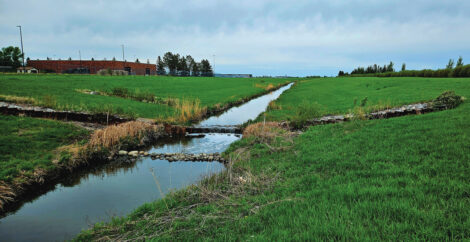
Use creek bank erosion control methods with water-loving vegetation, and brace the bank with organic refuse to keep the bank intact and build back sediment.
Humankind has been attracted to rivers, creeks, and streams since the dawn of time. Early humans across the planet depended on proximity to water sources for drinking and irrigation. Communities were built along banks, using the flowing water for transportation, energy production, and industry. To this day, many of the world’s major cities lie along the banks of major rivers.
The impact humans have on rivers isn’t all beneficial, however. For at least a century, rivers have served as dumping grounds for human and industrial waste, been dammed, and made subject to industrial agriculture runoff. Increased tile drainage (from underground pipes installed to drain soil water) and changing weather patterns have increased the severity and frequency of flooding in many major river systems. Despite this, a quick scroll through real-estate listings of land near rivers will almost always turn up the most expensive properties and expansive homes right next to the water. Rivers still attract human habitation in the face of increasing flood risk.
The Dynamics of Erosion
Erosion along rivers, creeks, and streams is a natural process. In my career in conservation, I’ve had many speaking engagements. I tell audiences that nature is dynamic and always changing. Human nature, as it is, wants things to stay the same, thus creating a dichotomy.
A natural river has sinuosity. The river curves as it flows, sometimes flowing miles in one direction before switching back almost onto itself. Though it may not be apparent on the ground, using a drone or software program, such as Google Earth, for a bird’s-eye view reveals that a river slowly moves over time, creating new channels and abandoning others.
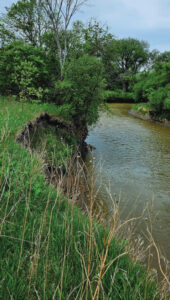
The abandoned channels, called “oxbow lakes,” slowly fill with sediment when the flow is cut off. The landscape and ecosystem experience nearly constant movement of silt, sand, rock, and debris.
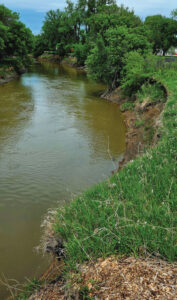
The outside bend of a river, called a “cutbank,” is slowly eroded by the river channel. The river channel swings from the inside bend to the outside bend.
The water’s velocity is swiftest on the outside bend, and material moved in the current is deposited on the inside bend, also called a “point bar.” As the water slows down on the inside bend, materials fall out. Rocks fall out first, followed by sand. Silt, the finest material, falls out of the slowest water.
By contrast, engineered drainage ditches, usually found in urban areas but also in agricultural areas, are designed without sinuosity. Instead, they have large, gently sloped banks. These human-made conduits move large amounts of water quickly. Heavy equipment is required, sometimes annually, to remove sediment buildup and keep the flow moving. Without this “cleaning,” the ditches fill with sediment and flow is greatly restricted.
Creek Bank Erosion Control Methods
All to say: Though erosion is a natural process, it’s exacerbated by human alterations. The removal of deep-rooted grasses and trees along the banks, the dredging and deepening of channels, and intensive agriculture and construction are all factors that contribute to erosion. Drainage from impervious surfaces, such as concrete and asphalt, and tile drainage bring water to rivers faster, increasing the flow rate. As water moves faster, the erosion rate increases.
Avoid Hardscaping
If you’re given a choice in where to build a structure or set up a pasture, you’ll want to choose the point bar side of the river, where water velocity is slowest and natural erosion is least. Of course, you won’t always have the choice. In cases where you’re taking on a homestead that’s already built along a river, your task as the current owner is to restore the streambank to prevent or slow future erosion.
Won’t building a concrete wall work? Or at least dumping riprap over the side? If you notice accelerated bank erosion, I caution against an engineered solution. Not only is this method exceedingly expensive, it may or may not have the desired results. Though it seems to make sense to use impervious objects to protect the bank, the opposite occurs. I remember playing as a kid in a gravel driveway after a rain and the numerous small potholes filling with water after a gully washer. I’d build a tiny dam using rocks to slow down the flow, which would work until water pooled up enough, at which point it would find the weakest point, accelerate erosion, and wash around the dam. The rock would tumble away, and the puddle would drain.
The same thing happens with riprap or engineered hardscape structures. The water slowly works at finding the weakest point. It may take a year or 10, but eventually, enough water will force itself behind the rock and into the softer soil, and a dramatic erosive event will occur. When I visit homesteads with riverbank erosion issues, nearly every time, the owners have been mowing, grazing, or farming near the bank. The easiest thing to do is to stop those practices.
Let Nature Reclaim
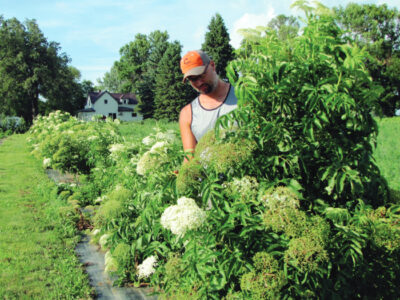
Turf grasses, overgrazed pasture grasses, and cash crops all have shallow roots. Roots are the glue that holds the soil together, and when the ground is saturated, hydraulic actions cause slippage and slumping. Without even planting anything, a buffer of untouched land will quickly start going “wild.” New trees will begin to grow, grass will come in thick, and the land will begin to heal. At my property, I started leaving 15 feet of land near the bank unmowed. After only a few years, box elder, cottonwood, and elder have started to grow. Though the bank doesn’t look kept and neat, allowing the natural vegetation to grow will help stabilize it.
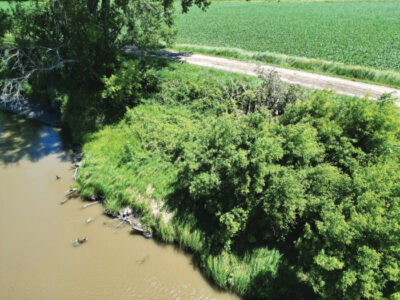
I’ve always marveled at the intelligence of my ancestors when it came to building homesteads, especially in the prairie region. My home was built in 1887, two years before North Dakota became a state. Though it’s perched on a cutbank, it’s a few feet above the flood plain and has never had water closer than 60 feet from the house. How did the builders have this foresight without modern technology? Bur oak trees grow in the yard and nearby. The trees are at least 200 years old, so they were there before the construction of the house. Bur oaks don’t tolerate wet feet, and any flooding would preclude them from growing. By building their house near the oaks, the family likely knew the home would be safe from floods.
Existing vegetation allows us to play detective, even when a river is low. Areas with a profusion of box elder, willow, elm, black spruce, larch, dogwood, ash, cottonwood, and false indigo, among many other water-loving trees and shrubs, make it obvious that the land is submerged (at least part of the time). Oaks, hickories, lilac, aspen, and most conifers won’t tolerate waterlogged soil. A quick survey of the land and its tree species can prevent big problems down the road.
Plant Natives
The next step is planting native grasses and trees. This takes a bit longer than just letting nature take its course, and I recommend planting on the next buffer away from the natural area.
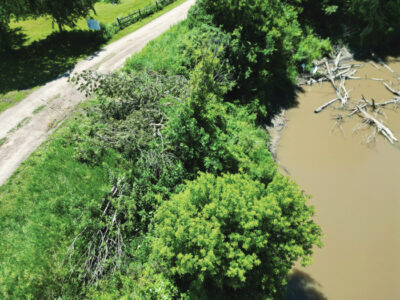
A mix of native, hardy shrubs and trees takes some time to grow, but the value far exceeds the time. Cottonwood, box elder, elder, nannyberry, linden, dogwood, false indigo, and willow are all good choices for this zone.
In a natural river environment, trees fall into the water and drift downstream. When a single tree catches something in the current and stops, it starts to create a logjam. When a jam gets big enough, silt begins to settle and form sandbars. On the far outside bend of the river, near my driveway, the previous owner had started to push dead trees and brush over the side. On most homesteads, branches and trees will fall during the year. Rather than burning the brush, he’d use his tractor and brace the bank with the organic refuse. This replicates the natural process of sandbar creation.
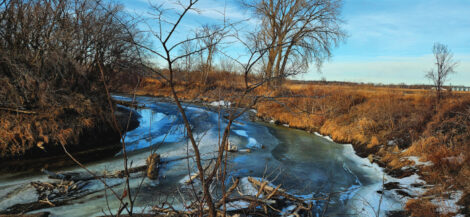
Today, I’ve continued the practice when I have brush to clean up. When the river rises in spring or after a hard rain, the branches and trunks of the dead trees are inundated. When the water recedes, it leaves behind silt and sediment. Over time, the sediment begins to collect and “build” land. Today, I have a tangle of trees, shrubs, and grapevines all over the bank, where there was once only scruffy grass and piles of brush. And this technique is free! It only requires some elbow grease and patience.
It’s a Process
Streambank restoration isn’t a quick fix and requires time and energy. However, by understanding the natural movements of the river or stream on your property and how erosion occurs, a homesteader can slowly restore what previous poor management choices diminished.
After a hard day at work, it’s relaxing to sit in a chair high on the bank, overlooking the stream or river. The breeze ruffles the cottonwood leaves high above, and the water sparkles and dances below. Though a river can be a difficult neighbor at times, working with nature can ensure your property is protected and your life is good.
Jeffrey Miller is the director of a conservation district in South Dakota. He and his family strive for self-sufficiency, through trapping, hunting, fishing, and gardening.
Originally published in the March/April 2026 issue of Grit magazine and regularly vetted for accuracy.